





The Immediate ROI of Unified Clinical Communication and Collaboration
Fast, reliable communication and collaboration is a critical piece of quality patient care and the resulting positive outcomes.


A woman walks into your emergency room complaining about severe stomach pain. She’s been referred by a local urgent care because she can’t eat or drink, and she’s on the verge of fainting.
The ER admits her and begins evaluating for possible ulcers or other GI issues. But while talking to doctors and staff, the woman shares that she’s seven weeks postpartum and can’t stand up without becoming dizzy.
This introduces a whole range of new possibilities and potential complications. Suddenly, internal bleeding, uterine rupture, and other serious postpartum complications must be considered.
The attending physician wants to review her medical records, talk to the OB, and order targeted imaging—fast. The patient could be dealing with a life-threatening emergency, but right now, there are simply too many unknowns.
Delivering effective care requires fast, collaborative communication between the urgent care, ER staff, OB clinic, and other specialists to quickly analyze the information, schedule tests, and identify the problem before it’s too late.
This scenario is exactly where unified clinical communication and collaboration (CC&C) shines.
Fast, reliable communication and collaboration is a critical piece of quality patient care and the resulting positive outcomes. It also reduces stress and uncertainty for healthcare providers. And if better communication comes by way of consolidating tech to replace outdated point solutions along the way, it’s often a win for your budget as well.
So if that’s all true, why do most hospitals still operate with an inefficient patchwork of communication tools?
Let’s see how quickly a CC&C platform can start generating ROI for your organization.
Why clinical communication is broken: The current landscape
Communication may be the backbone of healthcare operations, but that backbone is usually built from different point solutions piecemealed together over time as new communication challenges or requirements emerge.
“We see 14 different systems that are touching communication today,” says Ben Moore, Chief Innovation Officer at PerfectServe. “It could be the paging system, the call center software, the secure texting, or the provider scheduling.”
In most cases, these different systems aren’t unified through a single, centralized platform—meaning they don’t talk to each other. And if they do, it’s rarely fluently. As a result, information gaps develop, workflows get disrupted, and communication inefficiencies proliferate.
👉🏼 SVP of Client Services Miriam Halimi talks about working with customers to consolidate their tech stacks and unify important scheduling and communication workflows.
Accountability issues can also develop. People may blame scheduling mishaps on the admins who put them together, but it’s often a result of information that’s incomplete, dated, or missing altogether. Systems that don’t readily facilitate consistent scheduling and communication can negatively impact every part of the care delivery process.
Many of these clinical communication problems are chronic. But even so, many healthcare organizations still aren’t convinced that it’s time to make a change.
Why the status quo goes unchallenged in healthcare
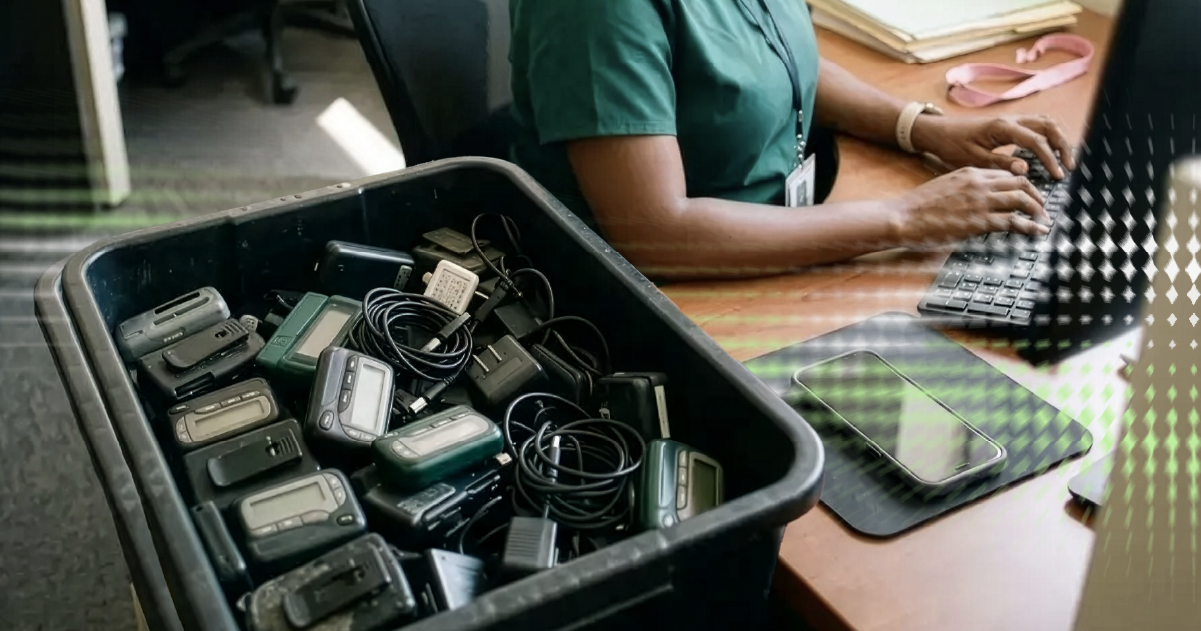
Want a prime example of the point solution problem in healthcare communication? Consider the humble pager: a wireless communication tool that preceded smartphones by decades.
👉🏼 SVP of Client Services Miriam Halimi highlights some of the unavoidable pain points of using basic communication tools like pagers.
While pager communication has had a long run in healthcare thanks to its simplicity, reliability, and limited maintenance requirements, newer tools like secure texting provide a reliable and compliant alternative to pagers that can be easily integrated into much more sophisticated communication workflows.
But those advantages aren’t always convincing to healthcare providers and executives.
“Most of the time, when we ask them why they’re still doing things a certain way, their response is, ‘Well, we're not saying it's the best, but it's always kind of worked, so we just kept doing it,’” says Aman Athwal, Regional VP at PerfectServe.
According to Aman, there are three key types of catalysts that drive change for healthcare operations:
A distant fourth, Aman says, is the desire to consolidate solutions to reduce tech complexity and save money. But for the most part, technological change is only going to happen when one of the three aforementioned conditions exists.
This is where a single advocate can make a difference. By sparking a broader conversation about the change you believe your organization needs, you can set into motion a process of reevaluation that could ultimately inspire your leadership to take action.
What clinics risk when they rely on patchwork communication tools
When systemic communication issues are ignored, patients are usually the ones to suffer. According to a study of malpractice risks in healthcare, 44% of malpractice claims that cite communication as a root cause resulted in the patient suffering serious harm or death.1
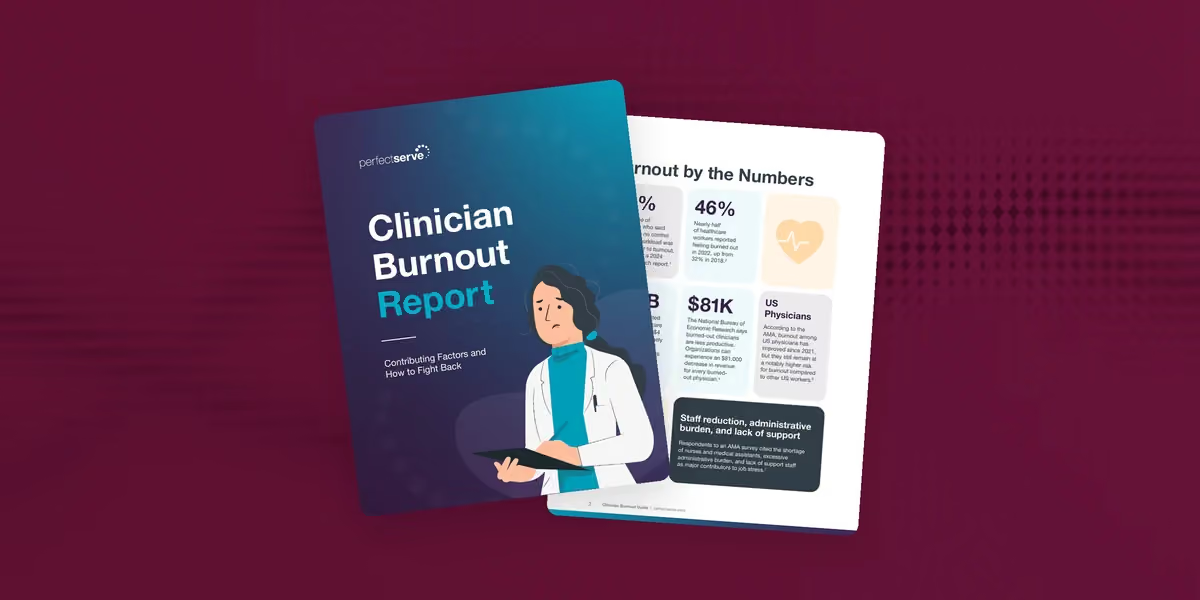
Communication issues are also a key driver of burnout. A recent CDC report found that 46% of healthcare workers reported feeling burnout often or very often in 2022, compared to 32% in 2018.2 Things have leveled off a bit since then, but burnout is still elevated versus pre-COVID levels.
👉🏼 Chief Customer Officer & Chief Clinical Officer Kelly Conklin discusses burnout in healthcare and how PerfectServe is helping customers to address it.
According to Moore, those high rates of burnout continue to garner the attention of healthcare organizations.
“Health systems have really doubled down on reducing burnout for both nurses and physicians and have made that a front-and-center issue,” says Moore. “And it's not necessarily altruistic, either: They're doing it because if they don't, then they lose those providers. And it costs about half a million dollars to replace a [single] provider.”
Calculating the immediate and long-term impact of unified communication and collaboration
The status quo is a little easier to upend when you don’t have to wait long to reap the rewards of your efforts.
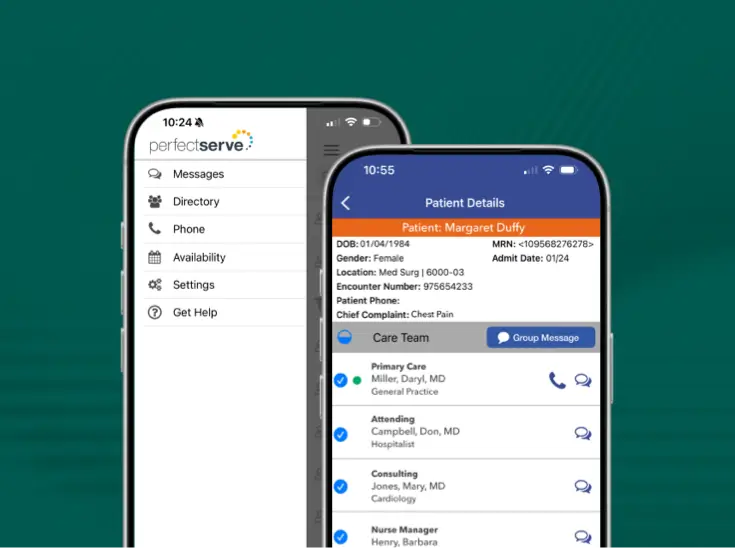
That’s what a well-developed CC&C platform should offer: Immediate impact as soon as it’s deployed, addressing core communication and scheduling needs across the five key areas of concern:
Let’s walk through the ROI case for CC&C software across its financial, operational, and patient care impacts.
Financial impact: Improved cost efficiencies
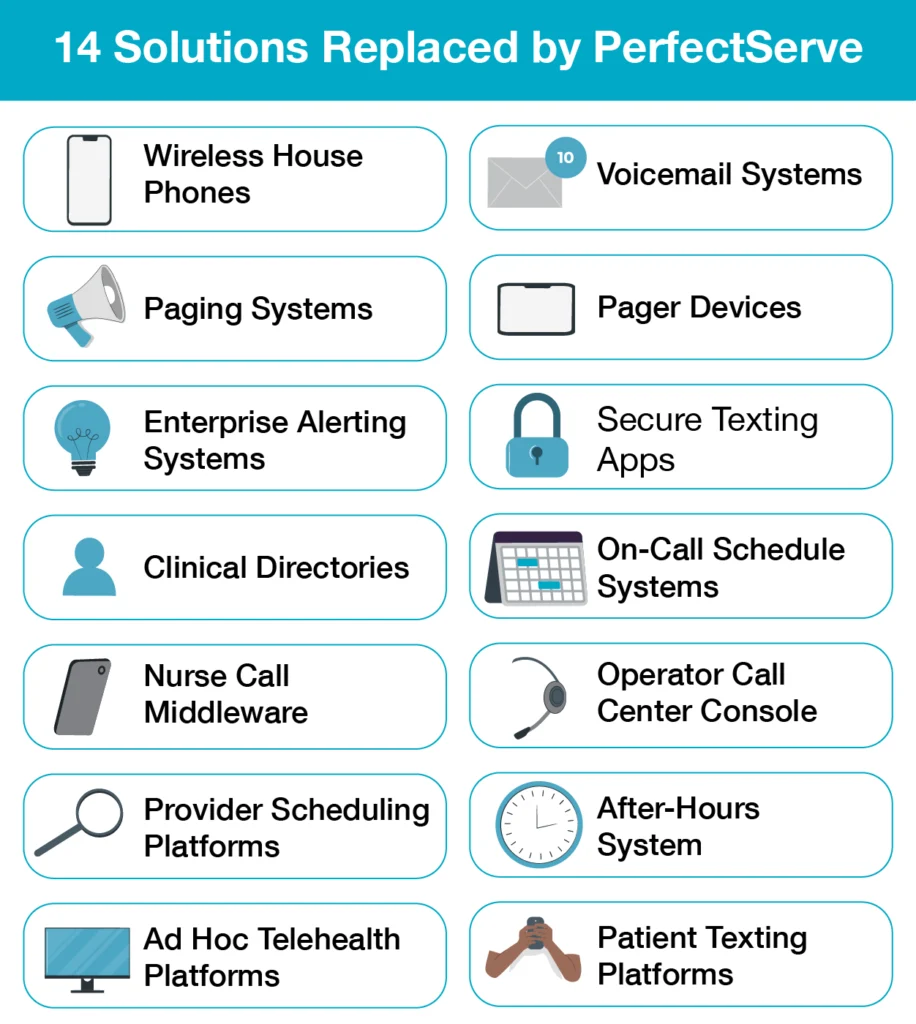
CC&C platforms can deliver direct cost savings by consolidating point solutions and simplifying your organization’s tech stack. By replacing up to 14 disparate solutions with a single unified platform, healthcare organizations can cut out inefficient vendor relationships and dramatically reduce their technology costs.
“Say your organization is using 14 point solutions that cost $2 million annually,” says Guillaume Castel, CEO at PerfectServe. “With PerfectServe, we can consolidate all of that into one platform for $700,000 a year. That’s $1.3 million in savings right there—plus potential ancillary savings because you’ll need fewer staff to manage systems that used to live in the basement.”
In the scenario Guillaume describes, a healthcare communication system implementing PerfectServe could fully recover the annual cost of its investment within the first year of the partnership.
Operational impact: Helping systems run faster and better
Efficient, reliable communication reduces delays and inefficiencies that can impact caregiver productivity and patient throughput. By making communication faster and more intuitive, clinical communication and collaboration tools remove common roadblocks and enable healthcare professionals to spend more time focusing on constructive collaboration and patient care, which ultimately enables higher rates of patient throughput.
👉🏼 Chief Innovation Officer Ben Moore lays out why achieving excellence in clinical communication requires a dedicated communication platform.
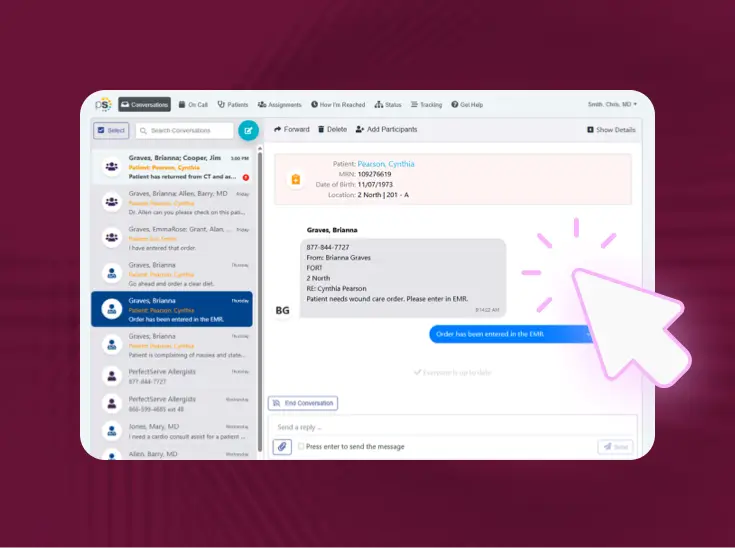
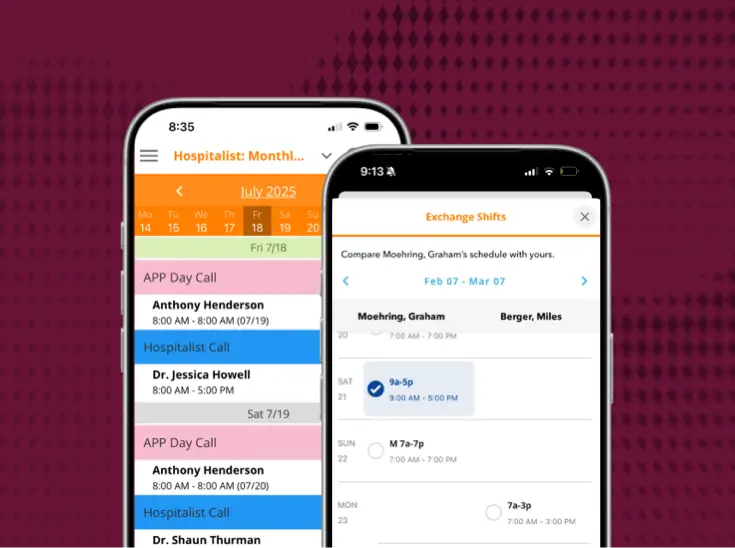
When communication and scheduling systems work in concert to facilitate patient engagement, it’s a beautiful thing. It’s easy to find the right person to contact for any clinical situation, and there’s never a concern that messages will sit in an unmonitored inbox or get delivered to someone who isn’t working.
👉🏼 President Taylor Rohrberger discusses the origins of PerfectServe's efforts to bring scheduling and communication together.
Those operational efficiencies also have implications for your organization’s bottom line. “When you make meaningful improvements to throughput, you can get more patients into your clinic—and therefore get more revenue out of your operations,” says Guillaume.
Patient care impact: Higher overall patient satisfaction
According to Guillaume, the long-term ROI impact of improved patient care is CC&C software’s most important value prop. The benefits to patient care are so numerous that quantifying them becomes a challenge—but, as he notes, “all those little things actually have very, very documented benefits to patient care and the health system.”
If you’re a patient in a hospital that doesn’t use that kind of communication platform, you can expect to hear overhead messages all day long in your room—even when you’re trying to nap and would be better served by a quiet environment. A CC&C platform can digitize and centralize almost all communications, meaning those loudspeakers will largely fall silent.
And what if you’re a patient who wants an extra blanket in your room? With a CC&C platform, the system relays a message to the appropriate staff person—in this case, probably a patient care tech—who can fulfill your request in minutes.
But frequently, the stakes with healthcare communication are much higher.
👉🏼 CEO Guillaume Castel explains how efficient communication can be the difference between a good patient outcome and a bad patient outcome.
“The most important scenario is if somebody’s dying and you need to mobilize a care team,” Guillaume says. “PerfectServe can do that in one-seventh the time of our competitor. If you talk to a chief medical officer, that speed of mobilization is paramount.”
Unified CC&C delivers value for everyone
CC&C software has the capability to touch every part of healthcare communication, and you’ll be hard-pressed to find a patient care process that isn’t impacted by communication in some way. That’s a major reason why this technology investment offers such strong ROI potential.
It also means that many different voices will want to weigh in when technology like this is being evaluated.
“The ultimate goal of using a CC&C platform might be enabling positive change across your organization, but that transformation can start within a single department,” Aman says. “When change happens on a small scale and you can show the rest of your organization its potential, it’s easier to get other departments to buy in—and then you’ll get an even better return on your investment.”
With the right internal support advocating for adoption, a CC&C solution can help your organization save money, streamline operations, reduce unnecessary care team toil, and deliver a better, more consistent patient experience.
Sources
See it working for real teams





.jpg)


.png)





Bring us the workflow that [hurts most]
We'll show you how it runs on PerfectServe, with your teams, your sites and your EHR.