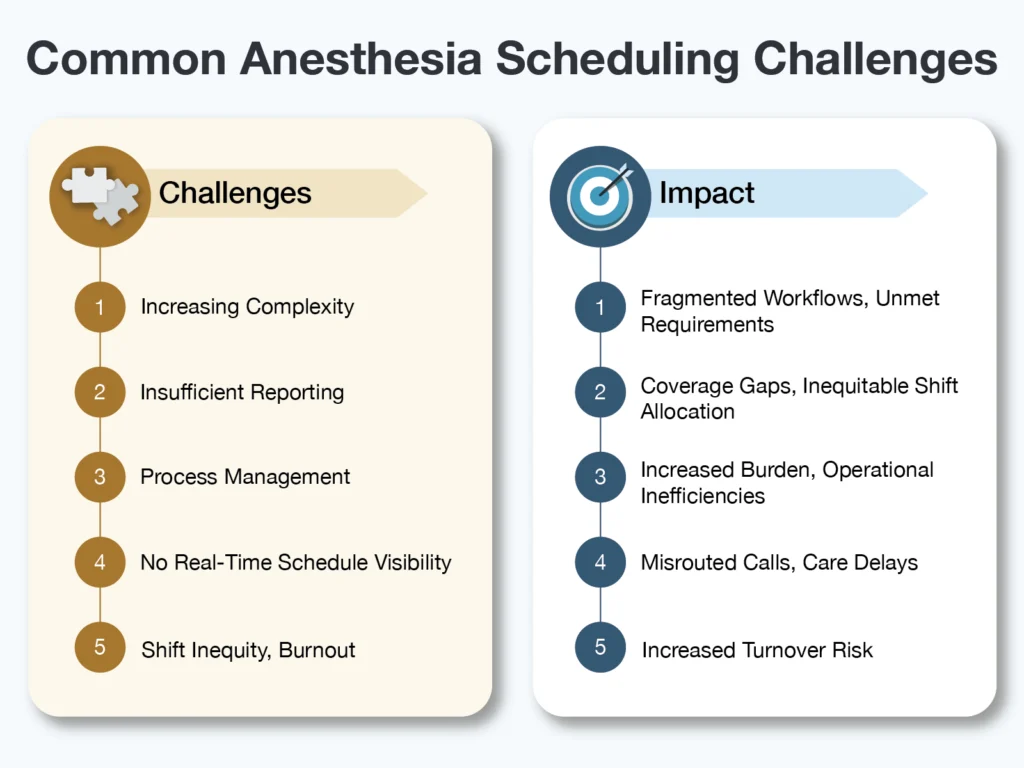
Anesthesia scheduling is inherently complex. Maintaining consistent coverage means navigating factors like unpredictable case volume, last-minute cancellations, credentialing hurdles, and clinicians moving between locations.
On top of that, the average anesthesiologist works 45–60 hours a week,1 which makes it challenging to manage breaks and ensure proper time off between shifts.
Let’s dig deeper to explore why anesthesia scheduling is uniquely difficult, what the consequences of poor scheduling are, and how a revised approach can make meaningful improvements faster than you might expect.
Why anesthesia scheduling is uniquely difficult
Anesthesiology scheduling is uniquely difficult because it presents a specific set of care-delivery challenges. Among other scenarios, these schedules have to account for:
- Emergency procedures
- Unpredictable surgery durations
- Imbalanced call coverage
- Compliance rules
And like all providers, anesthesiologists have their own shift preferences and work-life balance goals. It all adds up to a schedule that’s incredibly difficult to balance, especially when it’s created and managed by hand.
Even with scheduling tools, the burden of managing schedules often falls on an administrator, who may even be a provider themselves. They have to spend time juggling PTO requests, call shifts, and shift swaps, all the while making sure changes are reflected in a schedule that everybody else can see.
If this sounds familiar, you’re not alone. As just one example, Ochsner Health’s anesthesia department was spending an average of 68 hours per month building schedules. It took purpose-built healthcare scheduling tech to drop that time investment down to 14 hours—a 79% improvement.
Operational consequences of poor scheduling
Ineffective anesthesia scheduling isn’t just an administrative issue. Some of the most common consequences of poor scheduling include:
- OR delays
- Excess overtime costs
- Care team communication breakdowns
- Staff burnout from imbalanced workloads
Scheduling issues have also been identified, for example, as one of the most significant drivers of delays in getting patients from the OR to incision.2 If your scheduling method isn’t flexible enough to accommodate lots of variables and real-time changes, cases can get sidetracked quickly.
Those delays aren’t just operational headaches—they can have real consequences for patient care delivery. One study found that in hip fracture patients, delays in surgery were associated with higher mortality at both 1 month and 1 year.3
Poor scheduling also places a significant burden on anesthesiologists, who cite the problem as one of their primary job frustrations. In a study, over half (51.7 %) of anesthesiologists surveyed agreed that increased schedule flexibility would help address burnout.4
Not to mention, burnout is costly—and scheduling inefficiencies are a major contributor. Standard scheduling methods rarely incorporate the data needed to optimize shifts, and you end up with negative consequences like unfair shift allocation or misaligned (too much or not enough) OR usage. Those inefficiencies can then stretch staff, increase overtime, create wasted effort, and drive stress, all of which contribute to clinician burnout.
Addressing these inefficiencies benefits both staff and the bottom line:
- One medical center found that improving first-case on-time starts can save nearly $88,000 in six months by cutting just 20 minutes of daily OR overtime.5
- A large health system found that data-driven anesthesiology scheduling has generated over $800,000 in annual savings by reducing overtime and idle time.6
Real-world anesthesia scheduling use cases
A strong anesthesiology scheduling platform will be purpose-built to support the unique, real-world needs these groups face. And whether they’re managing a single facility or coordinating coverage across multiple locations, anesthesiology teams need a scheduling solution that can:
- Account for last-minute case additions and changes without disrupting the entire schedule
- Build call schedule fairness into every shift, ensuring equitable distribution over time
- Match credentialed providers to the correct locations, roles, and case types
- Ensure call order equalization, so no one clinician is consistently over- or under-utilized
- Maintain visibility across all sites, making it easier to quickly identify gaps and reassign coverage as needed
How to optimize anesthesia schedules
Anesthesia scheduling software can help your organization balance call coverage, manage provider workloads across locations, and mitigate burnout driven by inequitable schedules. It can serve as a single source of truth across departments across all locations, ensuring every care team member has access to the same real-time schedule, along with reporting that supports fairness and transparency.
With a rules-based approach, the possibilities for managing both personnel and operational needs expand significantly. These rules become the backbone of a schedule that can adapt to the unique demands of your anesthesiology department. This enables:
- Real-time shift updates, even for last-minute changes
- Provider preference management for increased satisfaction
- Automated time-off requests and shift swaps
So yes, anesthesia scheduling is incredibly complex. But it’s nobody’s fault—anesthesiology is just a fast-paced, high-stakes specialty, and standard scheduling workflows can make these complexities too difficult to manage.
By leveraging data-driven, flexible scheduling tools that don’t shy away from complexity, hospitals can streamline OR efficiency, reduce overtime, support provider well-being, and ultimately improve patient outcomes.
Anesthesia Scheduling FAQs
What makes anesthesia scheduling difficult? 

Anesthesia scheduling is uniquely complex because it requires balancing a large team of physicians, APPs, and CRNAs across a high volume of cases while accounting for individual preferences, skill sets, and shift requirements. Creating an optimal schedule is an arduous task that often requires edits after completion due to the difficulty of capturing each individual’s preferences the first time around. (can add LB value prop here)
How do hospitals schedule anesthesiologists?
Most hospitals have traditionally relied on manual, spreadsheet-based processes — with schedulers spending anywhere from 60 to 75 hours per month. manually creating and publishing schedules. With Lightning Bolt, hospitals use a process called combinatorial optimization to rapidly identify the optimal schedule by considering variables such as staff availability, skill sets, and shift preferences. This allows them to maximize resource utilization while meeting very specific organizational constraints.
What is anesthesia call scheduling?
Call scheduling determines which anesthesiologists are available for urgent or after-hours cases, and it’s one of the most wellness-sensitive parts of the schedule. Lightning Bolt addresses this by generating gapless provider schedules using custom rules designed to include individual preferences and organizational needs, while giving providers the flexibility to swap shifts or request time off from anywhere.
How can hospitals improve anesthesia staffing efficiency?
Auto-generated OR assignments that match supply and demand mean fewer transitions of care, fewer delays and cancellations, and greater provider satisfaction. At Ochsner Health, implementing Lightning Bolt saved approximately 720 hours annually and improved vacation request approvals by 55%, boosting provider engagement scores by 30% in under one year.
How does scheduling software integrate with EHR and OR management systems?
Lightning Bolt streamlines workflows by integrating real-time schedules, provider availability, and other key metrics into the EHR, all while maintaining HIPAA compliance. This prevents communication and care delays by ensuring provider contact information is always accurate. On the OR side, Lightning Bolt integrates schedules into Epic OpTime for OR management and enhances on-call management in Epic with real-time scheduling data. Lightning Bolt can also connect to payroll systems like Kronos (to ensure timely, accurate payment for providers) and a range of clinical communication platforms (to facilitate more efficient care team coordination).
How does anesthesia scheduling differ from other medical specialties?
Every specialty operates differently and has its own set of priorities, but anesthesia is uniquely complex because it requires managing both a long-range staffing schedule and a daily OR case assignment layer—matching the right provider to the right procedure, room, and surgeon simultaneously. Lightning Bolt automates complex anesthesia schedules using priority rules that generate schedules meeting all rules and requirements, without leaving gaps, and balances call coverage across multiple locations. Few other specialties require those capabilities at the same scale.
Sources
- Anesthesiology’s allure: High pay, flexibility, intellectual stimulation, American Osteopathic Association: https://thedo.osteopathic.org/2012/03/anesthesiologys-allure-high-pay-flexibility-intellectual-stimulation/
- Staff Perceptions of Operating Room Delays, University of Colorado Denver: https://www.ucdenver.edu/docs/librariesprovider74/quality-and-clinical-effectiveness-abstracts/perioperative_medicine_or_staff_perceptions_of_or_delays.pdf
- Use of direct-acting anticoagulants (DOACs) delays surgery and is associated with increased mortality in hip fracture patients, National Library of Medicine: https://pmc.ncbi.nlm.nih.gov/articles/PMC11458687/
- Anesthesiologists Burnout Increased Significantly in Two Years Since Onset of COVID-19 Pandemic, Study Finds, American Society of Anesthesiologists: https://www.asahq.org/about-asa/newsroom/news-releases/2023/11/anesthesiologists-burnout-increased-significantly
- Time Is Money: Can Punctuality Decrease Operating Room Cost? National Library of Medicine: https://pubmed.ncbi.nlm.nih.gov/31843690/
- New research finds data-driven staffing model delivers major cost savings for healthcare systems, American Association for the Advancement of Science (AAAS): https://www.eurekalert.org/news-releases/1116437

 Clinical Communication & Collaboration
 Medical Answering Service
 Provider & Staff Scheduling
 Healthcare Operator Console
 Integrations
 Features



 Organizations
 Roles
Roles
 Blogs
Blogs News
News Case Studies
 Downloads/Reports
 Events
 Videos
 Company
 Careers
 Why PerfectServe
 FAQ
FAQ Nurses of Note
 Best in KLAS