




Nursing Technology: Nurses Need a Seat at the Table
Excluding nurses from tech decisions can lead to low adoption rates and costly rework.


Key takeaways
- Excluding nurses from tech decisions can lead to low adoption rates and costly rework.
- Involving nurses early ensures workflows are optimized and reduces cognitive burden and clinical burnout.
- Organizations should make participation easy and transparent to secure nurse buy-in.
- Nurses offer critical, on-the-ground expertise that leadership often misses.
Nurses make up the largest segment of the healthcare workforce in the US, comprising approximately 5.2 million registered nurses (RNs) and representing about 1 out of every 5 healthcare professionals as of 2025.1 But somehow, they’re not often consulted for major IT decisions. Make it make sense.
These are the people charting patient vitals, tracking meds, and coordinating care. They’re often the ones using the technology the most. And yet, their input is frequently missing from important discussions about the tools they engage with every day.
Finding ways to include nurses in the tech decision-making process isn’t just common sense; it’s the best way to increase adoption and ensure their buy-in. Not to mention, nurses who feel heard and valued are far more likely to stay with their organization.
Let’s break down how to include nurses early in tech decision-making, why their involvement can make or break a new technology rollout, and the best way to create a meeting structure that feels welcoming.
Why are nurses left out of decision-making to begin with?
Research shows that nurses are rarely involved in the design or purchase of the healthcare communication systems they’re expected to use.2
Amanda Brown, VP of Nursing Workforce Optimization at Baptist Health, has seen this firsthand—and points to 3 common reasons why nurses get left out of IT decisions:
1) They're mostly women–and historically, that’s had an impact
Amanda points out that the nursing workforce is still 93% female, “and we know that it's hard to get that female voice at the table in our culture and our society.”
This isn’t always the result of overt bias. It’s often structural. The voices that are heard tend to be those already in the room. And nursing, despite its scale and impact, hasn’t historically held a seat at those tables.
2) They don’t feel welcome in the discussion
Amanda says nurses sometimes “carve themselves out of those conversations.” Nurses are busy, and some may feel overwhelmed by the idea of adding more meetings to their maxed-out schedules.
But even if they’re invited to the meeting, they may not feel empowered to speak up. Amanda points out that nurses may feel especially intimidated during large decision-making calls.
“They're used to speaking on behalf of their patients or their team in small settings or face to face. But these professional work settings are a very different environment, and getting comfortable speaking up can be a learning curve.”
3) They're seen as needing protection
Sometimes, nurses are excluded based on a well-meaning but misguided sense of protectiveness.
As Amanda puts it, there’s often an attitude of, “Let's not worry the nurses with this. Let them take care of the patients.” Nurse managers, in particular, are seen as already stretched thin—so instead of being invited into the process, they’re shielded from it.
Unfortunately, this kind of thinking does more harm than good. Rather than protecting nurses, leaving them out of discussions means they’re more likely to end up with tools that could actually make their lives harder.
What are the risks of not including nurses in decision-making?
Excluding nurses from tech buying decisions won’t just limit adoption rates. It hinders the success of new technology rollouts, contributes to burnout, and leaves valuable insight out of the equation.
Scrapping plans and starting over
Amanda shares the example of a tool for ambient listening. On paper, it sounds efficient. Nurses can simply speak their notes out loud and the system transcribes them.
But nurses flagged a problem: Sharing clinical observations in front of a patient felt awkward and impersonal.
That feedback came early enough to adjust course, but this kind of we-know-because-we-live-it-every-day insight doesn’t always get surfaced in time. When nurses aren’t involved up front, you risk rolling out tools that make patient care harder.
Nurse burnout & cognitive burden may lead to workarounds
65% of nurses report feeling stressed and burned out.3 Amanda warns that when tools don’t fit the way nurses actually work, they create more cognitive burden. When nurses feel swamped, they may take risky shortcuts.
Amanda remembers testing out a patient-turn sensor. During a trial, one nurse admitted she flipped the sensor manually to avoid getting flagged. She was so overloaded with alerts and alarms that she simply couldn’t deal with another one.
If nurses feel that tech is working against them, they’ll work around it. Without nurse input, decision-makers might overlook these risks.
Missing out on expertise
Many nursing directors have decades of nursing and management experience.
“When you bring nursing leadership to the table early, you’re getting that global picture. We’re always thinking about workflow, patient impact, and what this will look like at the end of the process,” says Amanda.
A nurse’s experience is not a physician’s experience, and that’s the whole point. Without understanding everything happening on the hospital floor, you can’t solve complex problems.
What happens when nurses join the tech decision-making conversation?
Nurses aren’t just end users. They live with the impact of every technology decision, right at the bedside. Involving them early benefits the whole project and, very likely, the whole organization.
Getting workflows right the first time
Nurses can spot the unintended consequences of new technology. Bringing them into the purchase or design process earlier means you’re much more likely to get the workflow right the first time.
As just one example, you might assume that a new workflow for critical labs should route all results to a nurse’s inbox to ensure nothing falls through the cracks. But a nurse would tell you that copying the nurse and the provider prevents unnecessary manual follow-up, allowing the provider to assume responsibility immediately, when appropriate. This leads to faster results delivery, more efficient treatment, and more time for nurses to take care of other patients.
Secure their support and buy-in
It can be highly frustrating to roll out new technology, only to find that nurses are resistant to using it. But that resistance is often caused by imposing the tech from above, rather than inviting nurse feedback early on.
Amanda saw this in action when her hospital rolled out mobile phones for clinical staff. On paper, the phones seemed like a clear upgrade that gave nurses more flexibility and the benefit of having real-time info in the palm of their hands. But even after this switch, nurses were still using bulky workstations on wheels (WOWs). Why?
Well, it turns out the issue wasn’t the phones—it was the fact that WOWs often represented the only dedicated work surface for nurses in patient rooms. Without them, it was harder to do things like prep medication. Adding small mayo stands to patient rooms improved mobile phone adoption instantly.
Without that feedback, the hospital might still be wondering why mobile phone usage didn’t catch on the way they had planned.
Higher adoption
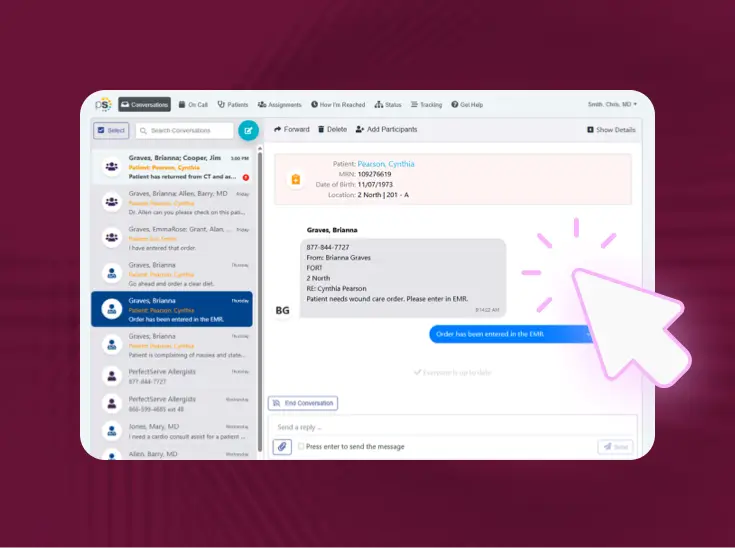
At the University of Tennessee Medical Center (UTMC), the COVID-19 pandemic prompted a quality improvement initiative to streamline communication workflows and improve nurse satisfaction by embedding PerfectServe messaging inside the electronic health record (EHR) interface.
40 nurses participated in a months-long study to test the effect of improved communication processes on nurse satisfaction at UTMC. The results were clear: when asked for their feedback on the new embedded messaging format, UTMC saw a 28% increase in nurse satisfaction with communication processes.
How to Improve Nurse Communication
Overall, the switch to embedded messaging led to a 21% year-over-year increase in PerfectServe communication volume with patient census remaining consistent. Clinicians, even those who never used PerfectServe before, felt comfortable embracing embedded messaging within the EHR. Making nurses the “test subjects” ensured that their feedback was captured consistently and drove much of the progress.
How to redesign tech decision-making to include nurse insight
Organizations that want to include nurses might struggle to find the right approach. Even when nurses attend the discussions, they don’t always feel comfortable participating.
Here are a few approaches to make sure you build nurse feedback into your tech buying process:
Make participation easy
Nurses have packed schedules. If you want them to show up, you need to make participation easy. Send online invites, make it simple to join, promote the meetings, and schedule them at workable times.
Be clear about what their role is
“These are not business people who spend their days in meetings,” Amanda explains. Meetings may feel unfamiliar, so package things clearly: describe the problem and why a new technology solution is needed, list out potential options, and explain the implications of each choice.
Avoid false choices
Amanda cautions that it doesn’t make sense to bring nursing staff in to brainstorm options or consider choices that won’t be realistic for several years: “I don't like to bring things to the team until it's really their decision to make.”
If their feedback isn’t necessary yet, they’re not likely to stay engaged in the process.
Be transparent about money
Leaders sometimes avoid getting into budget discussions with nurses, but as Amanda notes, “Nurses are very practical.”
Explaining budget trade-offs helps surface nurse priorities and makes tough decisions easier to accept. Amanda describes a time when her organization had to choose between purchasing bed scales or ceiling lifts. Only a few of the former could be purchased because they were more expensive, while the latter represented a cheaper option that could be deployed to more patient rooms.
Because the nurses understood the details—including the cost and the pros and cons of each—they chose the lifts because they were more likely to have the broadest impact on patient care. They were empowered to make a pragmatic choice … so they did!
Build feedback into your workflow
To reiterate, some nurses may not feel comfortable speaking up in large meetings. Amanda recommends creating polls and feedback forms to gather their input. You can also visit nurses to ask for their thoughts and suggestions in one-on-one or small group settings, which are more likely to feel comfortable and generate honest feedback.
How to support nurses the right way with technology
Too often, technology rollouts don’t meet expectations. Sometimes it’s a lack of leadership buy-in, sometimes it’s due to competing priorities, and sometimes it’s because of poor design.
When you bring nurses into the tech purchasing and implementation process right from the start, you’re more likely to benefit from their expertise in a way that leads to a well-designed, fully considered deployment. Due diligence here can help you save time and money, avoid reworking processes, and significantly improve adoption rates after go-live.
At PerfectServe, we’ve seen this dynamic firsthand:
- Our clinical communication solution always prioritizes engaging nurses early, because their input shapes workflows that actually deliver in practice. It’s not theory, it’s experience.
- Many members of our team are former nurses, lab techs, and even health system leaders. They bring a clinical perspective to every deployment.
- We understand how essential it is to invite nursing voices into the process from the beginning. Scheduling and communication technology can transform nursing workflows by giving them the access and information they need to make the best decisions for their patients.
And last but not least, involving nurses signals to the largest segment of your workforce that you care about their opinions and want to make their lives better. What a concept!
For more insight into the life of a nurse, read how technology can decrease their workload and promote patient well-being.
How to Promote Nurse Well-Being
Sources
- Healthcare Industry Statistics, Facts, and Trends. Pennsylvania Institute of Technology.
- Enabling nurses’ engagement in the design of healthcare technology – Core competencies and requirements: A qualitative study. Science Direct.
- The State of Nursing in 2025. Christine E. Lynn College of Nursing.
See it working for real teams





.jpg)





.png)





Bring us the workflow that [hurts most]
We'll show you how it runs on PerfectServe, with your teams, your sites and your EHR.