 Clinical Communication & Collaboration
 Medical Answering Service
 Provider & Staff Scheduling
 Healthcare Operator Console
 Integrations
 Features
Report
Learn how PerfectServe's rules engine makes care team collaboration easier.
Read Now >>TABLE OF CONTENTS

If you manage a medical practice, you’re familiar with the chaos: phones ringing, patients routed to the wrong place, critical messages getting lost in the shuffle, and being unable to reach the right provider at the right time.
It’s frustrating for patients, disruptive for providers, and nothing but chaos for practice managers. But that’s the reality when your answering service isn’t built for healthcare.
You know something needs to change. But with so many options—from automated medical answering services to new AI tools and even call services that rely on live agents—it can be difficult to land on the one right for your practice (and get buy-in).
Let’s separate the wheat from the chaff to get a better sense of what’s working and what’s just making life harder for medical practices today.
To better understand what practice managers are up against, we sat down with Karley Paul, a medical answering service expert with over a decade of experience leading technology implementations, and Alex Bricker, who has worked with dozens of medical practices, specialty clinics, and multi-site groups over the past 5 years to learn more about the ins and outs of call management.
Their assessment was clear: The status quo is chaotic, inconsistent, unpredictable, expensive, and leaves patients in a lurch and practice managers scrambling to keep operations running.
Many practices still rely on small, independent vendors with live agents that can’t keep up with the pace, complexity, and unpredictability of healthcare. “Sometimes, mom-and-pop services are great,” shares Karley. “But they can have high agent turnover, which creates chaos and inconsistency because agents never get fully comfortable in our world.”
That inconsistency extends to billing, too.
“A lot of providers charge by the minute or add surcharges for after hours, weekends, holidays, or demand spikes,” explains Alex. “If there’s an event or a seasonal illness that causes an increase in calls, costs go up, which makes budgeting difficult.”
Some answering services try to be everything to everyone, but in healthcare, generic, non-customizable services often fall flat.
When calls are routed through agents trained for generic interactions—and not medical practices—they miss critical nuances, such as HIPAA violations, the true definition of “urgent,” and the context and historical knowledge needed to adjust in real time. Agents with no medical training (and no additional context) are less likely to convey the right message with the right terminology. If a provider receives a message that just doesn’t make any sense, it’s an extra layer of frustration—and could delay a time-sensitive situation.
Practice managers have a lot on their plates, including managing staff, handling complex scheduling duties, and overseeing other daily operations. Implementing and managing an answering service shouldn’t fall on their shoulders too, but according to Karley, many managers still carry that weight.
“A lot of implementation falls on practice managers,” she shares. “Whether it’s for a new EHR, scheduling service, or answering service, they shoulder that, which can pull them away from core responsibilities.” On top of that, they often have to navigate unfamiliar integrations and estimate costs that can fluctuate with usage-based pricing models.
Behind the scenes, more problems emerge, especially for practice managers who are juggling outdated workflows and processes that put patients, providers, and themselves at risk:
The status quo is a mixture of inefficient processes, dated (or nonexistent) technology, and overwhelmed staff who are asked to do too much with not enough time and not enough reliable information.
In a perfect world, practice managers could approve the upgrade with more intelligent call handling, but that’s typically not the reality. That’s why the next best move is to build a business case that centers on these 6 points.
Physician-owners wear two hats: provider and business operator. So when calls jump and costs follow due to per-minute billing or surcharges, budgeting becomes difficult.
That’s why a rules-driven answering service with flat-rate pricing can be a compelling upgrade and the center of any business case. It gives practice managers the ability to approach the physician-owner and say, “Here’s what we’re spending now, and here’s exactly how much we could save with a solution that uses better technology.”
Not every return shows up in a spreadsheet. For many practices, one of the most meaningful benefits of a more capable answering service is the peace of mind it provides, especially in protecting providers’ time and their ability to focus on delivering the best patient experience.
“Taking calls is a critical piece of my practice,” says Sound Beach Pediatrics founder Dr. Katherine Noble, known as “Dr. Katy.” “But it can create stress and disruption, so any way to reduce that burden can improve physician quality of life and our ability to recruit new providers.”
Every practice is unique, from their schedules to the way providers prefer to be contacted. That’s why rigid routing systems that only send calls from A to B rarely work, especially for practices with dozens of providers.
“We worked with a group of 60 providers,” shares Karley. “You can’t have a menu that says, ‘Press 1 for Dr. Paul, Press 2 for Dr. Smith,’ all the way down. That’s not a good experience.”
That’s where intelligent, customizable routing becomes key. Instead of limited options, practice managers can tailor call flows to reflect the practice’s unique structure by adding details about specific providers, locations, and call types.
Because these details can be updated quickly at any time, this kind of call management system also shines when unexpected situations arise, such as during a public emergency when sharing real-time updates with patients becomes paramount.
For all of technology’s positive impacts on healthcare, it’s also created challenges. That includes tech sprawl that drags down the patient and provider experience, drives up costs, and can create duplicative work.
“We don’t want you to duplicate work,” emphasizes Karley. “We integrate with scheduling systems and, based on who’s on call, we’ll route the call accordingly.”
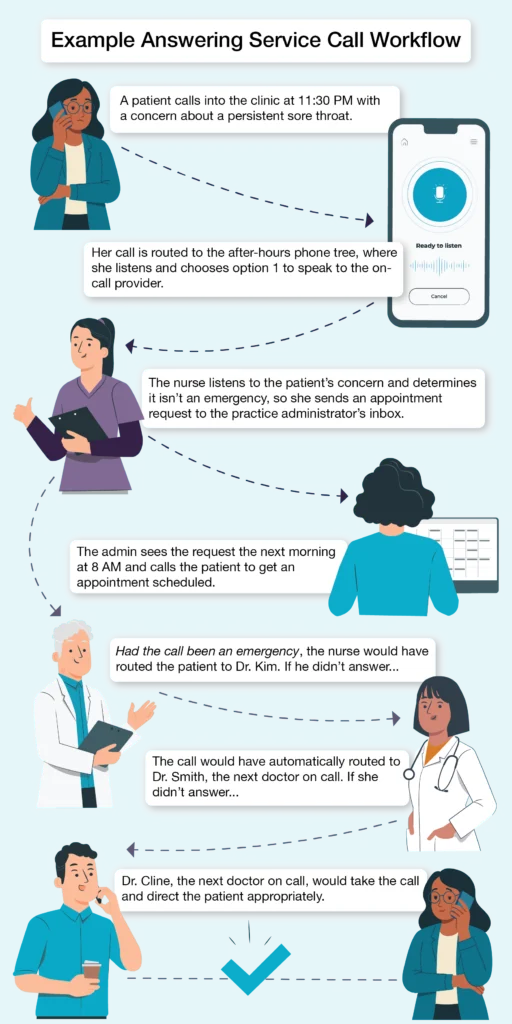
But interoperability should extend beyond your scheduling system. For example, if you’ve got a platform that facilitates text and video communication with patients and their families to help manage appointment reminders, patient outreach, and follow-ups, it should be integrated with your answering service to create a more unified communication experience that doesn’t inflict app fatigue.
Most states require answering services to include a 911 disclaimer, which can be a statement as simple as, “If this is a life-threatening emergency, please dial 911.” It’s a core requirement, but not all services include or enforce it.
Equally important is protecting patient data, which isn’t guaranteed when practices use systems that aren’t encrypted or rely on live agents who aren’t properly trained and may share PHI with people outside the workforce. A more modern answering service specifically built for the realities of healthcare won’t leave this to chance.
Referrals are everything for medical practices. But when patients struggle to reach the office or get routed incorrectly, satisfaction scores drop, negative online reviews follow, and patient leakage may increase.
Practice growth and stability depend on reputation, explains Alex. “If an office gets a lot of negative reviews, it’s time to have a real conversation with the doctor. Tell them: ‘You care about patients and our community, but right now, our call service isn’t letting us do that.’”
We’ve walked through the ROI of an answering service that facilitates more intelligent call management. But how does something like this work in the real world? Below are a few real-world examples from PerfectServe customers, including two that Karley shared and one from a previously published case study.
A geriatric practice faced a flood of after-hours calls marked urgent—but, as Karley explained, most didn’t require that level of attention. The real issue was that their answering service wasn’t designed with their patients or call patterns in mind.
Like many practices with an older demographic, many calls were routine: questions about transportation, care coordination, and prescription refills. But because the first option on the menu was, “If your matter is urgent, press 1,” most patients selected it … even when their situation wasn’t urgent.
To fix this problem, they installed a more flexible and capable answering service with a redesigned call flow that prioritized the practice’s most common requests. The result? An 8% reduction in urgent calls.
Karley also shared an experience involving a large medical group with over 20 offices that lost its mom-and-pop answering service with little notice.
“The group contacted us, desperate for a solution,” explains Karley. “The catch was that they needed it live across 25 offices in two weeks.”
Typically, onboarding includes a consultation, call-flow approval, and more. But because the group was in a bind, the team streamlined the process and completed the implementation in just 8 business days. That kind of speed is only possible with a cloud-based solution backed by an experienced team.
Between rising costs, complex schedules, and growing patient volume, burnout remains a threat, which Dr. Katy sees firsthand.
“Anything that helps me create automation and reduce my staffing needs is helpful,” she says. “It allows me to spend more time with my patients and their families.”
That automation comes from a medical answering service with HIPAA-compliant messaging and advanced after-hours call management, both of which reduce stress and minimize communication errors by bypassing human operators.
Dr. Katy also layered in real-time scheduling to make sure calls always get routed to the right provider at the right time. Providers can access their schedules instantaneously and view reports to ensure schedule equity, which frees up even more time to focus on taking care of patients.
Practice managers are the backbone of every practice. They’re coordinators, communicators, and problem solvers all wrapped into one.
But too often, they’re also asked to manage outdated, manual, and inefficient answering services that create unnecessary risk and make everyone’s life more challenging.
Medical answering services that use repeatable, tech-enabled workflows can reduce that burden significantly. But before making the switch, managers need to build a clear business case around predictable cost savings, provider efficiency, regulatory peace of mind, and a smoother experience for everyone involved.
Do that, and the physician-owner will be ready to sign on the dotted line.
Is your current answering system costing you time, money, and productivity? Learn more about the benefits of automated medical answering services.
 Organizations
 Roles
Roles
 Blogs
Blogs News
News Case Studies
 Downloads/Reports
 Events
 Videos
 Company
 Careers
 Why PerfectServe
 FAQ
FAQ Nurses of Note
 Best in KLAS