





3 Staff Retention Strategies That Address the True Causes of Turnover
Learn how fair scheduling, reduced administrative burdens, and stronger feedback loops can help organizations improve retention and support clinician wellbeing.


“I want the younger generation to know it’s worth it,” shared Nurses of Note honoree Sulane Knight when we asked her what changes she’d like to see in nursing. “To be the one to hold the hands of family members as they watch a loved one pass, support a new mother when she feels like she isn’t enough, cradle a new life in their arms while they take their first breath.”
Her words illustrate why so many nurses and healthcare professionals enter the field in the first place: to do work that matters.
But for a growing number of clinicians, that sense of meaning is colliding with the day-to-day realities of the job as mounting burnout pushes many to ask a question they never expected to face: Is this the right career for me?
This is the workforce reality Chief Nursing Officers (CNOs), nurse leaders, and other healthcare executives are navigating, and why the right retention strategies built around operational wellness (and not just signing bonuses) need to sit alongside patient care, safety, and operations as a core priority.
What does that look like? Our study of 343 clinicians shows us the path.
Make schedules fair, equitable, and predictable
For most people outside healthcare, a work schedule is something they can generally count on. You know when you’re working, when you’re off, and can plan the rest of your daily life around that.
For nurses and other clinicians, scheduling is often anything but straightforward, and that unpredictability can quickly become a source of frustration, stress, and burnout. For some, it can also influence whether they stay: when we asked clinicians which non-salary factors would make them more likely to remain on the job, fair and predictable scheduling came in second.
Several scheduling challenges help explain why:
- Workload intensity: 49% believe their schedules don’t account for patient census or acuity
- Fatigue from previous shifts: 38% cited schedules that don’t consider fatigue from prior shifts
- Personal commitments: 33% cited schedules that fail to account for time-off requests, family responsibilities, and other needs outside of work
- Continuity of care: 32% said scheduling practices overlook the value of maintaining continuity among clinicians, patients, and care teams
- Manual processes: 72% said their scheduling process still includes a manual element, making it harder to keep schedules optimized and up to date as needs, availability, demand, and preferences shift
These scheduling challenges point to a simple reality: clinicians want to live their lives outside of work. In many cases, their schedules stand in the way of that. As Miriam Halimi, PerfectServe’s SVP of Client Services, said, “A physician’s schedule very much impacts their life, their quality of work, and may cause burnout if they’re working too many shifts.”
The effects show up both personally and clinically. Clinicians can become more fatigued, struggle to meet patient demands, and lose the autonomy that keeps them engaged. "When you lose that feeling of control and don't feel like you can plan for life events,” shares PerfectServe’s Chief Clinical Officer and Chief Customer Officer Kelly Conklin, MSN, CENP. “It's hard to feel as motivated as you want to about the work you're doing.”
Retention strategies should focus on creating schedules that are predictable, fair, and adaptable to clinicians' needs. This often involves shifting from manual processes that don't offer enough control or flexibility to accommodate change.
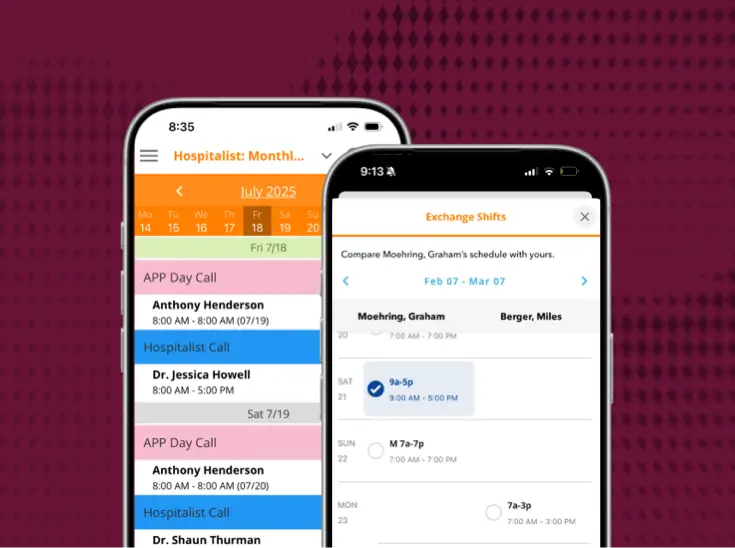
One way to do that is with rules-based automated scheduling systems that allow organizations to build clinician needs, like time-off requests and shift preferences, into the system alongside staffing requirements.
This approach also simplifies managing schedules as needs evolve. For instance, if a shift becomes available, the system can alert all qualified individuals who might be able to take it. When someone steps in to take the shift, the schedule updates for the entire team immediately.
That combination of visibility, fairness, and control can make a difference, which is what happened for Ochsner Health. After implementing a flexible scheduling system with PerfectServe’s Lightning Bolt Clinical Team Scheduling, their average engagement score for physicians jumped nearly 30%. More importantly, according to Dr. Choudhry, an anesthesiology resident at Ochsner Health, this flexibility gives anesthesiologists “one or two mornings or afternoons a month for them to better attend events important to them.”
Take work off their plate: cut the non-clinical load
Every job involves tasks that seem disconnected from the primary responsibilities. But for nurses and other clinicians, much of this non-clinical work (mostly done at a computer) takes time away from patient care, which is what motivates them to continue working.
“The time spent in front of a computer is overwhelming,” shares Kelly, “and documentation is now so highly scrutinized that it contributes directly to burnout.”
Clinicians also spend time:
- Documenting care in the EHR: Charting patient care and completing required documentation related to billing, compliance, quality, and value-based care.
- Managing schedule-related communication: Resolving conflicts, requesting changes, and working with administrators or scheduling teams.
- Coordinating care: Finding the right provider, relaying information, and ensuring critical updates reach the right person at the right time.
- Navigating fragmented technology: Moving between apps, inboxes, and systems, chasing down information, and trying to connect dots across them all.
- Responding to alarms and alerts: Managing frequent interruptions from alarms, system notifications, and other alerts that disrupt workflow and lead to alarm fatigue.
In fact, we found that nurses spend 34% of their time on communication-related tasks. As Kelly puts it, "Everybody's being asked to do more, but there are no more hours in the day.”
Kelly also describes a potential solution. "Leaders can automate processes,” she says, “so that information is sent to the on-call provider and the nurse caring for the patient, allowing neither to interrupt their work or take a break."
However it takes shape, Jennifer Torosian, RN, MSN, NEA-BC, CENP, just wants to see change: “I’d advocate for anything that makes nursing and staff workflow lean and less burdensome to improve the quality of care we provide and the face-time we have with patients.”
Close the feedback loop: listen first, act second
Kelly makes it simple: “Give voice and power to those who do the work.”
That may sound obvious, but our research suggests it’s not happening consistently. In fact, for the 12-month time period preceding our survey, just 33% of clinicians said their leaders made changes to operational tools or workflows after soliciting their feedback. Another 22% said leaders asked for feedback but made no changes, while nearly 40% said leadership never asked for their input.
This presents two challenges:
- Clinicians don’t feel heard: Repeatedly raising concerns without seeing change can make clinicians less likely to speak up and more likely to accept inefficient workflows, inadequate technology, and other problems as “simply part of the job.”
- Leaders miss key insights: Clinicians have a lot to say about what would improve their work, including simpler technology, less time spent on administrative processes, better scheduling, and fewer lapses in communication.
That's why closing the feedback loop matters, and why failing to do so can become a persistent retention problem. To combat it, leaders need to give clinicians safe spaces to speak up, easy ways to share feedback, and create a blame-free culture.
David Trout, a Clinical Nurse Educator at the University of Tennessee Medical Center (UTMC), says it’s also imperative to bring leaders close to the front line. “The value of leaders being present on the front line listening to staff and collaborating to tackle problems together cannot be overstated,” he shared. “When staff feel like they have the clout to effect change, their perceptions of powerlessness will likely be abated.”
At the same time, leaders should acknowledge concerns directly, clarify resulting action, and follow through when a workflow or process changes. They should also be wary of engaging clinicians if their feedback isn’t going to be considered seriously during the decision making process. Repeated asks for input with no visible follow-through on the other side will likely exacerbate disengagement.
The best retention strategy is making the job worth staying for
While these strategies can improve the workplace and retention, they also serve a greater purpose: show clinicians that their time, expertise, and experience are valued.
Fairer schedules give clinicians more control over their lives. Reducing non-clinical tasks lets them focus more on patient care. And when leadership regularly listens to and acts on feedback, clinicians feel their opinions are valued.
That’s not just theoretical, either. Across PerfectServe’s Nurses of Note winners, some of the best examples of satisfaction and wellness come from those who were given the support and influence to make their workplace better.
PerfectServe’s Nurses of Note stories show what that can look like.
Kari Treadway saw that new nurses weren’t getting consistent support from their preceptors. “We noticed a lot of inconsistencies, and a lot of our newer staff didn’t feel supported,” she said. So she and another nurse developed a more structured orientation model and brought it to leadership.
Samantha Rovers, BSN, RN, CNOR, took a similar approach. When she noticed that communication handoffs were disrupting patient care, she went to the people closest to the work to understand why and base her solution on their experiences. As her nominator put it, Sam “always talks to the staff closest to the patient to help solve bigger problems.”
That’s what “voice and power” means. When clinicians have more control over their schedules, fewer barriers between them and patient care, and more say in the work that gets done, the job becomes more sustainable, and more importantly, worth staying for. As Sam puts it, “We all got into this because we wanted to make a difference and help people. And that’s ultimately why we’re all here.”
Ready to bring these staff retention strategies to life? Read our Nurse Retention Guide for more practical ideas and strategies.
See it working for real teams






.jpg)




.png)







Bring us the workflow that [hurts most]
We'll show you how it runs on PerfectServe, with your teams, your sites and your EHR.