





How to avoid alarm fatigue: 7 strategies for hospital teams
On the busiest days, 72% of the alarms a clinician received were the same alarm firing again within 10 minutes. We analyzed 1.47 million device alarms to find out why, and we share seven strategies for avoiding alarm fatigue, in the order to start.

On the busiest days in our July 2026 data, 72% of the alarms a clinician received were the same alarm firing again at the same bed within 10 minutes. On the quietest days, it was 22%.
We looked at 1.47 million device alarms sent to 5,113 clinicians across three health systems. I have high confidence in the direction of what we found: the more alarms a clinician receives, the fewer get resolved, and the more often the same ones come back.
Below is what alarm fatigue is, what it looks like in real data, and seven strategies for avoiding it, in the order I would start.
Quick answer: how do you avoid alarm fatigue?
Cut the alarms that need no action, send the rest to the right person, and measure the result every month. In practice, that means fixing technical alarms first, targeting outlier beds, monitoring only patients with a clinical indication, tuning limits and delays, setting escalation by role, suppressing repeats, and reviewing settings at every handoff.
What is alarm fatigue?
Alarm fatigue is the desensitization that builds when clinicians are exposed to a large number of alarms, many of them false or clinically insignificant. Responses slow down, or alarms get missed altogether. AACN's practice alert reports that recent studies found 89% to 99% of ECG monitor alarms were false or clinically insignificant.
The stakes are documented. The Joint Commission's Sentinel Event Alert on alarm safety counted 98 alarm related events over about three and a half years, and 80 of them ended in death. Because reporting is voluntary, that is likely a small share of what happened. A video study at a children's hospital found nurses responded more slowly as the number of preceding nonactionable alarms rose. Since 2014, the Joint Commission's National Patient Safety Goal NPSG.06.01.01 has asked accredited hospitals to treat alarm safety as a priority.
What does alarm fatigue look like in real data?
We analyzed July 2026 device alarms: 484,000 telemetry monitor alarms and 988,000 nurse-call alarms delivered to 5,113 clinicians across three health systems. Everything here is aggregate, with no patient information.
Four other findings shaped the strategies below.
- Technical alarms lead. 54% of parseable monitor alarms were technical: ECG leads off, no telemetry data, and low or empty batteries. ECG leads off alone accounted for more than 100,000 deliveries, the loudest single alarm in the data.
- A few beds carry a lot. 69 of 1,189 beds produced 100 or more asystole alarms each, which is 40% of the 34,925 asystole alarms delivered that month. The worst bed fired about 26 a day, most likely from loose leads.
- Escalations are common. 81,605 monitor alarms (17%) were escalation re-sends, meaning the first recipient did not respond in the allotted window. 40,759 of them reached the second or third level.
- Load is uneven. Patient care techs averaged 57 alarms per working day, compared with 31 for nurses. 1,102 clinicians had at least one day with 100 or more alarms, and 267 had a day with 200 or more. One nurse received 1,214 alarms in a single day.
This is one month from three systems. I treat it as a strong signal to act on, and not as settled science.
Seven strategies for avoiding alarm fatigue
1. Fix technical alarms first
Alarms that carry no clinical information are the fastest to remove. If more than half of your monitor alarms are technical, a leads and batteries workflow will help more than any change to clinical thresholds.
Start with skin preparation and daily electrode changes, both recommended in AACN's practice alert. A Johns Hopkins pilot found that changing electrodes daily cut total alarms in half. Then route battery and "no data" alarms to a technician or biomedical engineering, so the person at the bedside is not the first stop for a maintenance task. The loudest alarm in our data is a maintenance chore wearing a clinical costume.
2. Rank beds, not units
When 69 beds produce 40% of asystole alarms, a unit average hides the problem. Pull a weekly top 10 list of beds by alarm count, then check lead placement, equipment, and whether the patient still needs monitoring. Johns Hopkins researchers describe outlier patients as the ones generating the most monitor alarms.
The risk is cry wolf. When a true event fires on one of those beds, it looks like the last hundred false ones.
3. Monitor only patients who have a clinical indication
Every monitored patient generates alarms. AACN tells nursing leaders to build policies for monitoring only the patients with a clinical indication. If a patient no longer meets the indication, ending monitoring removes every alarm that patient would have produced. Build the check into rounds so it happens by default.
4. Tune limits, delays, and defaults by unit
The Joint Commission names default settings that are not at an actionable level, and alarm limits that are too narrow, as contributors to alarm fatigue. AACN recommends customizing ECG alarm parameters and the delay and threshold settings on pulse oximetry.
The reported results are worth knowing. Johns Hopkins cut alarms by 24% to 74% across six units. Stanford reported a 57% reduction in two units by adding time delays and conditional triggers, according to Becker's Hospital Review. In a pilot described in the same coverage, a UCSF Health leader said an 11 second detection delay cut alarms by 70%.
I have high confidence that unit specific defaults beat factory defaults. I am less confident that any single number transfers between hospitals, so make changes one unit at a time, with physicians and clinical engineering in the room, and track missed events.
5. Route by role and escalate on purpose
Seven of the eight most escalated alarm labels in our data were technical. If a low battery alarm reaches a second and third person, then the routing rule needs fixing.
Nurse-call adds its own load. Bed exit, chair exit, and chair alarms made up about 31% of nurse-call traffic, and they route first to patient care techs, who carry nearly double the alarm load of nurses. For each alarm type, decide the first recipient, the backup, the timer, and whether escalation is warranted at all. The Joint Commission expects policies that cover who responds and how.
6. Cut repeats and bursts
One in four alarms in our data arrived within 60 seconds of the previous one. The worst hour sent 246 alarms to one person, which is one every 15 seconds.
I have less published evidence for repeat suppression than for electrode care, but my gut says a 10 minute duplicate window is a sensible start, given that is where we measured re-fires, repeats climbed with load, and the first alarm stays intact. Begin with technical and nurse-call repeats. Escalate persistent alarms instead of re-sending them. Never suppress a life-threatening alarm class without clinical sign-off.
7. Review at every handoff, and measure monthly
AACN recommends checking alarm settings at the start of every shift, with any change in patient condition, and with any change in caregiver. In our messaging data, weekday volume nearly doubles between 7:00 and 7:30 am, and the 90th percentile acknowledge time rises to 101 minutes, while the daytime norm is about 31 minutes. Handoff is already crowded, so a one line alarm check in the script is easier to sustain than a new meeting.
Then track five numbers each month: alarms per clinician per day, re-fire rate, technical share, escalation rate, and your top 10 beds. The Joint Commission expects leaders to make alarm safety a priority and to educate staff, and these five numbers give that work something to point at.
Where should you start?
- Weeks 1 to 4: pull the five numbers and list your top 10 beds.
- Weeks 5 to 8: fix technical alarms and outlier beds on one unit.
- Weeks 9 to 12: tune limits, delays, and routing on that unit, then decide what to spread.
You can absolutely do this. One unit, one month of data, and one fix this week is a real start.
Where routing fits
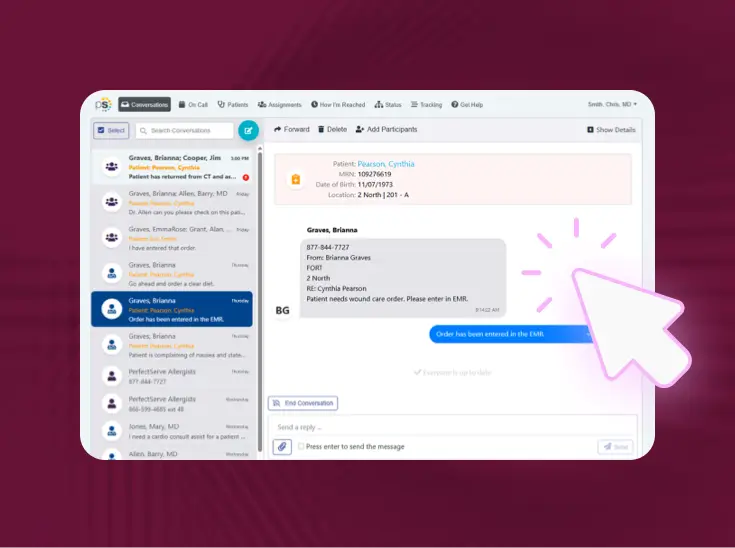
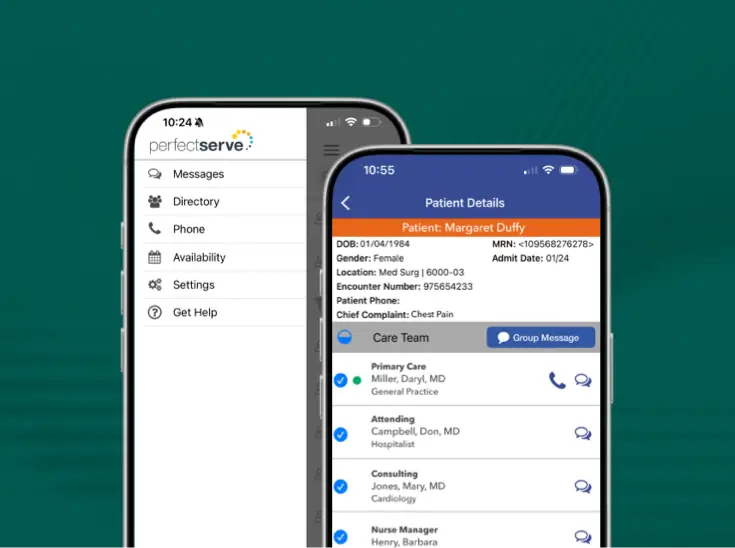
Most of these strategies end in the same question: who should get this alarm, and what happens if they do not answer. PerfectServe Clinical Collaboration routes device alarms and calls to the right person by role, with escalation when no one responds.
Alarm fatigue FAQs
What causes alarm fatigue?
Too many alarms, and too many of them needing no action. The Joint Commission points to numerous alarm signals, too many alarm-equipped devices, default settings that are not actionable, and limits that are too narrow. In our data, technical alarms and repeat alarms were the biggest contributors.
How many alarms are false?
It varies by setting. AACN reports 89% to 99% of ECG monitor alarms were false or clinically insignificant in recent studies. A Johns Hopkins quality project cites a range of 72% to 99% of monitor alarms not requiring intervention.
Does the Joint Commission require alarm management?
Yes. NPSG.06.01.01 requires accredited hospitals to make alarm safety a priority, identify the most important alarms to manage, set policies and procedures for them, and educate staff.
How many alarms per day is too many?
There is no universal threshold. Hospitals track alarms per bed per day by unit. In our data, the same-alarm re-fire rate was 33% for clinicians receiving 50 to 99 alarms a day, 42% at 100 to 149, and 72% at 300 or more. That is an association, and not proof of cause.
Who should own alarm management?
A cross-disciplinary team. The Joint Commission recommends clinicians, clinical engineers, information technologists, and risk managers working together, and AACN recommends an interprofessional team that gathers data and sets unit-specific defaults.
See it working for real teams

















Bring us the workflow that [hurts most]
We'll show you how it runs on PerfectServe, with your teams, your sites and your EHR.