






Top Healthcare Scheduling Best Practices
Effective provider scheduling is about more than filling shifts. It’s a strategic function that impacts patient care, provider satisfaction, operational efficiency, and financial performance.

A well-crafted physician schedule isn't just a calendar. It's the heartbeat of operational success.
Healthcare administrators face the complex challenge of balancing provider availability, patient demand, and organizational goals. One misstep in that balance can affect everything from patient care and staff satisfaction to operational efficiency and financial performance.
As provider schedules become increasingly complex, healthcare organizations are looking beyond manual processes and disconnected systems. The most successful organizations approach scheduling as a strategic function, using technology, integrations, data, and expert guidance to create more efficient workflows and better experiences for both providers and patients.
Below are four healthcare scheduling best practices that can help organizations improve operations today while building a foundation for future growth.
Key Healthcare Scheduling Best Practices
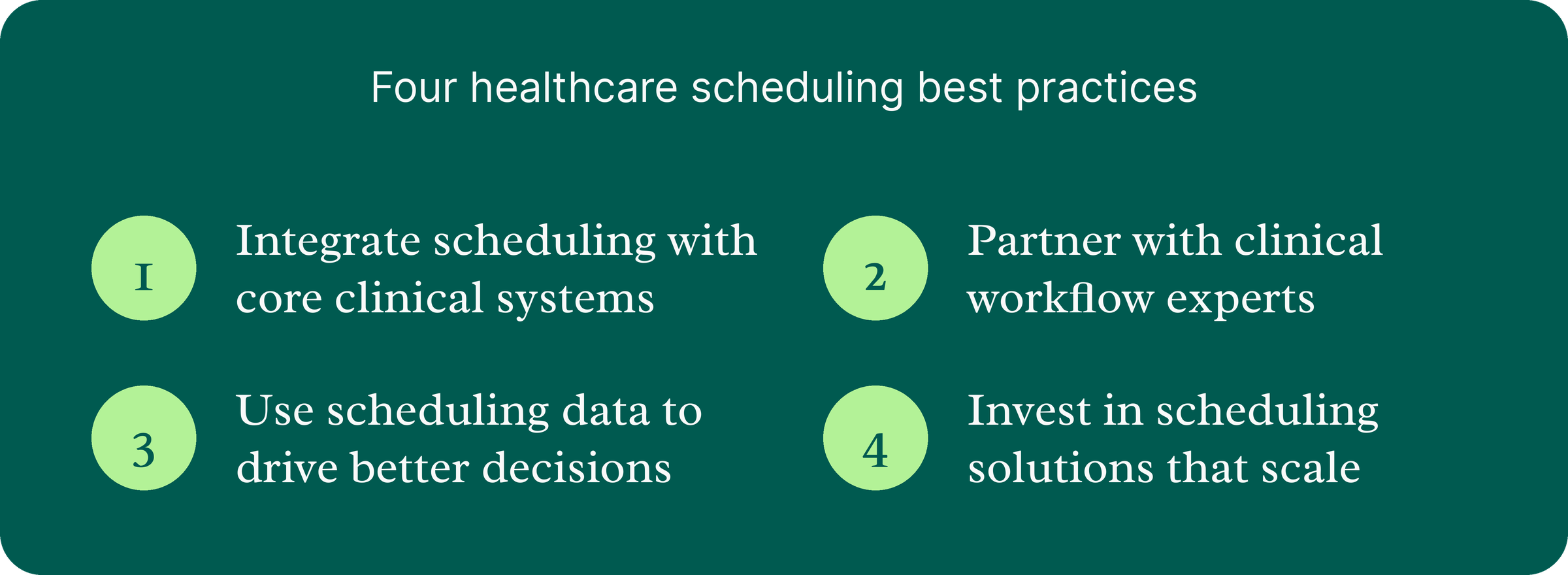
- Harness intelligent integrations with key clinical systems, including payroll, clinical communication, EHRs, and other operational tools
- Partner with vendors that understand clinical workflows and provide expert, responsive support
- Use scheduling data to uncover resource utilization trends, staffing challenges, and workflow improvement opportunities
- Invest in scheduling solutions that can scale alongside organizational growth
Integrate Scheduling With Core Clinical Systems
Integrations are crucial. They connect disparate healthcare solutions and allow them to share data across multiple platforms. This ensures care teams have access to the most accurate information for the highest quality care delivery possible.
But integrations do more than connect care tools. Used correctly, they help a health system make better decisions and reduce errors in many areas. Ultimately, integrations foster collaboration and create a more connected, effective healthcare ecosystem.
While every integration serves a purpose, some have a greater impact on day-to-day operational efficiency than others.
You're likely struggling to ensure your providers work fair shifts, care teams communicate effectively, and provider supply matches patient demand. One specific integration makes this much easier—and more accurate.
Scheduling.
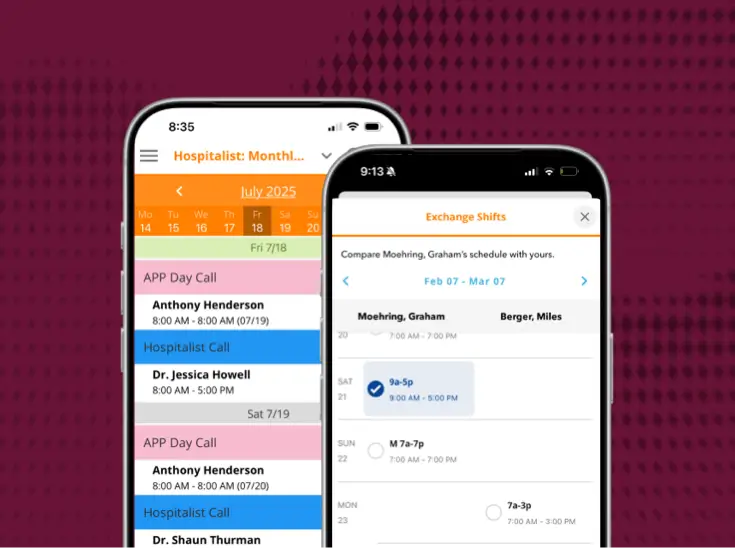
With access to real-time, accurate schedules, staff work efficiently. They know their shifts are equitable and they have a healthy work-life balance. They have the time they need to see each patient without being rushed, and they even have enough time to finish their administrative tasks.
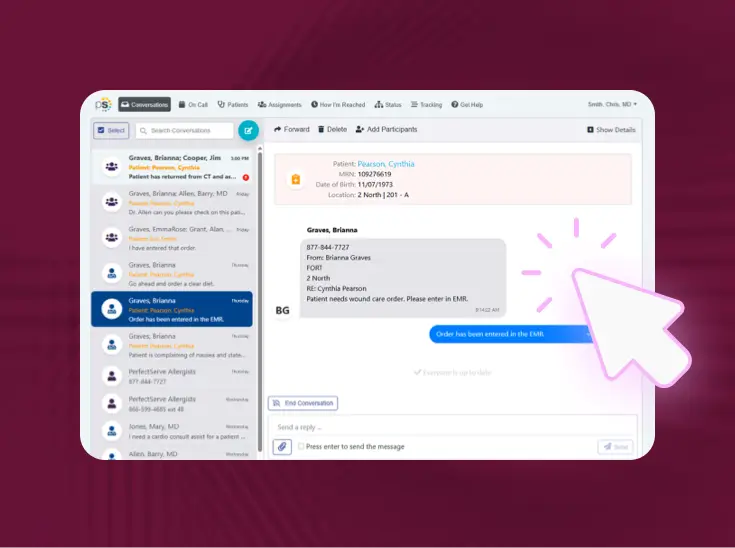
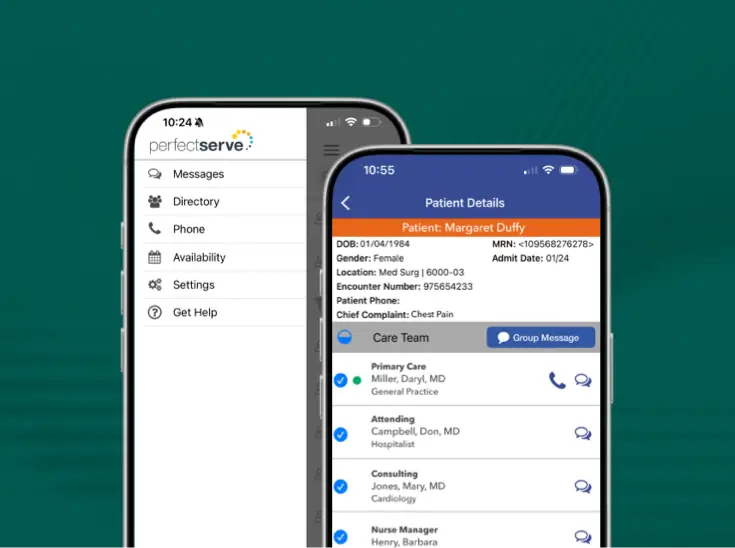
Then, imagine that an organization unifies its optimized scheduling software with its clinical communication solution. Now, when a physician needs to consult the on-call radiologist, they can confidently contact the right person without confusion or delays and send them a message that includes patient context in a few clicks.
Why? Because their communication system is deeply embedded with their accurate scheduling system.
This eliminates errors and simplifies clinical workflows for the entire care team. It even helps care teams deliver fast care by streamlining their ability to communicate accurately with one another.
In another example, Dr. Nick Perkins, Associate Chief Medical Informatics Officer at Prisma Health, demonstrates the power of integration in ensuring accurate pay for his providers. Their hospitalists work custom hours, with additional hours requiring special overtime pay.
Before implementing optimized scheduling software, processing hospitalist pay took 5-10 days on average. Now, schedulers can pull "tallies" to see real-time data on hospitalist shifts and overtime hours, driving payroll accuracy for more than 120 physicians.
This has led to:
- A 90% reduction in processing time
- Reduced workload for physicians and payroll administrators
- Significantly improved payroll accuracy
- Elimination of manual review processes
- Drastically reduced scheduling errors
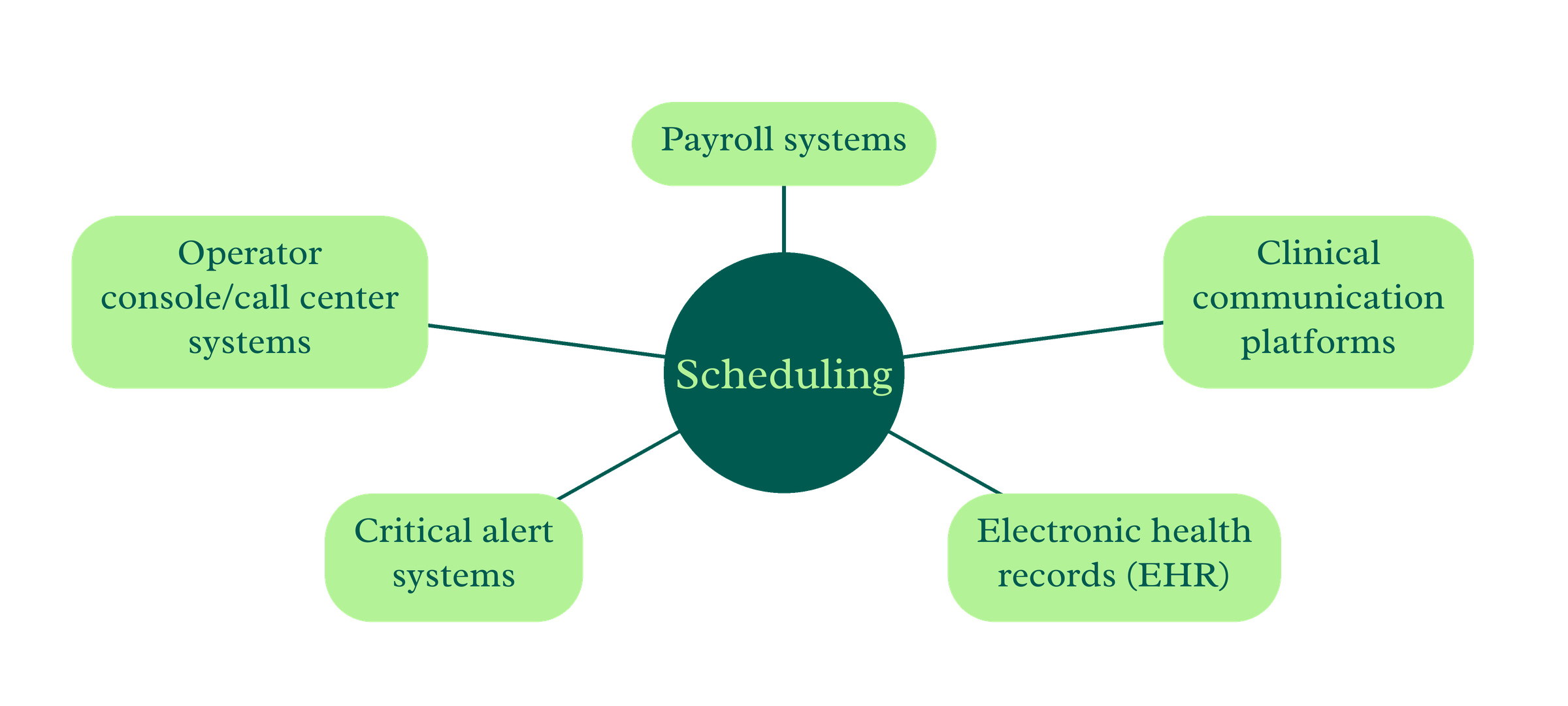
Leading healthcare organizations use scheduling as a connected part of their operational ecosystem rather than an isolated administrative tool. Here are a few healthcare system integrations to consider:
- Payroll Systems: Automating time tracking, overtime calculations, and compensation management to ensure accurate and timely provider payment
- Clinical Communication Platforms: Enabling real-time coordination between care team members and ensuring messages reach the right provider at the right time
- Electronic Health Records (EHR): Synchronizing provider availability with patient appointments and clinical workflows
- Critical Alert Systems: Routing urgent notifications to the appropriate on-call providers without creating alert fatigue
- Operator Console/Call Center Systems: Streamlining patient-provider communication and reducing response times
Partner with Clinical Workflow Experts
We all need customer support at times. It's an essential component to most tools and software we use today in health systems of all sizes. And it's essential for a reason—if a problem arises that the user can't solve, they're stuck.
The truth: customer support is only as good as the people providing the support service.
That begs a few questions:
- What makes a vendor good?
- What defines good customer support?
- What do health organizations need from vendor support teams?
No matter the solution or vendor, a strong partnership is essential for success. It's not just about having support when things go wrong—it's about continuously improving workflows to enhance patient care and staff operations.
That's why clinical support teams should be clinical workflow experts.
Healthcare leaders are solving the problem of subpar customer service by partnering with vendors who provide nothing less than white-glove service. These vendors have the right people behind their technology, people who have direct or near direct clinical experience and healthcare knowledge.
The top things health organizations want in an IT vendor are proactive ownership of client issues, the ability to achieve outcomes, quality of upgrade experiences, and a good roadmap experience.¹ Healthcare organizations should look for partners that offer:
Proactive Partnership
- Regular system health checks and performance optimization
- Customized training programs for new staff and system updates
- Quarterly strategic planning sessions to align technology with organizational goals
Comprehensive Support
- 24/7 availability for handling critical issues
- Quick response times for rapid resolution
- Specialized knowledge to support care team workflows
Specialized Healthcare Expertise
- Integration expertise for seamless connection with other solutions
- Training and resources for ongoing education
- Scalable solutions for organizations of all sizes
- Empathy and communication skills to support staff in high-stakes healthcare environments
For systems requiring enterprise-level support, dedicated customer support teams can help establish central governance and internal superusers to ensure rules and standards are followed even when support isn't immediately available.
Use Scheduling Data to Drive Better Decisions
Data-driven decision making has transformed scheduling from an administrative task into a strategic advantage. Data from within your schedule offers valuable insights that can optimize workflows throughout your system—from scheduling processes and resident management to care delivery, resource utilization, and staffing levels.
That said, many health systems don't utilize their scheduling data accurately. Organizations that actively use scheduling data can uncover opportunities to improve resource utilization, reduce inefficiencies, and support workforce planning.
Data utilization use cases include:
- Staffing optimization: Analyzing trends in patient volume to align staffing levels with patient demand
- Resource allocation: Ensuring the right specialists, equipment, and rooms are available when needed
- Predictive analytics: Identifying patterns to forecast busy periods to proactively adjust schedules
- Workload balance: Distribute shifts equitably to prevent burnout and improve physician satisfaction
Invest in Scheduling Solutions That Scale
Organizations will often purchase and implement a useful IT solution, but after a few years, the solution can't keep up with the number of patients a system is seeing or providers using the technology.
That's why professionals look for healthcare scheduling software that are scalable and can grow at the same pace as the organization.
No matter if it's a small practice or a multi-state enterprise system, scalability is essential to growth. While a solution may work for a health system today, will it accommodate system growth in the next year? The next five years? The next decade?
Scalable solutions allow a healthcare organization to:
- Utilize their existing, familiar technology year over year
- Avoid retraining admins and end users on new tools
- Cut costs by not having to buy new solutions every few years
- Adjust best practices to scale instead of starting over with new techniques
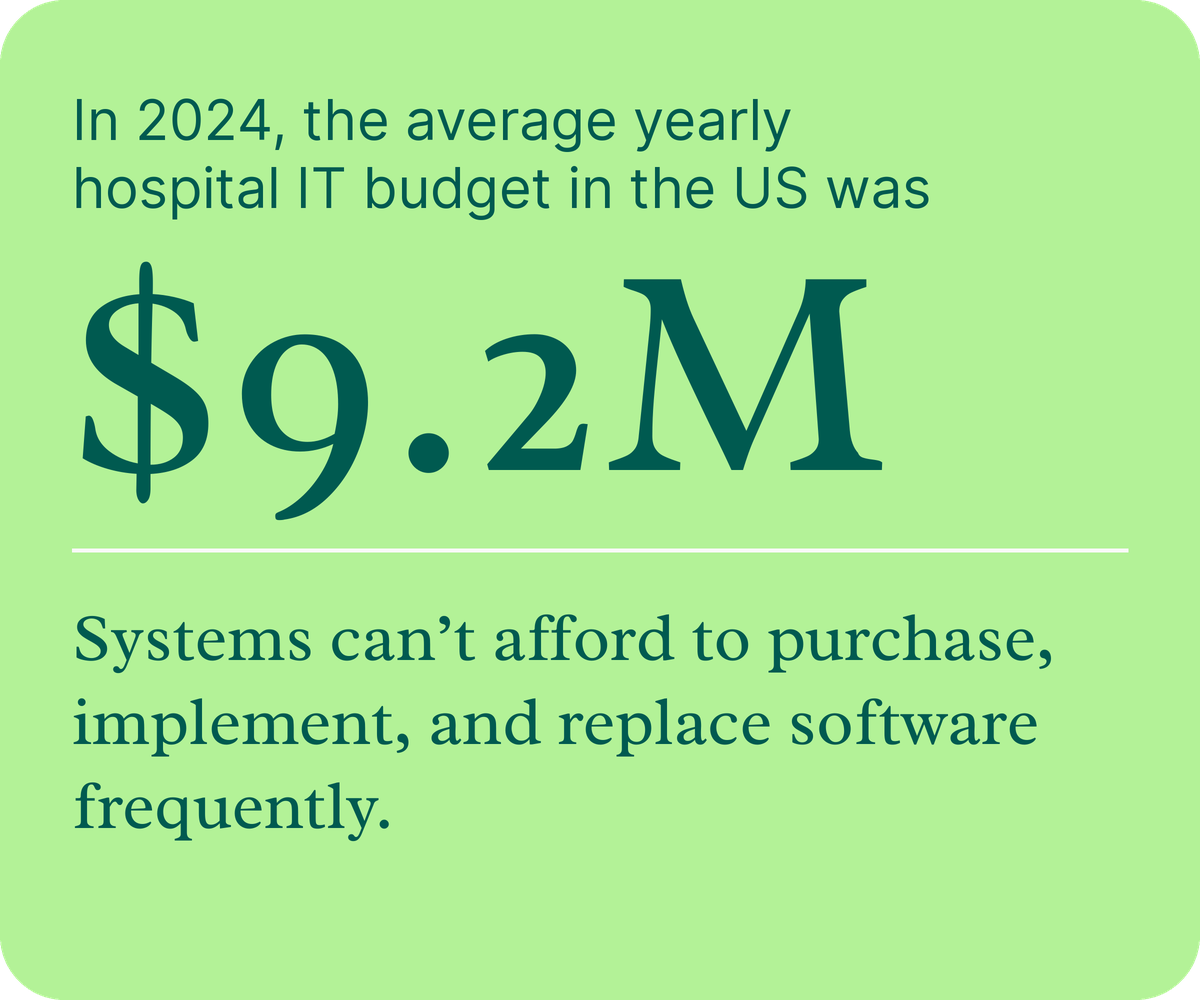
Financially, scalability cuts major costs in the healthcare setting. The average yearly IT budget for hospitals in the US was $9.2 million in 2024,² but imagine how much a system could save if they purchased one solution that lasted them a lifetime. With the average cost of purchasing and installing a new EHR ranging from $15,000 to $70,000 per provider,³ systems can't afford to purchase, implement, and replace software frequently.
The takeaway: Organizations need to consider the long-term scalability of the solutions they buy, no matter the IT use. Investing in scalable solutions from the start prevents the costly cycle of repeatedly upgrading to new software as your organization expands. Organizations should evaluate whether a scheduling solution can support both their current requirements and long-term growth plans.
Build a Stronger Scheduling Foundation
Effective provider scheduling requires more than simply filling shifts. Healthcare organizations need the right technology, connected workflows, actionable data, and scalable processes to support both providers and patients.
Organizations that invest in integrated scheduling systems, leverage scheduling data, and partner with healthcare-focused technology vendors are better positioned to improve efficiency, reduce administrative burden, and support long-term growth.
Looking for more practical scheduling guidance?
Download our comprehensive guide to physician scheduling best practices to learn how healthcare organizations can build fair schedules, improve communication, create flexibility, and use scheduling data to continuously improve operations.
See it working for real teams















Bring us the workflow that [hurts most]
We'll show you how it runs on PerfectServe, with your teams, your sites and your EHR.