





The Data On Physician Burnout and What To Do About It in 2027
Burnout is a hot topic in healthcare, and the data suggests we have a long way to go before we beat it. What can leaders do to combat burnout in 2027?

Two decades in healthcare can bring medical innovation that feels like a century’s worth of change. And yet, over that same period, we’ve made surprisingly little progress on one of its most persistent challenges: burnout.
It’s not for a lack of attention. Leaders have written about it, and studies have painted a picture filled with warnings that, in hindsight, make today's scale of burnout feel inevitable. In fact, the CDC found that 46% of healthcare workers reported burnout often or very often, while 44% said they were likely to look for a new job.
Meanwhile, additional pressures have intensified. Case in point: staffing shortages remain a challenge, with KLAS Research finding that 65% of nurses said staffing shortages contributed to burnout.
If the next 20 years are going to look different than the last 20, we need to reframe the conversation and address the root causes driving burnout.
Reframing the burnout conversation for good
For years, burnout remedies have revolved around a familiar protocol: increase salaries, offer counseling and other well-being “perks,” recruit aggressively to offset retention gaps and, according to one article from the early 2000s, simply “make time for yourself.”
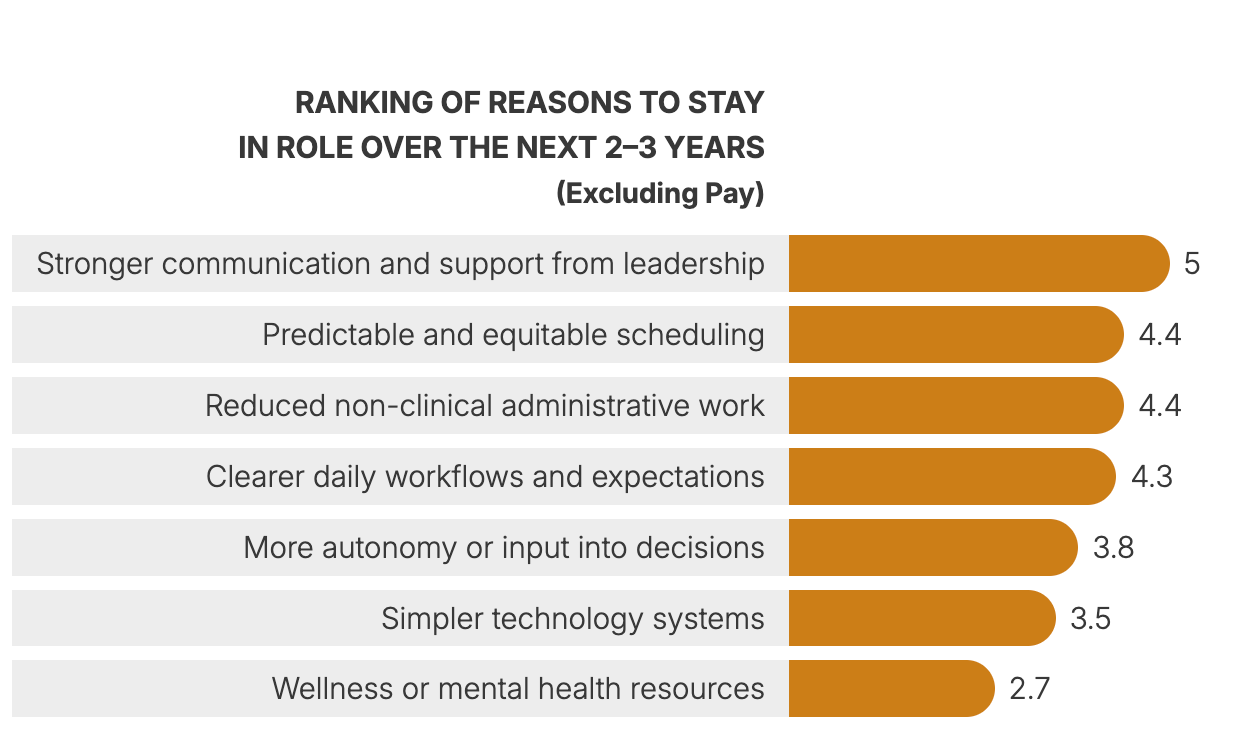
None of those approaches are inherently wrong, but they mostly focus on helping clinicians once the problem has already taken hold. Our survey of 343 clinicians, on the other hand, suggests that they’re looking for something more fundamental, including stronger communication and support from leadership, which ranked first, followed by predictable and equitable scheduling, and then less non-clinical administrative work.
“What clinicians are describing are symptoms of deeper operational issues: how schedules are built, how alerts are managed, and how communication flows during a shift,” said PerfectServe SVP of Client Services Miriam Halimi, JD, DNP, MBA, RN-BC. “To make a real impact on wellness, leaders have to strengthen these core systems. When operations run smoothly, care teams can focus on patients instead of fighting the process.”
Why clinicians say their schedules aren’t cutting it
When we asked clinicians about shortcomings in their current schedules, they identified several issues that explain why scheduling can become a meaningful contributor to burnout:
- They don’t account for patient census and acuity: Almost half of respondents said the scheduling process doesn’t account for how many patients they have or the level of care they require.
- Fatigue from prior shifts is overlooked: Almost four in 10 said the fatigue they carry from previous shifts isn’t considered when schedules are built.
- Life outside of work isn’t prioritized: A lack of recognition of personal commitments and time-off requests is another gap, cited by 33% of respondents.
- Continuity of patient care is lost in the process: About 32% said scheduling doesn’t account for patients’ ongoing needs, which can complicate transitions and make complex care harder to coordinate.
PerfectServe’s Chief Customer Officer & Chief Clinical Officer Kelly Conklin says the gaps are even more consequential as the work itself becomes more demanding. The reason, she says, stems from more care shifting into the home and through virtual visits, which means “more patients are coming into hospitals sicker than they were 10 years ago.”
That’s why Kelly is adamant that organizations must look beyond ratios. “It’s not just about coverage,” she explains. “It’s about patient load, acuity, and a perceived lack of sensitivity from administrators to the growing administrative burden.” For example, a nurse caring for 7 relatively stable patients can face a very different workload than one caring for 7 patients with complex or high-acuity needs.
When clinicians are repeatedly tired, stretched thin, frustrated, and unable to give life outside of work the time and attention it deserves, the question is when, not if, burnout will surface.
Why scheduling is a lever leaders should pull to tackle burnout
Unlike patient acuity and the size of the available workforce, scheduling gives leaders a defined set of decisions they can meaningfully change in the near term. This makes scheduling a useful place to start for a few reasons:
- Leaders can change it now: Scheduling involves inputs leaders can influence, like coverage allocation, accounting for clinician preferences, and workload distribution across their teams.
- It restores some control to clinicians: Allowing clinicians to have a say in their shifts, days off, and how their work aligns with personal commitments brings back a level of autonomy and predictability they told us they want.
- Leaders can measure whether the changes are working: The right scheduling technology can help leaders monitor improvements through custom reports, including shift fairness, staffing levels, resource utilization, and how well they’re accommodating clinician preferences, especially as those preferences evolve.
Another study also shows that the connection between control and burnout is impossible to ignore. According to the AMA and Mayo Clinic, 75% of health professionals who lacked control over their workload and schedules reported burnout, compared to just 39% among those who felt they had control.
This combination makes scheduling a practical lever. Although it won’t eliminate burnout, it offers a benefit leaders can’t pass up: a way to improve the work itself, strengthen operational wellness, and reduce some of the costly downstream effects.
The financial case for more flexible and equitable scheduling
More predictable, equitable schedules combined with greater autonomy can make the work more sustainable and help address one of burnout’s most expensive consequences: lack of retention. Clinicians told us clearly that equitable schedules are a key factor in whether they stay.
According to Ben Moore, Chief Innovation Officer at PerfectServe, that financial reality is driving the burnout conversation. “Health systems have really doubled down on reducing burnout and have made that a front-and-center issue,” he shares. “And it’s not necessarily altruistic, either: They’re doing it because if they don’t, then they lose those providers. And it costs about half a million dollars to replace a [single] provider.”
This creates a challenging cycle. Burnout can push clinicians to leave, and when they do, the clinicians who remain absorb the workload, which can contribute to another wave of stress and turnover.
But for leaders, the good news is that more predictable, fair scheduling gives them a useful lever. It’s the same lever Ochsner Health pulled to change its approach and improve both operations and the workplace experience. Overall, the department cut the time required to create and publish schedules by 79%, increased vacation-request approvals by 55%, and increased physician engagement by nearly 30%. Over time, the improved communication also helped them save $600K with better operating room handoffs.
Beyond the schedule: What else is contributing to burnout?
Scheduling may be one of the clearest places to start addressing burnout, but it’s hardly the only operational pressure weighing clinicians down. In fact, according to our survey, 96% of clinicians reported that they lost time for patient care due to systemic issues, which include:
- Communication friction: 87% of clinicians face at least one communication challenge during a shift, and 57% report that waiting for callbacks reduces time with patients. Kelly notes that an expanding tech stack is a significant factor, with clinicians now managing multiple (usually not well-integrated) platforms and devices, which often means more alerts, alarm fatigue, and extra systems to oversee.
- Administrative tasks: Documentation, managing schedules, and other non-clinical tasks consume a substantial amount of time. Kelly noted, “The number of clicks, time spent at a computer, and managing schedules all take away from what they want and love to do: patient care.”
- Lack of a feedback loop with leadership: Nearly two in five clinicians (39%) said leaders hadn’t asked for their feedback about operational tools or workflows in the previous 12 months, while another 22% said leaders had asked, but no meaningful action followed. The result is an environment where frontline clinicians have little say over the tools and workflows that create the most obvious friction contributing to their stress.
Now consider these factors alongside scheduling friction, and both the causes of and potential solutions to burnout come to light. “Clinicians see a direct correlation between the non-clinical work they’re asked to do and the amount of time they’re able to spend on patient safety and care,” shares Ben. “By addressing the white noise with operational wellness, excess admin work, delays in back-and-forth communication, and other common roadblocks, healthcare leaders can take better care of their clinicians and set them up to focus on the most urgent work affecting patient outcomes.”
Navigating burnout in 2027 starts with a step
We can’t eliminate every source of burnout. Patient acuity will remain unpredictable. Workforce shortages won’t disappear overnight. And some of the non-clinical work will remain a necessary part of the job.
But we do have a clear place to start: the operational pressures leaders can influence, including scheduling friction, communication failures, non-clinical tasks, fragmented and growing technology systems, and whether clinicians have a voice in workflow and system decisions.
That’s how we can change the trajectory of burnout and make sure the conversation over the next two decades is one of progress, not what-ifs.
Want a deeper look into what clinicians say is driving burnout and where healthcare organizations can make a difference? Download our Clinician Burnout Report today.
See it working for real teams












.jpg)
.png)







Bring us the workflow that [hurts most]
We'll show you how it runs on PerfectServe, with your teams, your sites and your EHR.