



How Patient Engagement Software Improves Outcomes and Reduces Costs
Establish a foundation for better patient engagement with these key steps.

How Patient Engagement Technology Improves Outcomes and Reduces Costs
Engaged patients have better outcomes.1 They show up to appointments, follow treatment plans, and even manage chronic conditions more proactively. But for healthcare providers who are already stretched thin, scaling a meaningful patient engagement program has never been easy.
Physicians, nurses, and other care team members are carrying heavier patient loads than ever, which means they have less time for the kind of face-to-face patient interaction that builds trust and drives care engagement. The gap between the care teams want to deliver and the time they have to deliver it is real, and it's growing.
Patient engagement technology can help to change that equation by making it possible to deliver personalized, timely communication to thousands of patients without adding extra burden to care teams.
Here's what physicians and care team leaders need to know.
Healthier Patients, Healthier Communities, Lower Costs
When patients stay engaged with their care, the downstream effects can be significant. Emergency department utilization drops. Readmissions decline. Preventable gaps in care close before they become costly.
Automated appointment reminders are one of the simplest, highest-impact tools available. For Ridgeview Rehab Specialties, automated text reminders — including scheduling details and location information — helped the organization reduce its no-show rate by 12.6% over two years, yielding more than $138,000 in recovered revenue.
The impact holds across patient demographics, regardless of age or socioeconomic background. If patients can text, they’re very likely to engage with SMS-based outreach.
Empowering Patients to Take an Active Role in Their Care
Consumerism in healthcare is driving many patients to be active participants in their care journey. Patient engagement platforms support that shift by keeping patients connected to their care team between appointments.
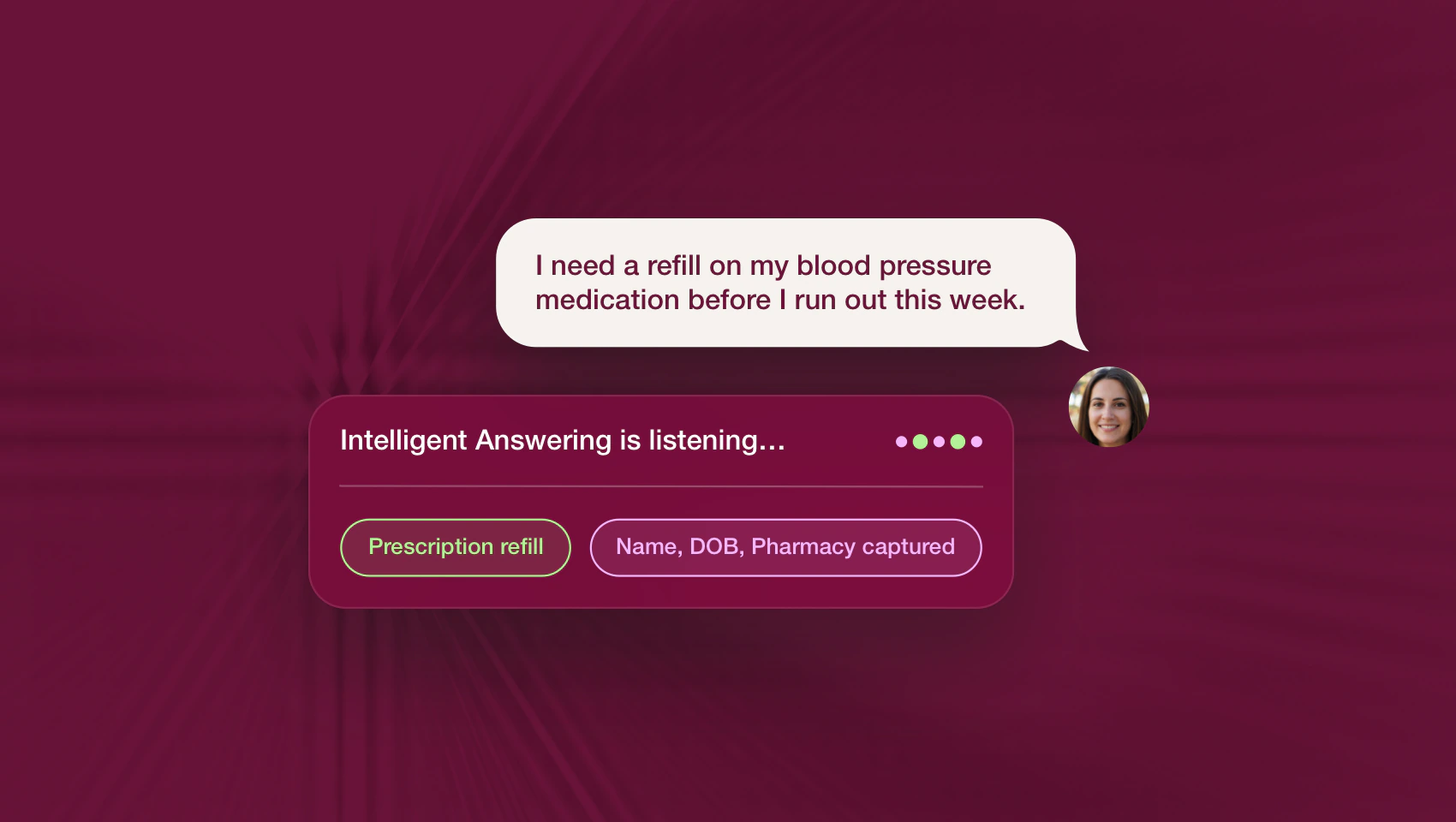
Automated provider-to-patient messaging can deliver questionnaires that track key health indicators, medication refill reminders, and condition-specific education, all without requiring manual outreach from clinical staff.
For patients managing chronic conditions, this kind of continuous touchpoint can be the difference between staying on track and falling through the gaps. A diabetic patient can receive automated prompts to log blood glucose readings between visits. A post-surgical patient can get a daily check-in that flags concerning symptoms before they become complications; if they report worsening pain, the software can alert a provider to follow up. A hypertensive patient can receive reminders to take their medication and track their blood pressure at home.
In each case, the care team stays informed without having to initiate every interaction, and the patient feels supported without requiring an appointment.
Helping Patients Retain Appointment Information
Exam rooms are high-stress environments. Research shows that patients forget 40–80% of what they're told during an appointment,2 and nearly half of what they do retain is incorrect. Studies spanning several decades consistently show that patients accurately recall only about half of recommendations given during visits, and the number drops further when stress or anxiety is a factor.3 That’s why follow-up is so important.
The format of follow-up communication matters too. Patients who receive narrated video content are significantly more likely to understand their condition and correctly answer questions about their care instructions than those who receive text alone, whether by text message or some other channel.2
Automated follow-up messages can close this care gap. Sending links to condition-specific resources, educational videos, care instructions, or medication guides gives patients something to reference on their own time, reinforcing what their care team told them without requiring a follow-up call. By making everything more convenient, you can really set patients up for success.
How to Build a Patient Engagement Strategy
Building a patient engagement strategy doesn't require starting from scratch. Most organizations already have communication touchpoints in place but need help assessing what's working, closing care gaps, and bringing everything together into one game plan.
Whether you're building from the ground up or consolidating existing tools, these four steps will help you establish a foundation in better patient engagement:
- Audit your current patient communication touchpoints and assess which are actually reaching patients.
- Identify consolidation opportunities—most organizations have fragmented solutions that could be unified into a single patient communication workflow.
- Determine the size of your reachable patient population (i.e., how many verified mobile numbers you have on file).
- Build a phased rollout plan across hospitals and affiliated clinics, including the awareness and adoption efforts needed to drive utilization.
What to Look for in a Patient Engagement Platform
Not all patient engagement tools are created equally, so as you evaluate solutions, these capabilities matter most:
- Multichannel communication without friction. The best platforms meet patients where they are via text, voice, or video, and without requiring them to download an app, create an account, or remember a password. 91.9% of patients agree that text updates helped them avoid calling the office.4
- HIPAA-compliant security. Any platform handling patient communication needs to protect privacy at every touchpoint, from encrypted messaging to masked provider phone numbers when clinicians reach out directly to patients.
- Automated outreach across the care journey. Look for a solution that can automate communication at every stage: pre-visit arrival instructions, appointment reminders, surgical status updates for family members, post-discharge care plan instructions, and follow-up status surveys. The broader the coverage, the less manual work falls on clinical staff.
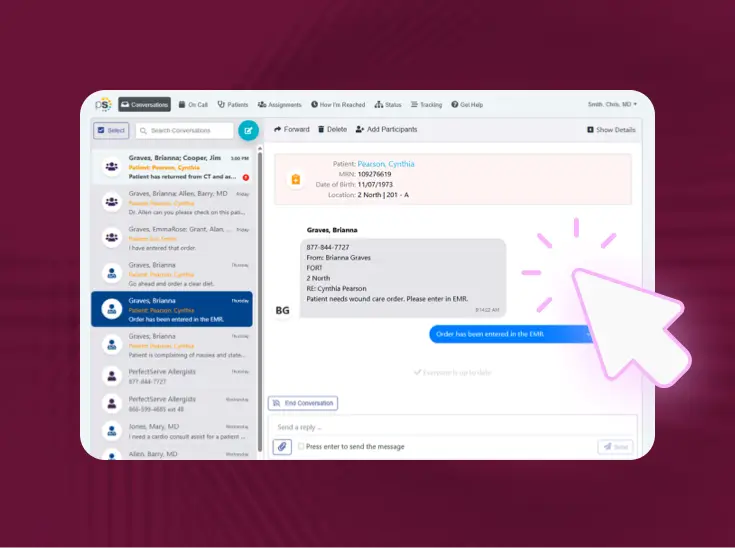
- Care team collaboration built in. Patient engagement doesn't happen in isolation. The strongest platforms connect patient-facing communication with internal care team workflows, like routing messages to the right on-call clinician, sharing images and patient information securely, and converting conversations into telehealth visits when needed.
- Readmission reduction tools. Timely follow-up after discharge is one of the highest-impact ways to reduce unnecessary ER visits and readmissions. Automated post-discharge check-ins that flag concerning responses for clinical review can make a measurable difference.
Ready to see what’s possible?
PerfectServe’s Patient Engagement solution is a proven, flexible, and secure platform built for the complexity of modern healthcare. It's live across thousands of care locations, facilitating millions of patient interactions every year.
Sources
- Patient Engagement, Health Affairs: https://www.healthaffairs.org/content/briefs/patient-engagement
- The Case for Using Visuals Along with the Teach-Back Method, Rendia: https://rendia.com/resources/insights/the-case-for-using-visuals-along-with-the-teach-back-method/
- Factors associated with patient recall of key information in ambulatory specialty care visits: Results of an innovative methodology, PLOS One: https://journals.plos.org/plosone/article?id=10.1371/journal.pone.0191940
- Evaluating the Utility of Using Text Messages to Communicate With Patients During the COVID-19 Pandemic, National Library of Medicine: https://pmc.ncbi.nlm.nih.gov/articles/PMC8208423/
See it working for real teams






.jpg)



.png)




Bring us the workflow that [hurts most]
We'll show you how it runs on PerfectServe, with your teams, your sites and your EHR.