




Benefits of AI Medical Answering for Medical Practices
Patient call expectations are evolving. How will AI step up to the plate?


AI Medical Answering Service Key Takeaways
- Inbound patient call management has evolved. AI is the next layer of intelligence, not a replacement for proven workflows.
- Conversational AI helps patients communicate naturally, reducing call abandonment and missed care opportunities.
- Intent-based routing gives providers better context, fewer unnecessary interruptions, and stronger after-hours protection.
- Practices gain visibility they’ve never had before. AI can transcribe and classify calls with full routing rationale included.
Every patient call starts with a need. Maybe it’s a prescription refill or a scheduling question. Sometimes it’s a symptom that feels urgent and needs attention.
Patients want simple: they want to explain what’s happening and feel confident they’re being guided to the right next step.
The thing is, practices need a way to manage those calls without overburdening providers. Many organizations use traditional answering services or Interactive Voice Response (IVR) systems to help practices manage growing call volumes.
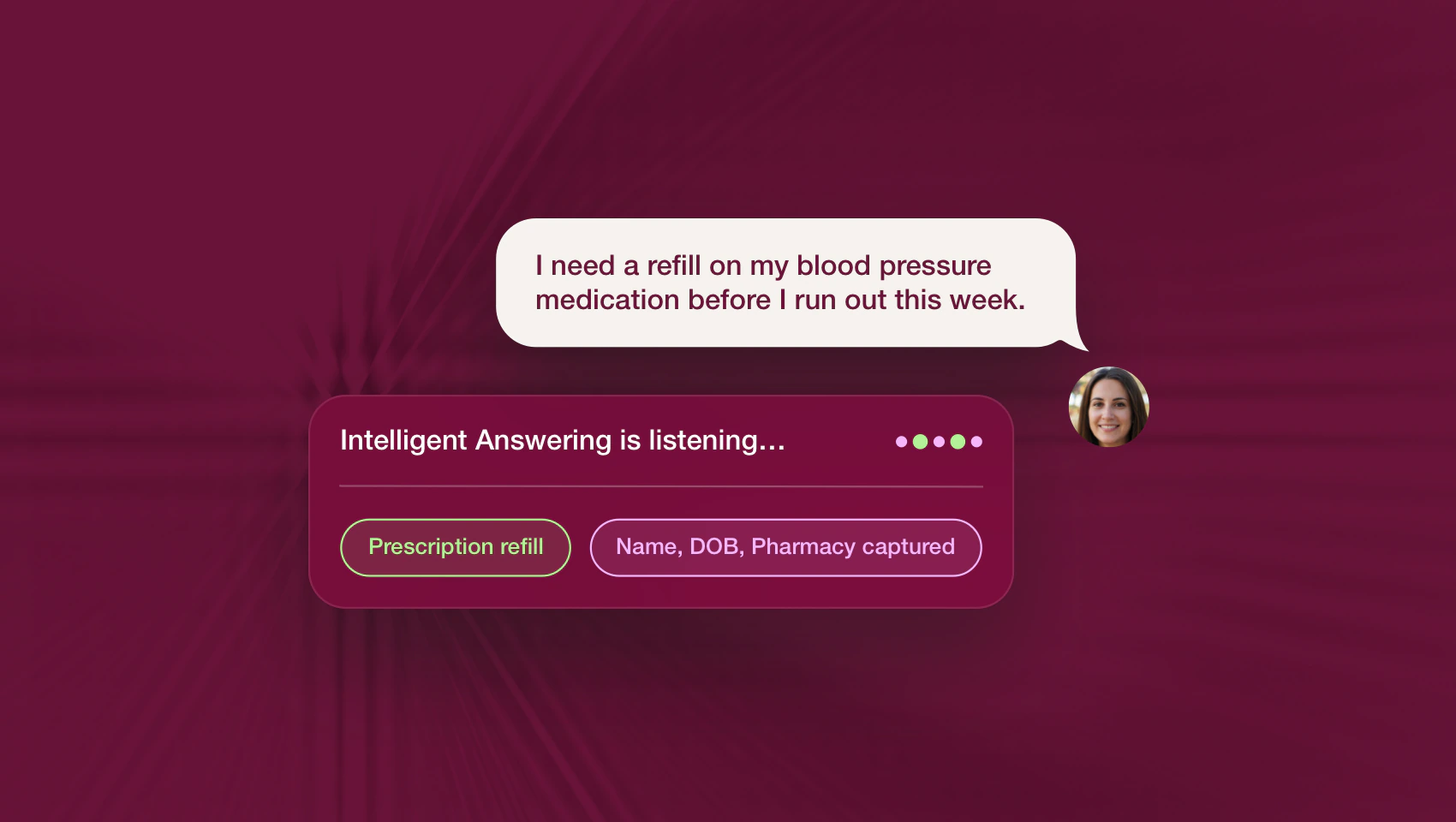
But patient expectations are evolving, and AI is stepping up to the plate to bring helpful and practical new functionality to these interactions. Instead of pushing numbers to direct a call, AI allows a patient to quickly and easily explain the reason they’re calling.
The question is, how exactly will this benefit patients and practices?
https://youtu.be/CBrBjNxtFc8
Why Patient Expectations are Changing
For most healthcare organizations today, call management systems are set up in a way that makes patients responsible for their own triage.
With these systems, a patient selects from options in a phone tree to get their call to the right place. And while the technology itself works, patients can get confused and may not always know how to categorize their needs. Maybe they’re anxious about medical concerns, unfamiliar with specialty distinctions, or are calling from a non-English-speaking household.
That process leaves the call burden on the patient, and the result is understandable: some callers abandon ship before reaching help, while others push the “urgent” menu option because it’s the simplest path to reach a live person.
At the end of the day, the patient just wants to relay their concerns and have them addressed as quickly as possible.

Why Practices Need to Embrace Call Management Change
When a patient pushes the “urgent” menu option in your voicemail tree, what happens to that call?
It's likely routed to an on-call provider who’s waiting to triage any symptoms the caller might have.
But when that caller just wants to refill a prescription or ask about their appointment at 11 PM, the on-call provider has taken a call that could have waited until morning.
This could also put a caller who does have a truly urgent need on hold.
That’s not a technology failure, because it's working as designed. It's actually an example of natural human behavior.
If this wasn’t a common occurrence, most organizations could shrug it off. Anecdotally, medical answering service managers and physicians often report that 60–80% of callers who say they need the on-call provider immediately are ultimately found to have issues that could safely wait until regular office hours.1
This burden doesn’t just impact the on-call provider taking the call. More often than not, call services can’t provide detailed data reports to produce a real record of what happened on the call, why the call was routed the way it was, or whether the issue was resolved. There’s no baseline to measure against and no infrastructure to build on.
That’s not a missing feature; it’s a design flaw. And up until now, few medical answering service solutions could reduce those burdens.
How AI Can Advance the Medical Answering Service
No matter how practices are managing their calls, the underlying needs are consistent:
- Patients have needs outside of business hours
- Practice managers want to limit misrouted calls
- Admins want better visibility into what’s happening on every shift
- On-call providers need accurate routing and protection from unnecessary interruptions
Enter conversational AI.
Whether a patient is calling about an urgent medical concern, a prescription refill, an appointment request, or something else entirely, AI can understand the intent behind the call and help guide the caller appropriately without requiring them to fit their needs into predefined options.
That shift alone has the potential to create a more intuitive experience for patients and a more efficient one for staff.
Rather than asking callers to navigate a menu, AI agents can just ... conduct a normal conversation. The caller describes what’s happening in their own words and in their own language. The system then routes that call based on what they mean, not which button they pressed.

For patients
Natural conversation in the caller’s preferred language reduces frustration and the likelihood of abandonment. There’s no menu to sift through, no selection errors to make, and no waiting for someone to pick up the phone to route you to the right place.
An AI agent can detect potential emergencies and immediately direct them to dial 911. Routine questions about hours, directions, and insurance are handled automatically.
This gets the patient’s call to the right place faster and reduces call burden for on-call staff.
For on-call providers
Because an AI agent can decipher intent and context to route calls accurately, providers can avoid those “urgent” calls that turn out to be routine in nature.
Instead, time-sensitive calls are simply routed to the right place, while non-urgent calls can either be handled by the AI agent entirely (e.g., a patient asking about office hours) or held until the next business day.
For practice managers and admin
An AI agent can instantly transcribe and classify every call with complete routing rationale.
This means there’s transparency that didn’t exist before: who called, why they called, where the call went, whether their need was resolved, and how long the call lasted.
Things like caller volume patterns inform staffing decisions, so a detailed breakdown can be essential to a practice’s ability to build an answering service that meets the needs of the population they serve.
Is AI Medical Answering Right for my Clinic?
No matter what you’re using to manage patient calls today, it's worth exploring what AI can do for your organization.
An AI medical answering service will benefit your organization if you experience any of the following issues:
- On-call providers are overwhelmed with call volume
- Patients frequently bypass the voicemail tree to speak to a person
- Patients abandon calls before their issue is resolved
- Calls are lost, dropped, or frequently routed to the wrong place
- Providers who are not on call are receiving patient calls or messages
- Patients express frustration with your current call workflows
- Call schedules are being built by hand and/or are constantly changing
- Admins have no way to track call volume, routing rationale, or other call data
Is AI Safe for the Medical Answering Service?
AI can meaningfully improve how calls are triaged and routed, but it isn't infallible. No practice should treat it as a perfect replacement for existing workflows and clinical judgment.
Conversational AI deployed in this medium is built to recognize language patterns, not to diagnose patients or make other clinical decisions. It can be equipped with a robust knowledge base to give it an impressive level of situational intelligence, but it can still miss context a trained provider would catch, especially with ambiguous symptoms or a caller who's struggling to clearly articulate what’s going on.
That's why the safest AI implementations are designed to be clear and honest, with escalation and redirect paths available when uncertainty creeps in. Safeguards must be put in place:
- The system should immediately identify itself as AI to remove ambiguity.
- If a true emergency is detected, callers should be instructed to hang up and dial 911.
- If the caller becomes confused or irritated, or if the system is struggling to make the correct choice, a fallback path should be available. The fallback can direct callers to a voicemail inbox, an IVR (phone menu) workflow, or even a live person.
The practices that will get the most value from an AI agent will treat the technology as a helpful triage layer with predetermined guardrails. To utilize AI in the safest way possible, your practice should take the aforementioned precautions while also performing ongoing reviews of call transcripts and routing decisions to make sure everything’s working correctly.
When deployed properly, AI can reduce noise, lower administrative burdens on staff, and get calls to the right place in a timelier fashion. Without safeguards in place, it can frustrate callers, make poor decisions, and cause more trouble than it alleviates.
Just like any other technology, AI should be implemented thoughtfully in a way that allows it to earn trust over time.
How to Use AI for Patient Call Management
For all the innovation in healthcare technology, the phone call remains one of the most common ways patients reach their provider, especially when they've got an urgent concern.
That isn’t going to change. When something’s amiss with your health, it’s human nature to look for the quickest way to connect with someone who can help.
What will change, though, is the way practices facilitate these connections.
AI agents will add a smarter conversation layer, intent-based routing, and detailed visibility that transforms a reactive call management process into something practices can actually learn from and build on.
And it can be done in a way that makes patients feel comfortable and like their concerns get addressed in a timely manner.
So the question isn’t necessarily whether the call experience with your answering service could be better. The more interesting question is: how can AI improve the call experience for your patients, providers, and admins alike?
For more about the growing role of AI in healthcare, check out Episode 1 of The Moore Report featuring PerfectServe Chief Innovation Officer Ben Moore.
Sources
- After Hours Answering Service (Thread), Reddit: https://shorturl.at/tl6EO
See it working for real teams










.jpg)
.png)






Bring us the workflow that [hurts most]
We'll show you how it runs on PerfectServe, with your teams, your sites and your EHR.