




Why Healthcare Scheduling Is Harder Than AI Thinks
AI can improve healthcare scheduling, but only when it’s built around the realities of clinical care. Effective scheduling requires balancing coverage, rules, and preferences, making human oversight and healthcare-specific optimization just as important as the AI itself.

AI can't transform healthcare scheduling unless it understands healthcare first.
A recent WIRED article should get the attention of every healthcare leader considering AI.
The story details concerns raised by nurses about an AI-powered scheduling system at HCA Healthcare:
- Nurses interviewed described schedules that conflicted with preferences and requested days off, stretches of consecutive shifts that led to exhaustion, concerns about the mix of experience on certain shifts, and significant effort required to fix problematic schedules.
- An HCA spokesperson told WIRED that nursing leaders retain final scheduling authority and that the system continues to be improved based on nurse feedback.
For those of us who build technology for healthcare, it's not a reason to sideline AI. It’s a chance to show what a difference it makes when you put in the effort to get it right.
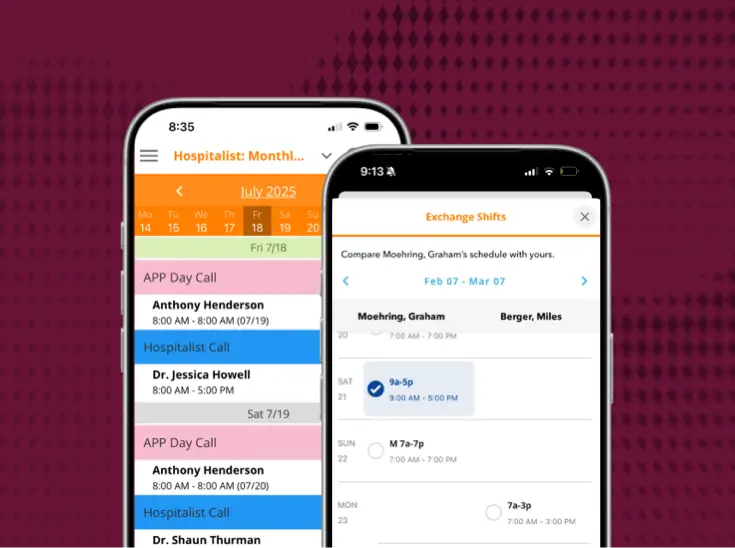
PerfectServe facilitates targeted nurse scheduling activity for some customers, but we don’t offer a fully-fledged nurse scheduling platform. Instead, Lightning Bolt focuses on scheduling physicians, other clinical teams, and even resources like rooms and equipment.
That experience means we've spent years tackling one of healthcare's deceptively difficult problems: building schedules that work both for provider organizations and the clinicians who take care of their patients.
One of the primary lessons we've learned is that a schedule isn't successful just because every shift has a name next to it.
For nurses, the schedule is more than just a schedule
Kelly Conklin, MSN, CENP, PerfectServe's Chief Customer Officer & Chief Clinical Officer, knows that from experience.
Before moving into healthcare IT, Kelly spent two decades as an emergency and trauma nurse and went on to hold a variety of health system leadership positions, including CNO, COO, and CEO.
Her perspective on stories like the one reported by WIRED starts with the environment nurses are already working in.
“When your workforce is already stretched, scheduling isn't an administrative detail. It has a direct impact on the experience of the people delivering care,” Kelly notes. “If technology makes schedules less predictable, creates more work for clinicians or administrators, or doesn't sufficiently account for the realities of the clinical environment, you're adding friction to a workforce that can least afford it.”
That is what makes healthcare scheduling different from employee scheduling in other industries.
Coverage always matters, because shifts need to be filled. But so do experience, qualifications, workload, continuity, nights, weekends, time off, individual preferences, and countless other operational realities that are unique to the clinical environment.
And behind every preference in a scheduling system is a real person who’s doing their best to balance work and life.
Those preferences aren’t just throwaway considerations. They represent things like childcare, doctor appointments, recovery following a difficult stretch of shifts, or simply the ability to know reliably where work stops and home life begins.
Organizations won't always be able to accommodate every request, but the consequences of ignoring those factors altogether can unsurprisingly be very human.
Not all AI solves problems the same way
Another lesson that can easily get lost in the enthusiasm surrounding AI is that it's not a standalone technology.
Ben Moore, PerfectServe's Chief Innovation Officer, leads product strategy and development and has spent his career building technology around healthcare workflows.
“One of the risks right now is treating ‘AI’ as though it describes a single approach. It doesn't,” he clarifies. “A large language model can be extraordinarily useful for problems involving language, context, and interaction. Scheduling is fundamentally different. It's a constraint and optimization problem. You may have hundreds or thousands of requirements and preferences that need to be evaluated simultaneously, and the resulting schedule has to respect the rules that matter to the organization without forgetting the needs of clinicians.”
Generative AI and LLMs have created lots of new possibilities for healthcare. But in this moment when moving fast seems to be the top priority, choosing a technology just because it’s the newest form of AI is different from choosing the technology best situated to solve your problem.
For complex clinical scheduling, organizations need to be able to define what “good” means for schedules:
- Who needs to be covered?
- What qualifications are needed for each shift?
- Which rules can't ever be “broken”?
- Which rules have some flexibility?
- How should nights, weekends, and the most difficult assignments be distributed?
- How should time-off requests and individual clinician preferences be weighed?
- What happens when some of these objectives are competing against each other?
The ability to work successfully through these questions should be built into the logic foundation of your scheduling solution.
The real intelligence starts with rules
Lightning Bolt uses AI-powered optimization to build physician and clinical team schedules around variables like coverage needs, provider rules, specialty requirements, individual preferences, and time off. Its algorithm (driven by combinatorial optimization) is designed to take all of these factors into account to create not just a complete schedule, but the most optimal schedule given available inputs.
That distinction matters because, to the average person, there may not be a version of the schedule that looks objectively correct.
Imagine two acceptable schedules. Each checks the necessary coverage box, and each complies with organizational requirements.
But one forces several clinicians into consecutive undesirable shifts, while another gives those assignments out more fairly.
Technology needs more than just data to “decide” which of these is better. It needs to know what the organization values and optimize accordingly.
“Sophistication is more than just generating the schedule,” says Ben.“You need to have an accurate view of the organization’s constraints, priorities, and tradeoffs, and the technology has to be able to weigh those things against one another to find the best possible solution. You need both intelligence and good inputs.”
That's also why humans will always be necessary for a process like this.
People make the rules. They understand the exceptions, they can recognize when circumstances have changed, and they understand clinical environments with a kind of nuance and intuition that can't be replaced by AI.
Don't optimize the humanity out of healthcare
For Kelly, that might be the bigger caution.
Nurses and other clinicians are already asked to put up with enormous amounts of operational friction.
When technology is implemented, the bar shouldn't just be a vague question like, “Did this save administrative hours somewhere?" Leaders should also ask what happens downstream:
- Does this make work more predictable for clinicians?
- Can admins more fairly accommodate clinician preferences now?
- If it’s related to scheduling, does the solution account for people, experience, and required capabilities for each shift?
- Can we explain why a shift looks the way it does if asked?
- What happens if the schedule gets something wrong? Can we pinpoint the issue to make sure it doesn’t happen again?
“Technology should give our clinical leaders better tools to exercise their judgment, not put more distance between them and the people they lead,” says Kelly.“Especially in nursing, where workforce challenges are so prevalent, we need technology that actually removes friction instead of solving one problem just to create another.”
"Don't use AI” isn’t the lesson
It would be easy to read stories like the one from Wired about problematic AI deployments and think that healthcare should tap the brakes.
That may be true in some cases, but here, the lesson is really that healthcare should be more deliberate. Especially with technology that uses AI, there should be a checklist:
- Ask what type of AI is being used and why.
- Understand the exact process the technology is supposed to improve.
- Determine how important variables (organizational rules, clinical requirements, clinician preferences) become part of the decision.
- Pressure test the outcomes. Every piece of technology will create an outcome, but is it a good outcome that meets your standards and helps your clinicians?
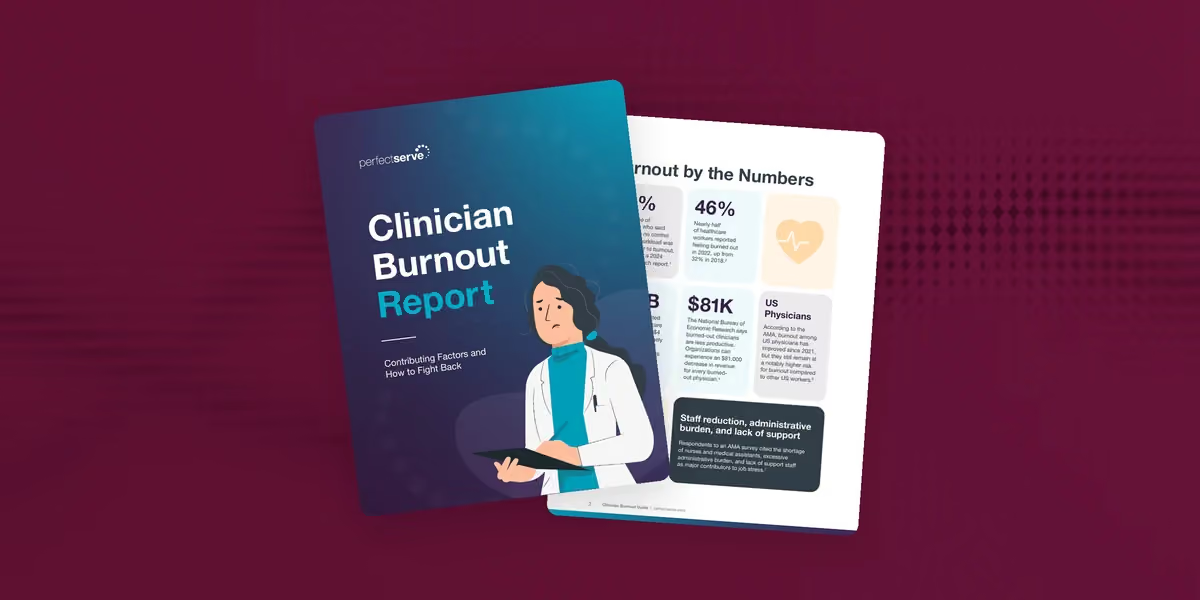
- Keep clinicians involved both before and after deployment. Nearly 40% of the 343 respondents to our clinician wellness survey indicated that leaders at their organizations don't ask for their feedback about operational tools & workflows, which is a fast track to eroding job satisfaction and disengagement.
The upside of AI done right is tantalizing. Lightning Bolt customers regularly report that its automated workflows drastically reduce manual scheduling work and create schedules that spread the workload around fairly without compromising patient care.
But adoption of AI, and technology in general, isn’t just about doing it to keep up with trends. The goal should always be tangibly improved outcomes, both for clinicians and the patients they treat.
For clinical scheduling, that means technology that can easily handle complexity without losing sight of the humans inside it.
That’s because, even when technology is generating the schedule, real people are still staffing every shift.
See it working for real teams




.jpg)





.png)






Bring us the workflow that [hurts most]
We'll show you how it runs on PerfectServe, with your teams, your sites and your EHR.