





How to Build a Fair On-Call Schedule: 5 Principles to Follow

Is it fair?
People have wrestled with this question for centuries. Aristotle even explored it, arguing that fairness and equity depend on circumstances.
Today, healthcare scheduling teams face their own version: What does fair on-call scheduling look like?
It depends, and often hinges on more than just handing out the same number of shifts, explains Tanner Vinson, PerfectServe’s RVP of Sales. “If two physicians have the same share of shifts in a year,” he says, “but one has half in June, they’ll feel like theirs is worse because it’s so concentrated in one period.”
In other words, equal doesn’t necessarily mean fair. While shift count matters, fairness also depends on the type of assignment, when it happens, how demanding it is, and even what prior assignments entailed. These details matter. In fact, according to our survey of nearly 350 clinicians, predictable, equitable scheduling ranked alongside leadership support and less administrative work as one of the biggest non-salary reasons they’d stay at their jobs.
So what do fair on-call schedules look like? And how can CNOs, COOs, and scheduling teams consistently build them?
What does “fair scheduling” actually mean?
The challenge starts with the word itself: What does fair mean?
Consider a different scenario from the one above: Two physicians each work a 12-hour weekend shift. One has a relatively light workload, while the other works over the holidays, when patient census and acuity are especially high. The hours are equal, but the burden isn’t. The same can be true for nurses working similar shifts but facing different patient loads or varying recovery time between shifts.
Those examples lie at the heart of fair scheduling. Clinicians can work the same number of shifts without carrying the same burden. This is why scheduling teams need to look beyond shift count and consider other factors, including:
- Shift desirability: nights, weekends, holidays, and overnights
- Workload: expected patient demand, census, acuity, and fatigue from earlier shifts
- Timing: consecutive shifts and the spacing between them
- Location: travel distance and high-demand sites
- Preferences and circumstances: eligibility, approved PTO, and contractual requirements
But “fair” isn’t just about the schedule. It also hinges on whether clinicians understand the process behind the decisions. As Katey Bailey, PerfectServe’s VP of Customer Success and Scheduling, explains, even a thoughtfully managed schedule can prompt questions such as: How many shifts am I working? Is that equitable? How does that compare to last month or to the rest of the year?
The problem is that maintaining that level of visibility and accounting for all the factors above is nearly impossible when scheduling still relies on manual processes.
Why manual scheduling struggles to stay fair
Despite years of innovation, scheduling remains surprisingly manual for most health systems. In fact, nearly three-fourths of clinicians in our survey said they deal with manual scheduling.
The consequences of that can take many forms. For Renee Loveless, a Medical Staff Coordinator for Medical Affairs, the biggest challenge was simply keeping everyone up to date. “Everything was on paper,” she says, “and it was difficult to get the latest updates out quickly.”
For other organizations, the challenge is the number of steps. “I saw one organization,” shares Ryer Hedderman, PerfectServe’s Regional Vice President of Sales, “track everything manually across 12 steps, including updating the system, sending an email, downloading a PDF, and sharing it on SharePoint.”
For a small practice or hospital, a manual process might be manageable, but as Tanner explains, once groups grow to 10, 20, 50, or 100 providers, teams naturally struggle to balance preferences, contracts, requirements, credentials, site assignments, coverage needs, and more.
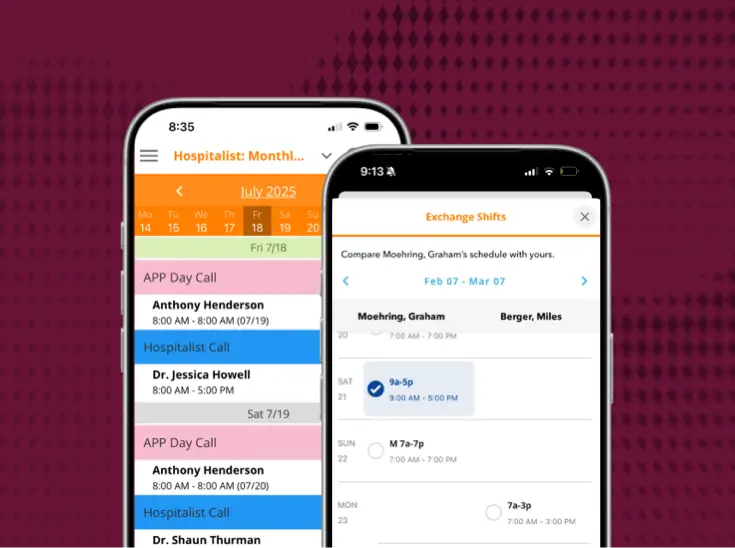
And that complexity doesn’t end when the schedule goes out. When clinicians call out, request time off, or swap shifts, it creates an avalanche of change, Tanner says.
Katey sees this play out, too. “If one clinician is out, you have to fill that gap and identify the best person to fill it,” she explains. The challenge? “Sometimes the best person has already worked their share of shifts or the shift doesn’t align with their preferences,” Katey says, which can lead to an imbalanced schedule and frustrated clinicians already teetering on the edge of burnout.
The 5 guiding principles of fair on-call schedules
Aristotle may have given us a useful way to think about fair schedules, but that doesn’t mean a universal formula exists. What we can do is turn to guiding principles that address the inequity and imbalance that make so many clinicians grow tired of weekly schedules.
1. Rank shifts by value and burden
That starts with recognizing, as Ryer puts it, that not all shifts are the same or equally desirable to clinicians.
A Friday night shift isn’t necessarily equivalent to a Tuesday day shift. A holiday assignment may carry a heavier burden than an ordinary weekday, while a shift with a light patient load can feel more demanding after an overnight shift.
So before organizations can distribute calls equitably, they need to rank them. For Tanner, that starts with a simple question: Which shifts do clinicians want to avoid? Tanner says that can vary by clinician. For example, he notes that some providers may willingly work Christmas in exchange for another holiday off. From there, they group assignments by factors such as nights, weekends, or patient demands and use those rankings to balance everything out across the group.
2. Equalize and space the burden
The next step is equalization, or fairly distributing shifts and specific assignments across clinicians over time. In other words, teams can use past assignments to guide future ones. For example, if one clinician takes an extra call in June, other team members can take extra call in other months.
Tanner points to one anesthesia group that applied equalization down to the level of individual assignment types. “They had rules and reports for Monday OB, Monday OR, Tuesday OB, Tuesday OR, and all of them had to be within an acceptable range.”
But an equalized schedule can still feel unfair if demanding shifts cluster. That’s where scheduling and spacing rules can help. In Lightning Bolt, organizations can make back-to-back night calls a high-priority rule that the system can never break, while adding a lower-priority rule that spaces night calls at least four nights apart when staffing allows.
3. Keep schedules fair as circumstances and preferences change
Even after teams equalize a schedule, circumstances and preferences can quickly shift the balance. “A schedule may start fair in January, but clinicians will trade shifts,” Ryer shares. “Someone might take a weekend in August in exchange for time off in February, but when they reach August, they wonder why they suddenly have three weekends on the schedule.”
That means scheduling has to account not only for the here-and-now but also for this variability, and to set guardrails so changes don’t quietly undermine the ranking, equalization, and spacing that made the schedules fair in the first place.
For Ryer, that makes a clear audit trail essential. “Sometimes the audit trail is hard to track if it's in email and Google Sheets,” he explains. By keeping a record of the original assignment and what changed, teams can see the full picture and use that perspective when making future assignments.
4. Balance fairness with operational requirements
Ranking and equalization can improve fairness, but organizations still have coverage requirements, contractual obligations, FTE commitments, credentialing restrictions, and patient needs to consider.
The result? Simply assigning someone who’s worked the fewest shifts isn’t always an option because that person may lack the credentials or eligibility for the site. Patient acuity or continuity may make another clinician the more appropriate choice.
Fairness has to work within that reality. Rules-based scheduling can help here, too, by treating requirements like credentials and coverage as firm constraints, then balancing other measures of burden, like weekends and nights, evenly across eligible clinicians.
5. Make fairness visible
Even when a schedule is fair on paper, clinicians need enough visibility to understand why. Without that transparency, Tanner says, comparisons between schedules can create unnecessary friction.
“If a clinician looks at their September schedule and thinks it’s unfair, then looks at someone else's and sees they have a great one, they may assume bias or favoritism was involved,” he explains. “Even if that’s not the case, it can cause friction.”
The solution is to make the logic behind the schedule easier to see and explain, which is only possible when teams document rules and assignment patterns and can point to the same criteria applied across the group.
As Ryer puts it, an administrator can say, “These are our rules, and there isn’t one that says you should get over 2 Mondays in October; you just happen to get 2 Mondays in October.”
What changes for patients and clinicians when schedules are fair
Katey gets to the heart of why this matters: “Nobody wants to work every Friday, Saturday, and Sunday, back to back, every month. It doesn't promote a healthy work-life balance, creates a burden and unnecessary stress that drags down patient outcomes.”
The problem is that spreadsheets, emails, and other manual processes make that balance hard to maintain, especially as schedules grow more complex and change over time.
With scheduling software like Lightning Bolt, organizations can build fairness into the system and deliver on three core principles:
- Equitability: Nights, weekends, and other desirable or demanding shifts are spread equitably, while still accounting for coverage and other clinical requirements.
- Visibility: Clinicians and administrators can see how teams build schedules and understand the rules behind them.
- Provider flexibility: Teams can accommodate preferences, PTO, swaps, and other changes without losing sight of how those adjustments affect overall work distribution.
For CNOs, COOs, and scheduling teams, the takeaway is simple: leaders can’t reduce fair on-call scheduling to shift count alone. Instead, they must account for the burden clinicians and nurses face, distribute it equitably, and provide enough flexibility and trust in their schedules.
At the end of the day, according to Katey, the goal is “to meet the requirements of the group, the needs of the patient, while also keeping the health and well-being of clinicians at the forefront of our schedules.
To see how your scheduling can become fairer and easier to manage, schedule a call with us today. We can walk through your current workflows and see if optimized, AI-backed schedules are right for your teams.
See it working for real teams






.jpg)





.png)






Bring us the workflow that [hurts most]
We'll show you how it runs on PerfectServe, with your teams, your sites and your EHR.