





How to Manage Complex Radiology Scheduling
Scheduling for radiology departments doesn't have to be a manual, arduous process. There are tools available to make the process easier, faster, more accurate, and more optimized.

Radiologists rarely work in just one place. They also rarely read one type of study. In fact, a single group might cover a handful of hospitals and imaging centers, staff several subspecialties, and blend in-person and remote reading, all while patient volume shifts every single day.
A spreadsheet, sticky note, or whiteboard can't hold all of that information, and it certainly makes tracking last-minute shift changes and swaps all the more unmanageable.
The truth is, manual scheduling was built for a simpler world: one scheduler, one set of rules, predictable coverage needs, and a few providers at one location.
That’s just not today’s reality. And while managing the complexities of radiology is demanding, there are tools available to make the process easier, faster, more accurate, and more optimized.
Let’s dive in.
What Radiology Schedules Have to Balance
Shift coverage is of the utmost importance. That sounds obvious, but it's essential to care delivery and to care team workflows.
However, there’s more to a good schedule than eliminating coverage gaps. Provider preferences and other competing constraints should be able to be managed and balanced:
- Subspecialty and credentialing match: Every provider can only be placed on assignments they're trained and credentialed for.
- FTE-based workload balancing: Call, weekend, and clinic shifts need to be distributed in proportion to each provider's FTE, not just split evenly with no regard for how much each person actually works.
- Spacing between taxing shifts: Back-to-back demanding shifts (think overnight call followed by a heavy reading day) can increase feelings of burnout if they aren't deliberately spaced out.
- Personal shift preferences: Some providers prefer working specific shifts, such as every other weekend or every evening Monday-Thursday. While these aren’t always guaranteed to happen, giving providers a sense of autonomy over their work schedules can make a huge difference in their satisfaction levels.4
- Individual reading-volume differences: Providers who are newer or work more slowly than their peers still need a schedule that accounts for that difference, rather than assuming every radiologist reads at the same pace.
- Holiday shift coverage: If one provider covered Thanksgiving and finds themselves also covering Christmas Eve and Christmas, they might start to feel like they’re bearing an uneven holiday coverage weight compared to their colleagues.
- Multi-site coverage. Every location and modality needs adequate coverage every day, without over- or under-staffing any single site.
When a scheduler tries to balance all of these by hand, something eventually breaks. Shifts won’t be optimized or equalized across teams simply because it’s nearly impossible to manage so many complexities without technology.
To make things worse, a scheduler might only find holes or mistakes after the schedule is published and providers have had time to review. And when they make one change, it leads to a cascade of other changes that are needed to try to ensure some semblance of a balanced, fair schedule.
Why Optimized Schedules Matter to Radiologists
Radiology is quickly becoming one of the most challenging and expensive specialties for physician recruitment.4 The Association of American Medical Colleges estimates a shortfall of nearly 42,000 radiologists by 2033.5
Data shows that most radiologists entering the job market today receive multiple offers before they've finished their search.6 Shortages are alarming, with the heaviest burden being in overnight and weekend coverage, as well as in smaller subspecialties like pediatric radiology and breast imaging.6
The scarcity of radiologist coverage comes at a high price tag. Research has shown that every month a physician position sits empty, an organization loses $150,000-$300,000 in downstream revenue.7 Recruitment typically costs $30k - $90k per provider depending on specialty,7 and it takes an average of 130 days to fill an open radiologist position.8 Not to mention, losing a radiologist to turnover can cost an organization anywhere from $400,000 to $600,000 to replace.9
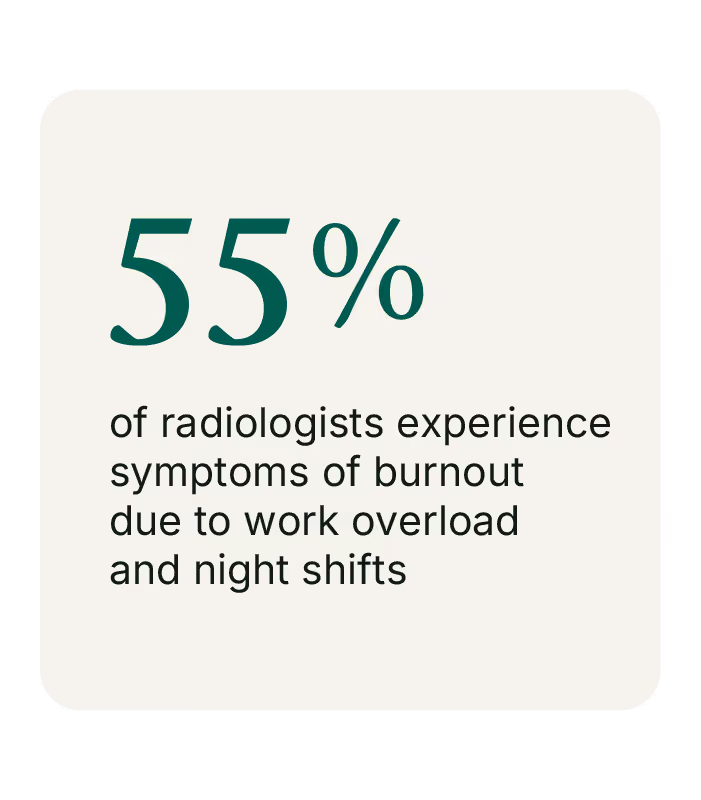
So, how does this tie into schedules? Because scheduling directly impacts provider satisfaction and is one of the keys to finding, hiring, and keeping radiologists happy. A 2023 study in the Journal of the American College of Radiology found that 55% of radiologists experience symptoms of burnout due to work overload and night shifts.10 Long working hours, irregular schedules, and limited or rigid scheduling have cited as being correlated with higher rates of burnout.11
Burnout is associated with poor patient care, medical errors and more negative outcomes ... You may also find lower patient satisfaction scores. Radiology leaders who are working to address burnout should recognize the problem as a patient care issue.”- Jay R. Parikh, MD, FACR. Professor of Diagnostic Radiology, MD Anderson Cancer Center
Making schedules more flexible is one of the top three ways physicians believe would help reduce burnout.12 That means building better schedules is no longer just an administrative task but a powerful recruitment and retention strategy.
How Automation Handles Radiology Schedule Complexity
Scheduling for radiology departments doesn't have to be a manual, arduous process. It might seem like the status quo, but hand-built schedules or weak scheduling software does not have to be a necessary evil.
Automated radiology schedule software is available, and it can take all of your pre-existing complexities, unique work requirements, provider requests, locations, and PTO into account. Intelligent scheduling software is much more efficient and cost-effective than manual builds. One large health system radiology department with 40-plus providers decreased the time they spent creating schedules by 75% using automated software.
But how does automation actually help with radiology scheduling complexity?
Optimized scheduling software pairs AI with a sophisticated algorithm called combinatorial optimization that considers every possible way a schedule could be arranged. Most importantly, it finds the schedule that best satisfies your organization’s needs.
Instead of tackling one variable at a time, it accounts for all of them together: every provider's credentials, their locations, their preferences, your organization's hours, and any other requirements specific to your group.
Pre-set rules are what keep the schedule in check. A provider can't work more than four days in a row. Dr. Kinker can't work the third Saturday of the month. Dr. Tyler can be scheduled at Park City and Davis Drive, but not at the neighboring hospital clinic. Dr. Caledon needs to be paired with a resident for the next four months. The algorithm weighs all of these at once and builds a complete, gapless schedule around them.
Something essential to truly optimized scheduling software is the ability to balance these rules. Not every rule carries the same weight, and that's where the AI does some of its most useful work. Some rules can never be broken, like credentialing requirements. Others can flex when coverage truly requires it, like a preference that Dr. McArdle not work weekends. The system understands the difference, so it protects what's non-negotiable while still finding a workable answer when a hard tradeoff comes up.
Every one of these rules and preferences is fully customizable to your organization, which means the kind of complexity that used to eat up hours of manual work can finally be automated away.
Connect with us here to see for yourself!
Real-World Impacts of Manual Scheduling Issues
Greenville, North Carolina-based Eastern Radiologists, LLC, was unsatisfied with their manual schedule-building process. The subspecialty radiology practice supports 18 locations, including six imaging centers and 12 hospitals, and manages a total of 61 provider schedules.
To build these complex schedules, they relied on an Excel spreadsheet. Eastern Radiologists had to build schedules that accounted for various organizational requirements, coverage for all specialties, fluctuating patient demand, and provider preferences.
In particular, they struggled to schedule a balanced number of “slow readers” (providers who are newer or tend to work slower than others) and faster readers. They faced other problems as well:
- Provider confusion based on incorrect schedules
- Some providers believed favoritism crept into the scheduling process
- Manual checks and edits were commonly needed
- There was no single source of truth for the schedule
- Manual Excel sheet formulas were often disrupted on accident
- Confusion about regional sites (what provider would be at which location) was common
- Multiple schedule versions were often being distributed, referenced, and accessed simultaneously
After switching to Lightning Bolt Scheduling, Eastern Radiologists implemented 385 unique schedule rules as part of a new automated scheduling process. This included a rule that only one slower reader could be scheduled at each location per shift. The automated process can also easily handle time-off requests, equitable shift distribution, and individual provider schedule preferences, such as preferred work days or the maximum number of consecutive shifts they’d like to work. This leads to schedules that better balance the needs of the organization with the needs (and wants) of providers.
Additionally, Eastern Radiologists are now able to download and analyze shift data to ensure equal distribution of work among all of their providers, including the ability to see who swapped shifts, who picked up shifts, and who may have dropped shifts or taken vacation time.
Lightning Bolt is able to generate this and many other reports to improve resource allocation and ensure workload equity. All of their implemented rules are now automatically considered to create the best possible schedule that meets organizational needs, accounts for provider preferences, and maximizes resources. You can watch an on-demand webinar featuring their Lightning Bolt experience here.
Contact us today to learn how you can ditch the manual work in favor of Lightning Bolt’s automated scheduling solution.
Physician Scheduling Best Practices for Radiology Groups
Radiology groups that get scheduling right tend to follow the same core practices, regardless of size or subspecialty mix:
- Match every assignment to subspecialty and credentialing. Don't rely on a scheduler's memory to know who's privileged where. Build credentialing and subspecialty training into the rules themselves, so a provider can never be placed on an assignment they aren't qualified for.
- Balance workload by FTE, not headcount. Split call, weekend, and holiday shifts in proportion to each provider's FTE. Two providers with different clinical commitments shouldn't be held to the same shift count.
- Build in recovery time between demanding shifts. Set minimum spacing rules between overnight call, heavy reading days, and back-to-back weekend coverage so fatigue doesn't compound across the schedule.
- Account for real differences in reading volume. Newer or slower-reading providers need a schedule that reflects their actual throughput — not one that assumes every radiologist reads at the same pace.
- Staff every site to its actual demand, not a flat default. Multi-site groups should size coverage per location based on patient volume and modality mix, rather than applying the same staffing pattern everywhere.
Groups that try to enforce all five manually usually manage two or three consistently before something slips—a mismatch, an uneven month of call, a site that's short-staffed on a busy day. That's the gap optimization software is built to close.
Taming the complexity of radiology subspecialties and multi-site staffing doesn’t have to be hard. There’s enough on an admin or provider’s plate already. See how Lightning Bolt's optimization engine can auto-generate a gapless schedule for your radiology group, built around your unique rules, requirements, and preferences.
See it working for real teams



















Bring us the workflow that [hurts most]
We'll show you how it runs on PerfectServe, with your teams, your sites and your EHR.