





What’s Causing Nurse Turnover, and How Can Hospitals Fix It?
The more nurses are burned out, the more they leave. What’s driving nurses toward burnout and turnover, and can hospitals do anything to address it?

It’s a nurse’s third night shift in three days, and the pressure is on. Alerts sound, call lights flicker, and messages ping from a pager and a separate shared device at the nurse’s station. Most of the notifications aren’t urgent, but each still demands the nurse’s attention, pulling her away from her patient’s bedside.
As the shift wears on, staffing shortages mean there are fewer nurses on the floor while higher-acuity patients require more care. Meanwhile, our nurse wastes valuable time tracking down the right provider who can handle a consult request. She then takes the time to forward a message meant for someone else that found its way to her inbox. She lets out a heavy sigh as she realizes she’ll have to finish some charts tonight after her shift ends.
And this is all before lunch. The cycle will repeat tomorrow, and then for her next shift. It repeats itself over and over for nurses all over the country, evident in the words of the nurses living it.

“The humanity I encounter is so beautiful, and I want to pour myself into their human experience,” said Niko Pantanizopoulos, RN, and a 2023 Nurse of Note. “But I can’t. I’d burn out by the end of the week, and then I’d be useless.”
His experience isn’t unique, as it reflects a challenge nurses face every shift: burnout. And though it’s become a bit of a buzzword, the CDC says more than half of nurses reported burnout in the past two years, and more than 60% said they felt overwhelmed.
For CNOs, nurse managers, and other hospital leaders, those statistics are troubling on their own, but they also raise an equally impactful challenge: retention. Simply put, when nurses are burned out, more will leave. In fact, a 2025 AMN Healthcare survey indicated that 61% of nurses said they were considering leaving their current role.
All of this raises a question with financial, operational, and human consequences: what’s driving nurses toward burnout and turnover, and can hospitals do anything to address it?
Exploring the causes of nurse turnover
“It seems like we’re nursing the computers more than the patients,” shared David Trout, a Clinical Nurse Educator at the University of Tennessee Medical Center.
Here, David strikes at the heart of nurse burnout and turnover. The more time nurses spend away from the work that brought them into the profession, especially work that feels unnecessary, inefficient, or unfair, the more demanding, frustrating, and unsustainable the job becomes.
For CNOs and nurse managers, reversing that trend starts with understanding where that avoidable friction lives. In many cases, the pressure traces back to poorly built schedules, heavy workloads, and fragmented communication:
- The schedule: Long shifts, overnight hours, and staffing pressure make schedules particularly consequential in healthcare. At the same time, staffing models don’t always account for factors such as patient acuity, workload, or fatigue, which often create schedules that look balanced on paper, but are anything but on the floor.
- The overload: Staffing shortages only add to the pressure, with 65% of nurses citing them as a driver of burnout. But the workload doesn’t shrink when the staffing does. Instead, it falls on the nurses who are there, which can mean higher patient-nurse ratios, fewer opportunities for breaks, delayed responses, and more non-nursing tasks falling into their laps. It can also compound safety concerns where nurses are managing higher-acuity patients while also navigating the far-too-present threat of workplace violence.
- The communication drag: Then there’s the communication burden, which remains fragmented despite years of investment in healthcare technology. According to a time and motion study, nurses spend 34% of their time just managing communication, from tracking down providers and responding to alerts to following up on messages and navigating different communication systems.
According to PerfectServe’s Chief Customer Officer & Chief Clinical Officer Kelly Conklin, compounding all three is a broader shift in patient care and acuity. “Patients are remaining in their homes as long as they can, receiving virtual care, provider visits, and in-home care,” she shared. With more handoffs, communication and administrative tasks become more complex for practitioners.
That evolution has real benefits, but it also means patients are arriving to hospitals sicker, which naturally adds more pressure to schedules, workloads, and communication systems.

Real stories from the nurses on the frontline
The data above show the impact of nurse burnout and turnover, but the nurses feel those friction points much more personally, with heavier assignments, less support, and less time for the patients they came into the profession to serve.
For Madison Poon, an RN in the NICU at Cincinnati Children’s Hospital Medical Center and a winner of the Nurses of Note Patient-Centered Care Excellence Award, the strain on nurses shows up in workload and a lack of support. “I hear a lot of nurses talk about how quickly burnout and mental health issues can arise,” she shared, pointing to the pressures of high patient loads and feeling underpaid. “There are so many amazing nurses who are great at the bedside, but they don’t have any resources to prevent burnout.”
And for Audrey Joseph, an infusion nurse at an outpatient cancer clinic, staffing pressures mean fewer nurses on the floor, but they also influence the work nurses have to absorb. “When we don’t have enough Certified Nursing Assistants (CNAs), unit coordinators, and transporters, those tasks fall on us,” she said. Her biggest question gets to the consequence: “How do they expect us to provide great and safe patient care?”
These experiences show the pressure nurses are under today, but they also underscore what nurse leaders are ultimately trying to protect: a profession people still want to join and stay in.
As fellow Nurses of Note honoree Sulane Knight put it, “I want the younger generation to know that it’s worth it.” But for that to happen, hospitals must first address the challenges that make nursing more stressful than it needs to be.
The operational cure to nurse burnout and turnover
Imagine a brand-new nurse training you. Now imagine that happening in an environment as high-stakes as nursing.
That was one of the challenges Kari Treadway, BSN, RN, RNC-NIC, noticed at UW Health Northern Illinois, where preceptor assignments varied, and relatively new nurses were tasked with guiding new hires.
Rather than accepting the status quo, Kari partnered with another nurse to develop a more structured orientation program that paired new nurses with the same designated preceptors for the first eight weeks, which ultimately created a more consistent and supportive foundation.
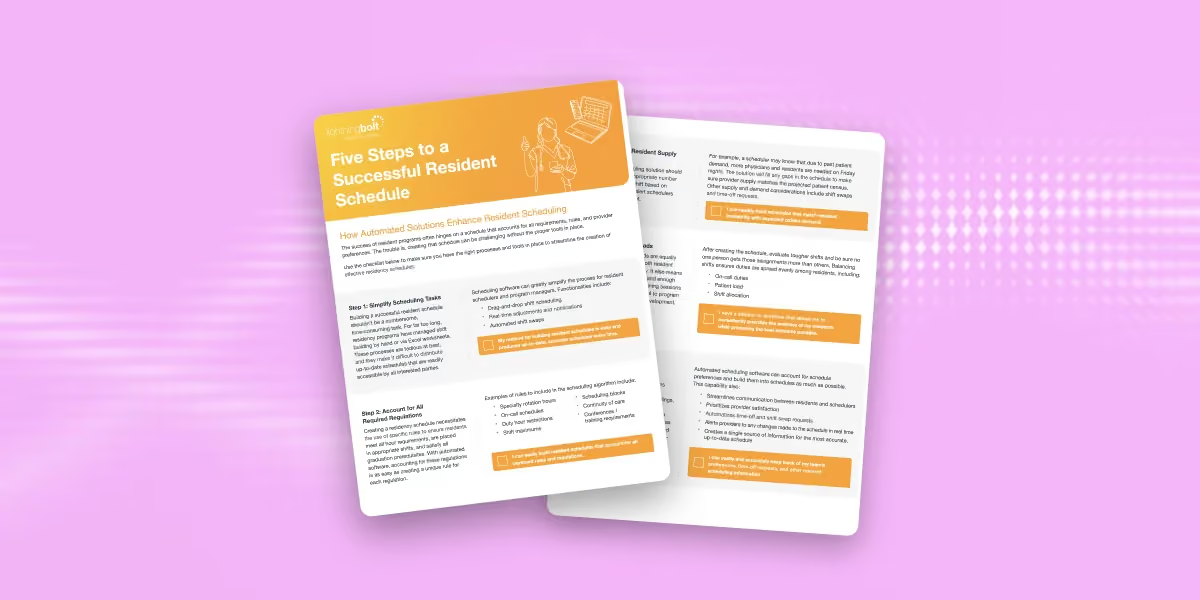
Make schedules fair, predictable, and demand-based
With more than 6 in ten nurses citing staffing shortages as a contributor to burnout and 85% of clinicians identifying at least one workload balance issue, schedules are one of the clearest ways to reduce the unnecessary strain.
In practice, that means:
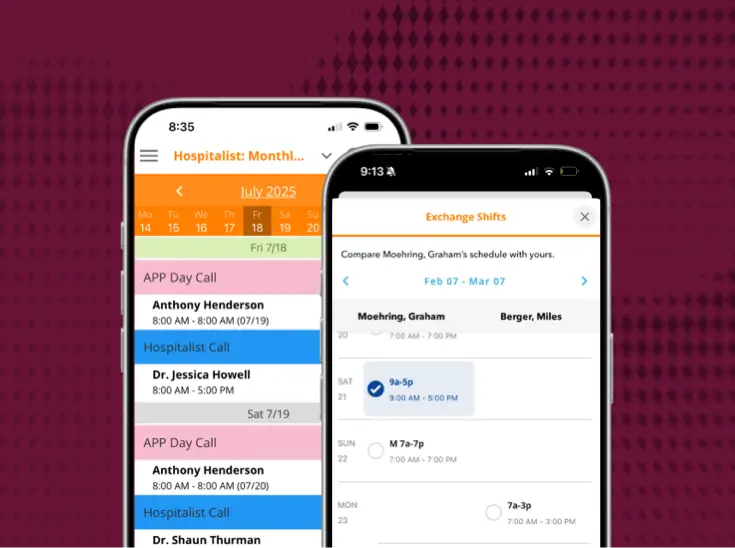
- Giving nurses more control: Build nurse preferences, availability, and personal commitments into scheduling processes whenever possible.
- Accounting for the workload: Factor in patient acuity, census, fatigue, and continuity-of-care decisions so schedules reflect shift demands.
- Distributing the work fairly: Equalize nights, weekends, holidays, and other “less desirable” shifts so the same nurses aren’t repeatedly carrying an unfairly heavy load.
- Making schedules predictable: Give nurses enough visibility into upcoming shifts so they can plan the rest of their lives around them.
It can also impact retention, too, with PerfectServe’s clinician wellness report finding that predictable and equitable scheduling ranks as the second-most important non-salary reason clinicians choose to stay.
Lighten the communication load
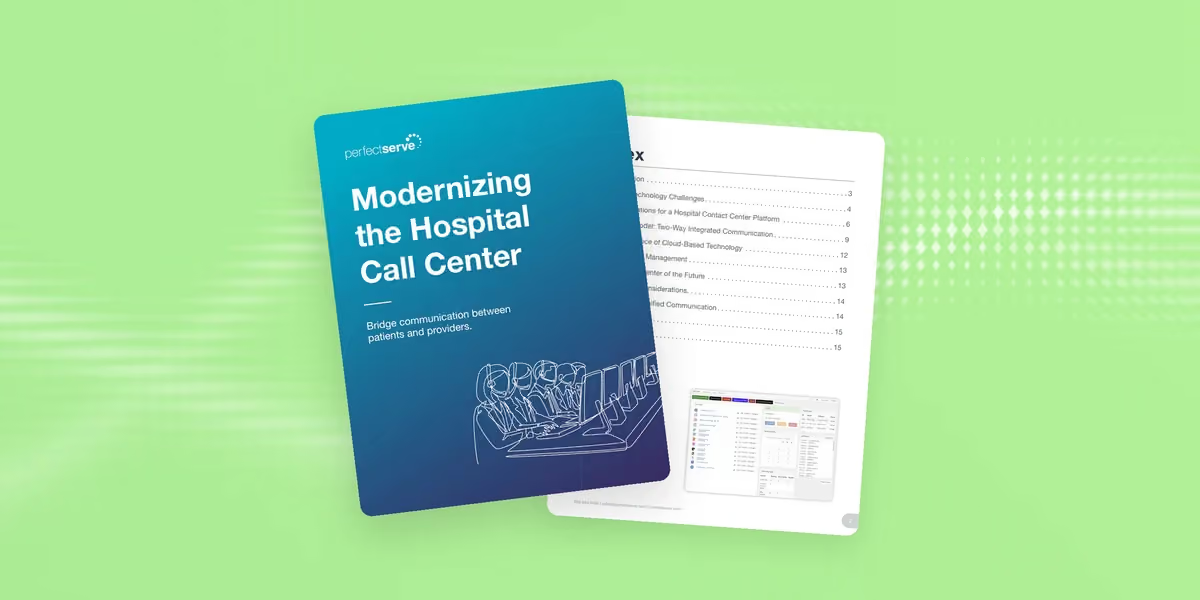
Scheduling alone won’t solve burnout and turnover. Nurse leaders also need to address the communication workflows that complicate shifts, slow response times, and make it harder to reach the right person when it matters most.
To fix that, hospital leaders should look to:
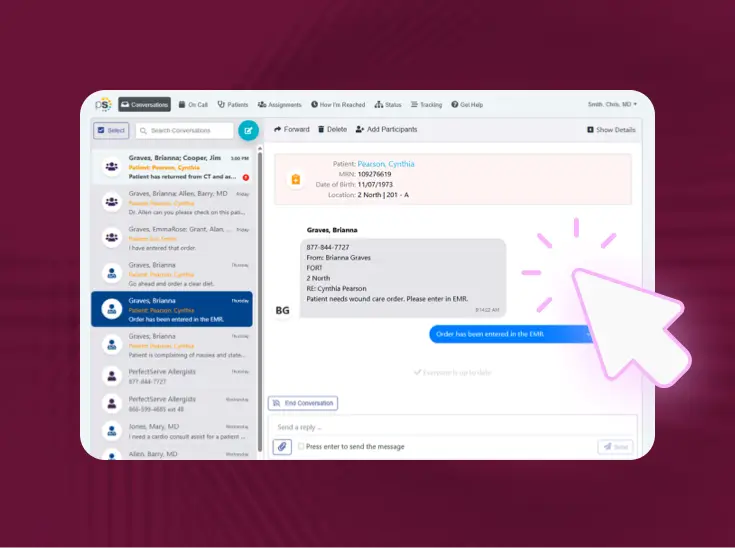
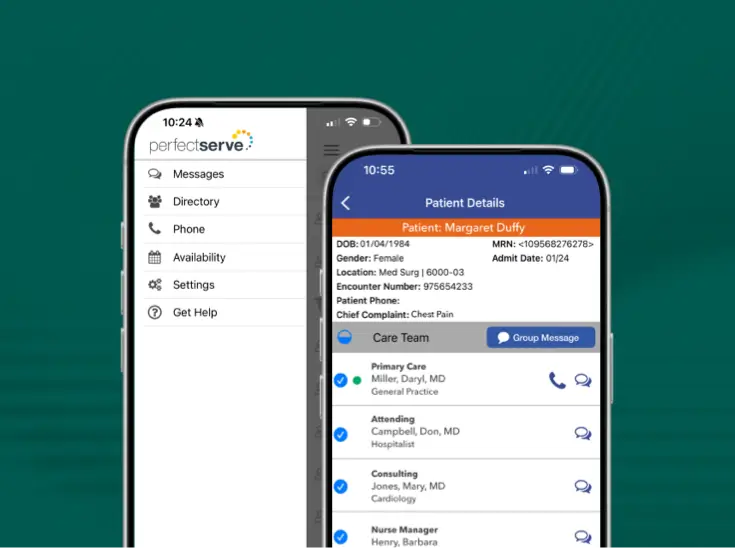
- Reduce pathways: Consolidate alerts, messages, and pages into a single inbox; integrate existing systems where possible; and make communication accessible at the bedside so nurses aren’t constantly moving between locations and systems.
- Address alarm fatigue: Prioritize critical alerts, standardize them where possible, and route non-urgent requests appropriately to reduce unnecessary noise.
- Improve communication workflows: Make it easier to see who’s on call, confirm whether messages were delivered or read, and automatically escalate unanswered messages when necessary.
Importantly, none of these changes should be designed in isolation. Whether hospitals start with communication or scheduling, nurses need a seat at the table. As Amy Staly, Director of Healthcare Product Strategy at Clearsense put it, “ I'd like to see more nurses at the decision tables driving policy, technology, and the intuition that we need behind it to deliver that care.”
Reducing nurse burnout and turnover starts with fixing the work itself
Barbara Carson, another Nurses of Note winner and nurse manager at East Jefferson General Hospital in Metairie, Louisiana, put the challenge succinctly: “The further we move from the nurses caring for the patients, the less we truly know what’s happening daily.”
That’s at the root of everything: unnecessary operational friction pulls nurses away from care and makes an already demanding job unnecessarily more difficult.
The good news is that acting on those challenges can create real change. Sam Rover, BSN, RN, CNOR, is a great example of improving communication at Newton-Wellesley. After noticing their paging system wasn’t optimized to connect anesthesia technicians with anesthesiologists throughout the hospital, Sam partnered with the hospital’s digital communications director to move those pages to a different system that created a streamlined form of communication.
The changes worked. During one overnight code on the med-surg floor, an anesthesia technician received a message and quickly responded with supplies. The anesthesiologist later told the team that the technician’s presence may have helped secure the patient’s airway faster and prevent aspiration.
There’s a financial case for reducing this friction, too. Every nurse who leaves because of this stress and inefficiency effectively restarts the recruiting cycle, which bleeds into onboarding, orientation, lost productivity, and even more staffing pressure.
Operational challenges create friction and unnecessary stress and push nurses toward the door, but they also create opportunities. For CNOs, nurse managers, and other hospital leaders, it’s time to fundamentally change the way nurses work, starting with scheduling and communication friction. Only then can hospitals reduce some of the pressures driving nurses toward burnout and, increasingly, out of the profession altogether.
Ready to take a deeper look at what drives nurse burnout and turnover and what healthcare systems can do about it? Read our Nurse Retention Guide.
See it working for real teams






.jpg)




.png)






Bring us the workflow that [hurts most]
We'll show you how it runs on PerfectServe, with your teams, your sites and your EHR.