





Operating Room Management: Scheduling and OR Efficiency
Managing an OR isn’t a simple task. An efficient OR depends on far more than just filling up the room and getting cases in and out on time. Can Automated scheduling help?

Operating rooms (ORs) account for roughly 60% of a hospital’s revenue,1 but they also represent the largest hospital cost category.2 As a result, effective operating room management has a huge impact on the financial stability of your hospital.

Managing an OR isn’t a simple task. An efficient OR depends on far more than just filling up the room and getting cases in and out on time. A truly optimized OR succeeds when the schedules of all parties are aligned, including anesthesia teams, surgeons, nurses, and the patient’s case itself.
Despite the need for all of these components to align, many operating room managers lack the technology needed to strategically and efficiently manage OR utilization. Schedules conflict, cases go long, and rooms stay empty. This isn’t a challenge that’s easy to tackle by hand, or even with basic technology.
So we’ll ask this: how is your OR schedule built and managed? If you’re doing things by hand, there’s an easier way.
How to Improve OR Management
Many hospitals focus on “on-time first case starts” as a marker for how well their OR is running. A well-functioning OR sees the first operation beginning on time with no delays, and the rest following suit.
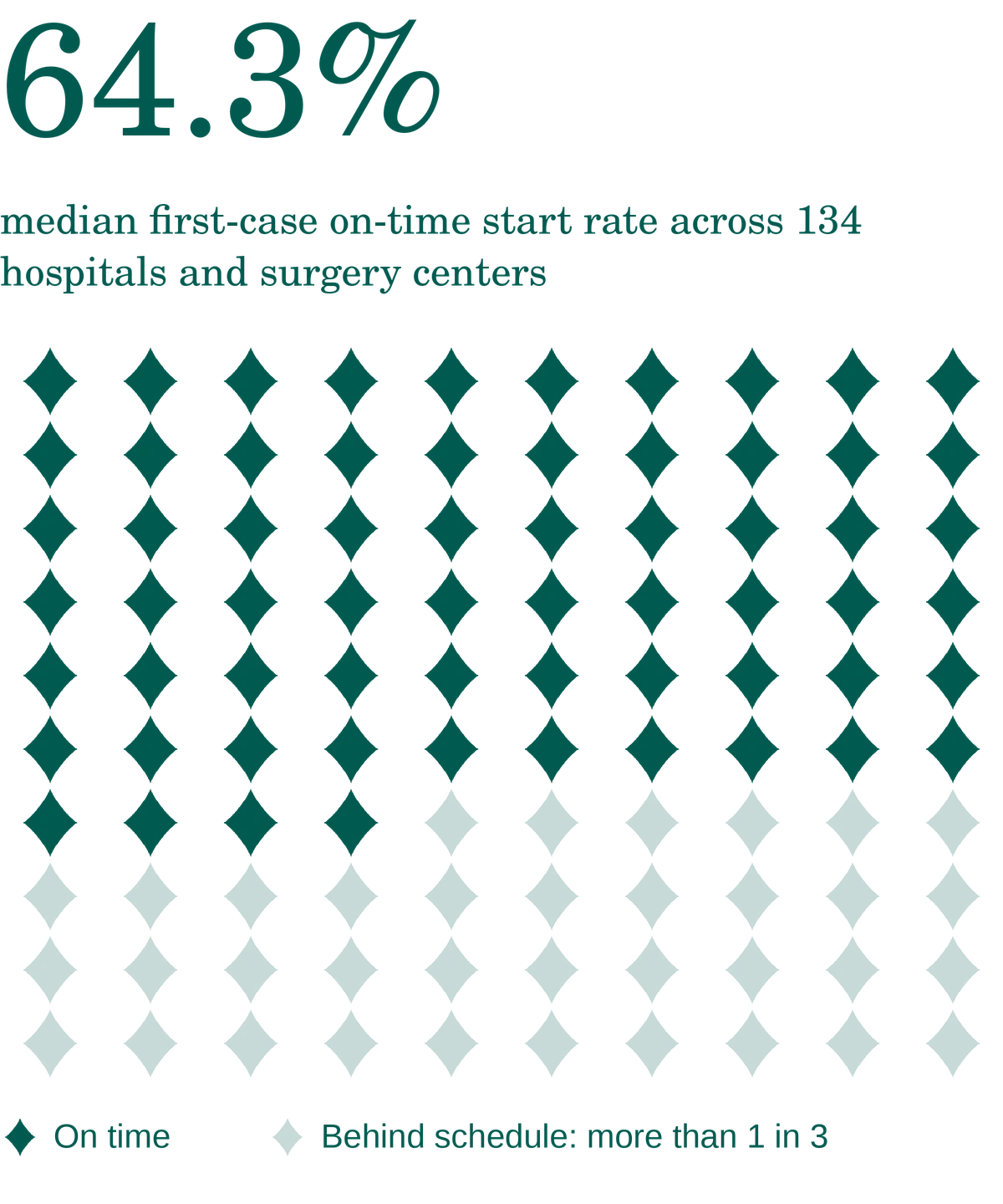
According to the OR Benchmark Collaborative, the median first-case on-time start rate across 134 hospitals and surgery centers was just 64.3%, meaning more than 1 in 3 operating rooms begin the day behind schedule.3 Because delays in the first case often cascade throughout the day, improving scheduling accuracy and OR readiness can have a big impact on throughput, staff utilization, overtime costs, and patient satisfaction.4
For the leader looking to improve those on-time start rates, the essential first step is to streamline the process that gets patients, surgeons, and equipment to the operating table on time. To do that, you need to evaluate how your teams and cases are scheduled, and then decide if an automated tool could help manage your team more efficiently.
How Automated Scheduling Improves Manual Processes
The Impact of Bad Schedules on the OR
Hundreds of scheduling tools exists, but they are not created equally. And before you even evaluate your current process or consider a new tool, you need to understand the implications of how improper scheduling impacts your bottom line.
Because operating rooms generate up to 60% of a hospital’s revenue,5 once labor hours, supplies, equipment, and other costs are considered, the cost of one minute of OR time can range from $50 to $150.4 6Even the slightest delay can have significant cost implications. Here’s an example:
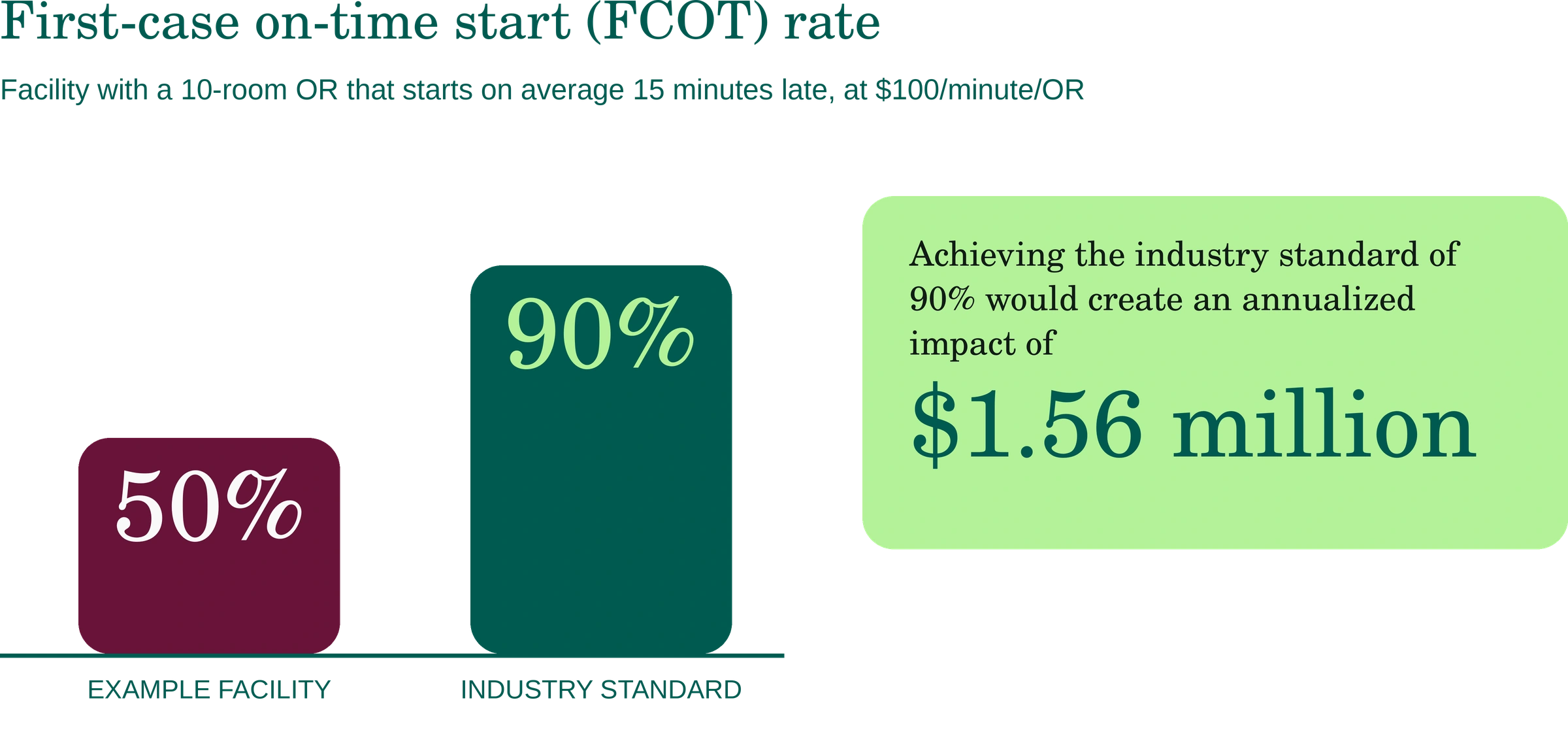
“High-performing organizations strive for a FCOT rate of 90% or greater, and falling below the industry standard of 90% can have significant cost implications. Consider, for example, a facility that has a 50% FCOT rate for a 10-room OR that starts on average 15 minutes late. Achieving the industry standard of 90% would create an annualized impact of $1.56 million at $100/minute/OR.”4
Outside of cost, delayed or canceled cases due to scheduling errors are deeply frustrating for providers and patients. According to an OR staff perception study, incorrectly scheduled procedures were among the highest-impact causes of surgical delays.6 Researchers identified scheduling and communication improvements as key opportunities to reduce inefficiencies. In another hospital study, up to 21.5% of surgical cases were delayed each month, contributing to staff dissatisfaction, patient frustration, and increased operating room costs.7
Assigning Providers to OR Cases
One of the biggest challenges for OR managers are case assignments, where providers from multiple departments, such as anesthesia, come together for one case. It’s typically one manager or provider managing these schedules, and daily OR assignments require multiple variables to be considered at the same time, like provider availability, OR room use, CRNA supervision requirements, case timing, etc.
By the time the scheduler builds a month-long schedule that has somehow aligned every department to every case with each variable above, something has changed. One small change to one part of the schedule affects several other assignments almost immediately.
Done manually, the process is time-consuming and frustrating to say the least. It can also heavily depend heavily on induvial knowledge, handwritten notes, and tracking down old emails. This can create coverage gaps when the scheduler can’t work the schedule out perfectly, or someone has to call out and no backup provider can be called in time.
Automating the process solves the frustration and coverage problems. Automation can see and consider all of the variables that each case depends on across multiple days, weeks, and months at a time. By allowing a technology solution to automate case assignments, the scheduler no longer has to worry about the utilization of staff, rooms, equipment, and time.
How Automation Boosts Schedule Compliance
Automation isn’t just above saving time and boosting efficiency. It can also help enforce scheduling rules by accounting for important parameters that can’t be treated as an after thoughts.
For example, anesthesia assignments need to account for rules beyond provider availability and room assignment. Post-call rest, provider credentials, supervision, and other rules matter to each and every case at an individual level.
Manual processes require schedulers to remember or manually verify all of these requirements, and ultimately lead to gaps in care or holes in coverage. Provider scheduling software can incorporate these rules automatically and weigh their importance, creating a more consistent process that reduces reliance on a scheduler’s memory or manually checking notes.
This boils down to a key take away: compliance rules should be built into the scheduling process from the beginning, not added into a schedule after the fact.

Four Ways Automated Scheduling Improves OR Efficiency
1. Grants teams real-time schedule visibility
Without proper scheduling technology, clinical teams can have trouble accessing the latest schedule and keeping it up to date. As schedules are updated, different versions of the schedule can linger and create confusion for both clinicians and administrators.
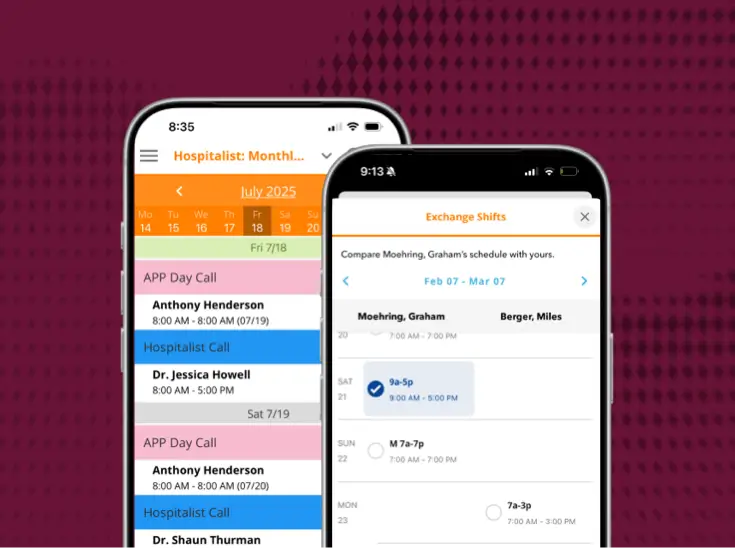
An automated provider scheduling platform increases schedule access by making real-time schedules available on any device 24/7. Hospitals and health systems that deploy a single digital scheduling solution across the enterprise can further streamline operating room management and efficiency by giving OR managers, directors, and others one place to see schedules for all clinical staff moving in and out of the OR.
2. Automate provider case assignments

Internal data suggests that each specialty department in a hospital spends roughly 291 hours building and managing shift schedules. Much of that work is delegated to physicians and clinical leaders who know the ins and outs of their departments’ schedules.
Automating the schedule-building process with a rules-based scheduling solution frees physicians’ time so they can get back to revenue-generating patient care.
3. Reduce manual handoffs and OR delays
A schedule becomes a tool for resource optimization when organizations can analyze and compare historical staffing patterns and create future schedules that align staffing with patient demand. The result? Efficient use of capital resources and more productive, satisfied staff.
Prescriptive analytics can give organizations insight into patterns of provider supply and patient demand on a daily, weekly, monthly, or seasonal basis. Supply and demand patterns help leadership optimally allocate resources as needed for certain surgical services, allowing organizations to cut waste, increase patient access, and avoid patient leakage.
4. Provides better data to optimize resources
The right scheduling tool can provide the proper utilization metrics to set benchmarks for improving operating room management and efficiency. With real-time visibility into OR availability, turnover times, and openings, users can best schedule providers and surgical teams directly into specific operating rooms.
The ROI of Automating OR Case Assignment
At Ochsner Health, automating provider scheduling reduced schedule creation time by 79%, saving roughly 720 hours annually. The organization also increased vacation approvals by 55%, improved physician engagement by nearly 30%, and generated approximately $600,000 in annual savings.
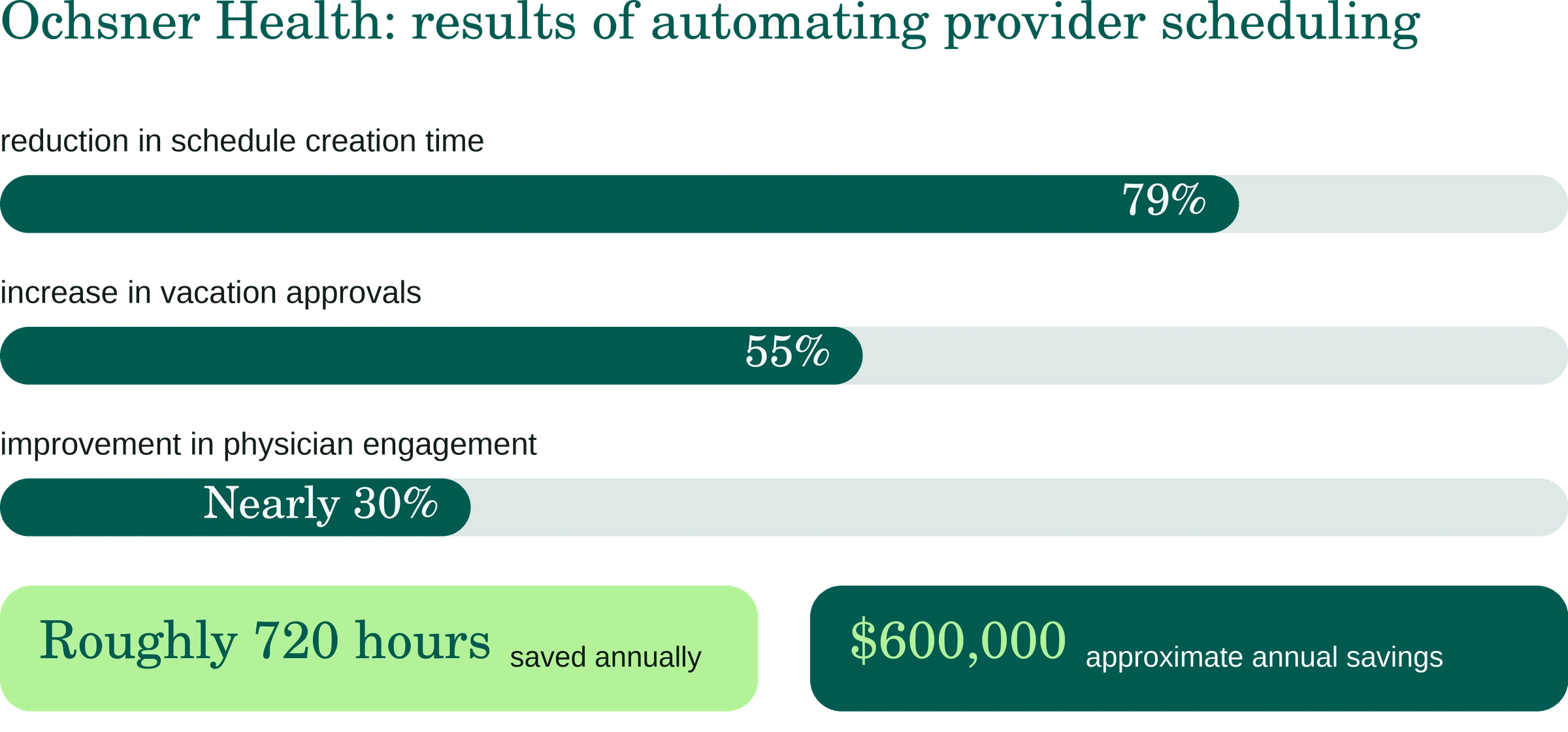
These results highlight an important point: the value of automated case assignment extends beyond administrative efficiency. By aligning provider availability, scheduling rules, and case assignments in a single workflow, hospitals can reduce manual work, improve provider satisfaction, and create a more efficient operating room environment.
The Result of Better Operating Room Schedule Management
Implementing the right provider scheduling and operating room management system can help hospitals and health systems holistically address OR efficiency. An advanced solution will also arm clinical and operational leaders with the data they need to track progress and set benchmarks for success.
With better OR scheduling and case management workflows, your hospital can see an overall increase in revenue, utilization, and provider and patient satisfaction. We’d be happy to take a look at your current workflows and see where automation might offer improvements for your hospital today. Schedule a demo here.
See it working for real teams




















Bring us the workflow that [hurts most]
We'll show you how it runs on PerfectServe, with your teams, your sites and your EHR.