





3 Scheduling Changes That Reduce Clinician Burnout
Most clinician burnout programs target the clinicians themselves, but to meaningfully improve clinician well-being, healthcare leaders need to look at the underlying systems that make burnout inevitable.

Most clinician burnout programs target the clinicians themselves. But resilience training, wellness apps, and clinician stipends treat the symptoms of burnout without addressing the cause. To meaningfully improve clinician well-being, healthcare leaders need to look at the underlying systems that make burnout inevitable.
For example, scheduling issues play an outsized role in clinician burnout. In our 2025 clinician survey, over half (56%) of nurses and practitioners said they experience regular spikes in demand or frequently feel overwhelmed and under-resourced. Excluding pay, predictable and equitable scheduling ranked as the second-highest reason clinicians said they'd stay in their roles over the next few years. By comparison, only 15% said they felt their schedule was well-balanced.

With nearly three decades of experience working with healthcare organizations, we’ve seen what works for clinician scheduling. These are three key changes that will make a radical difference for both your operational efficiency and your clinicians’ well-being.
Change 1: Build for visible scheduling equity
Improving healthcare scheduling isn’t easy, of course. Candace Capps, a former healthcare administrator, likens it to “playing chess”: “You're trying to build a perfect schedule that includes your organizational needs and [providers’] individual preferences, which is hard to do.”
Handling scheduling manually, or with an Excel spreadsheet, makes that chess game far harder. Yet nearly three quarters of clinicians (72%) deal with at least some manual scheduling.
Creating schedules by hand means that every shift change can cause a cascade of unintended consequences, explains Katey Bailey, VP of Provider Scheduling at PerfectServe. For instance, a scheduler may manually fill a scheduling gap by assigning it to the next available practitioner, without realizing “they've already taken their kind of allotment of shifts for that particular time period.” Then it’s back to square one.
A truly equitable scheduling system builds fairness in as a rule, rather than simply hoping for the best. This goes beyond contractual requirements, Katey explains. For instance, schedulers should make sure that practitioners aren’t constantly working weekends, or working back-to-back overnight shifts.
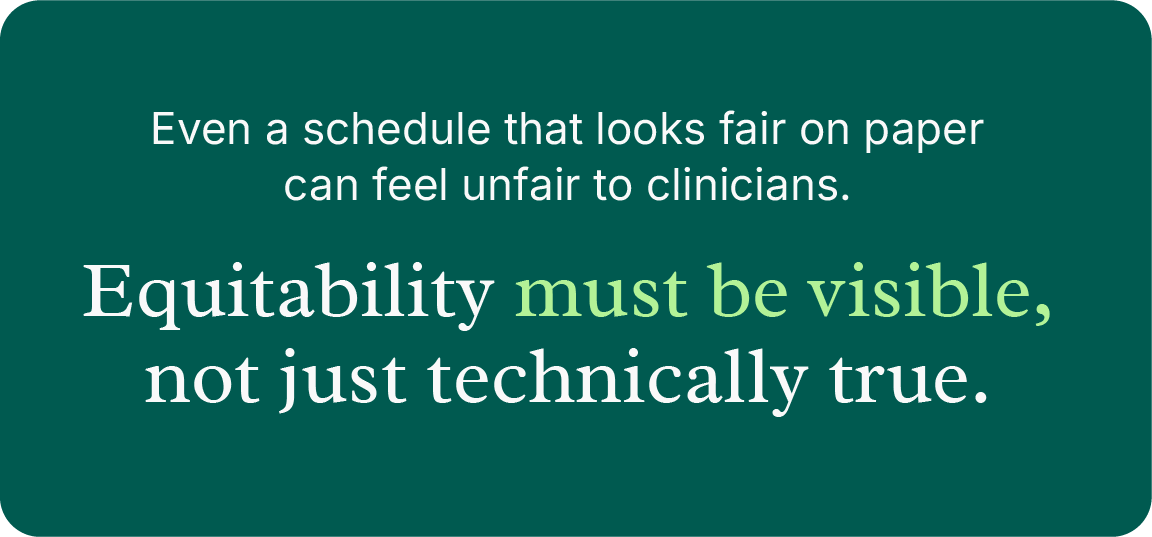
Even a schedule that looks fair on paper can feel unfair to clinicians. Equitability must be visible, not just technically true. Clinicians want to know that rules apply to everyone, and that weekend work (to take one example) is distributed fairly.
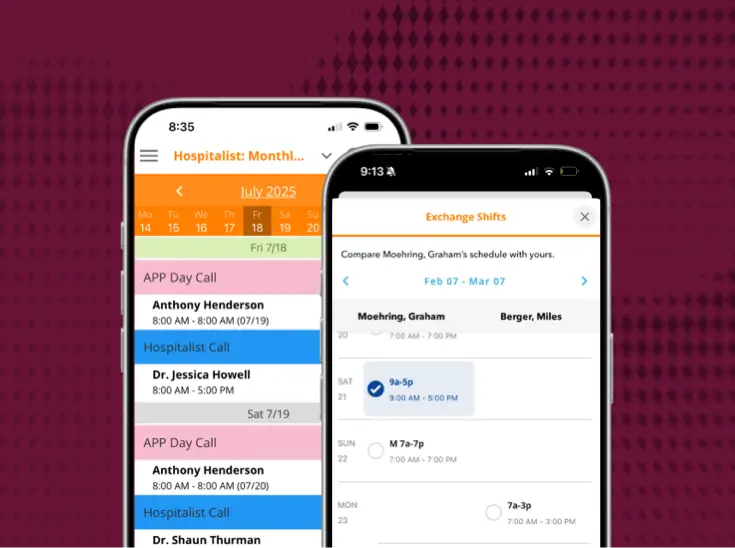
To accomplish this, many health systems have turned to rules-based automated scheduling systems that allow for real-time visibility. That way, everyone can see who's working, how shifts have changed, and even what workload distribution looks like for the whole team.
While workflows are customizable with automated software, the adjustment could look like this:
- When a shift opens up, it goes out through one channel to everyone who could take it, instead of getting resolved through a side conversation only two people know happened.
- Whoever's available claims it, and the schedule updates immediately for the whole team.
- No one has to guess whether the "final" version they're looking at is actually current.
Change 2: Give autonomy back where you can
Too many healthcare organizations treat scheduling as an “operations issue.” But as Miriam Halimi, PerfectServe’s SVP of Client Services, points out, scheduling is intensely personal. A former Chief Nursing Innovation Officer at a large health system, Halimi shares: “A physician's schedule very much impacts their life, their quality of work, and may cause burnout if they're working too many shifts.”
Physicians who feel they have little say over their own workload and schedule may be more likely to burn out. Yet that lack of control is the reality for many clinicians. For example, a study by the Washington Center for Nursing found that only 58% of staff nurses help build their own schedule. More than 30% of the clinicians we surveyed last year said that their personal schedule and commitments aren’t taken into consideration sufficiently when their work schedules are created.
The solution can be a scheduling system that gives clinicians greater control over their schedules while still adapting to operational realities. Importantly, control doesn't mean clinicians build their own schedule from scratch. It means the system accommodates individual preferences whenever possible, freeing the scheduler from having to retrieve dozens of requests from sticky notes and the deep recesses of their memory every time a schedule is built.
For instance, clinicians should be able to submit time-off and shift preferences directly into the system rather than routing every request through a scheduler who has to dig it out of an email thread or remember to glance at that small corner of the whiteboard. Six months after Ochsner Health implemented a system that gave anesthesiologists more control over their vacations and schedules, their average engagement score jumped nearly 30%, and approvals for vacation requests soared by 55%.
Change 3: Staff for demand, continuity, and acuity
In our 2025 clinician survey, workload intensity and patient acuity were the top-cited scheduling gaps, named by nearly half (49%) of respondents. Systems that don’t acknowledge acuity can create chronic understaffing situations, exhaustion, and burnout.
Often, the problem is caused by relying on hours per patient day (HPPD) calculations for scheduling. But patient acuity can dramatically impact how long practitioners will need to spend with each patient. A nurse scheduled for 12 hours with five patients might sound reasonable. But if three of those patients require complex interventions and constant monitoring, the nurse may well feel overwhelmed and under-resourced.
Scheduling for acuity isn’t just about the practitioner-to-patient ratio, either. “The bigger issue,” says Kelly Conklin, a former CNO and PerfectServe's Chief Customer Officer & Chief Clinical Officer, “is the number of supporting staff that are assigned to care for a given patient population on the same shift.”
The impact is felt on patient care, too. 32% of clinicians in our 2025 survey cited continuity of care as a factor their current scheduling practices overlook. Plus, as Katey points out, time spent on scheduling is time that clinicians aren’t spending with their patients.
Part of the problem is that many healthcare organizations are still only able to build out their schedule a week in advance. This is understandable if you’re handling the process manually, Katey explains. The “domino effect” of changes to the schedule will be limited to the next few days.
Unfortunately, this short-term scheduling makes it far harder to plan around patient volume. New patients get booked and the schedule has to be bent around appointments that were already set. A longer time horizon can allow for more flexibility, and also means that clinicians can give more notice about upcoming PTO.
A schedule that automatically takes workloads into account, incorporates patient acuity, and prioritizes continuity of care can make burnout much less likely. Providers are less fatigued and better resourced. This is a win for patient care too: burned-out physicians are twice as likely to be involved in patient safety incidents.
Simply put? More balanced workloads mean better quality of care.
Improving scheduling gives benefits that compound
These three fixes create a virtuous cycle for healthcare organizations, clinicians, and their patients. A transparent, equitable schedule means that clinicians feel their workload is fair. It also makes it easier for them to have some autonomy over what that schedule looks like. Designing for demand keeps the whole thing from breaking down the first time patient volume spikes.
Scheduling a complex, growing healthcare organization is no mean feat. As Katey comments, “I'm always amazed at what the scheduling administrators have in their brains. There's all this intuitive knowledge: 'This provider prefers to work at this time or with these individuals at the same time,' or ‘I know they've got their kid's soccer game every Thursday.'”
A manual system, built on Excel spreadsheets, memory, and the odd Post-it note, may be enough for a time. But as soon as the organization grows, or the scheduler leaves, the whole process collapses.
The only real way to build a fair, optimized schedule is to use an auto-generated process that accounts for all the rules, individual preferences, and unique demands of your team. Clinicians are less likely to burn out and quit. Schedules adapt easily to the greater complexity of a growing team.
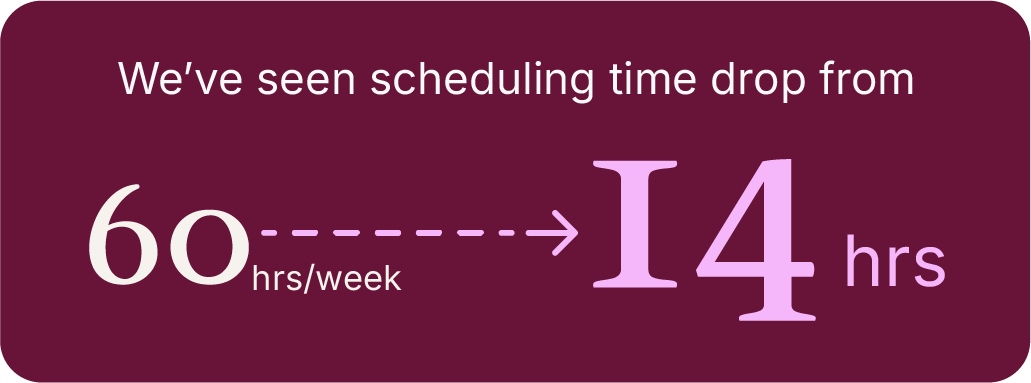
We’ve seen scheduling time drop from 60 hours a month to 14. Most importantly, patients receive better care from less exhausted practitioners. See how healthcare organizations like yours are putting these scheduling changes into practice.
See it working for real teams





.jpg)





.png)






Bring us the workflow that [hurts most]
We'll show you how it runs on PerfectServe, with your teams, your sites and your EHR.