



AI Voice Agents for Healthcare: Why They're Finally Ready
Many medical practices still struggle with call management. Intelligent Answering powered by ConnectiveIQ is here to fix that with AI agent Sloane.

Many medical practices still struggle with call management. More than half of practice managers say they still struggle with long call wait times, and more than 1 in 3 also report delayed clinical responses and inconsistent information (e.g., messages don’t have full patient context).
These issues can be significantly improved by introducing an automated medical answering service with dynamic call routing. Every call gets answered and routed to the correct person, around the clock, without adding extra staff resources.
But even with robust routing rules, the patient still has to make all the decisions. They listen to a menu of options and decide on their own how urgent their problem is. Some inevitably guess wrong; they either overestimate the urgency of their call or, worse, underestimate it and put their own health at risk. And some just get overwhelmed with choices, stall out, and hang up.
AI offers a fix to the problem. Instead of relying on patients to choose how their call should be categorized and routed, a sophisticated AI voice agent can understand their reason for calling and use that knowledge to get the call to the right place.
That’s why PerfectServe is introducing Intelligent Answering powered by ConnectiveIQ.
AI In Healthcare Communications: Why Now?
Healthcare providers have been rightly cautious about implementing AI. As just one data point, our recent research found that 9 out of 10 contact center professionals say they’re still at “early-stage” AI maturity. Data privacy, governance issues, and accuracy issues are all legitimate concerns with any AI model, especially when the product in question will be used to handle sensitive patient information.
“We've been watching this space for three years and playing with the technology," says PerfectServe Chief Innovation Officer Ben Moore. "But the models were not accurate enough or quick enough for what we needed to do."
A lot has changed in three years, and model accuracy has improved dramatically. Where the models still fall short, engineering fills the gap.
"We use other agents to monitor the agent to effectively get that error rate below 1% for calls," Ben says, "which is far better than a human call center experience can do." The technology is finally at a point where it can meet the healthcare industry’s rigorous standards.
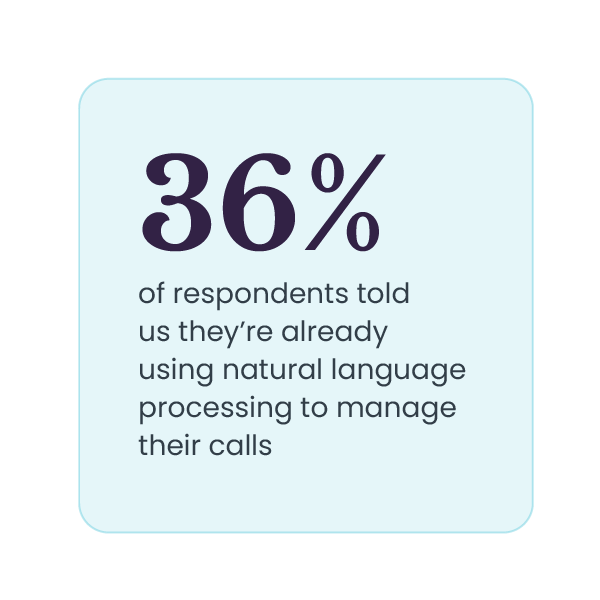
Healthcare call centers are already embracing its potential. In our recent survey, 36% of respondents told us they’re already using natural language processing to manage their calls, with an additional 33% piloting it. For more about the future of AI use cases in healthcare, check out our blog.
The Cost of Inaction
By this point, not using AI also comes with its share of risks. For starters, many medical practices are stretched past capacity by the sheer volume of communications, and disconnected communication technology makes effective call management even harder.
Clinicians are certainly feeling the strain. 49% report delays in call and message replies, which create a bottleneck for patient communication. At the same time, over half say waiting for calls and messages takes time away from patient care. On-call physicians spend too much time fielding non-urgent calls at 2 AM that should have been a next-day call-back. Patients mistakenly rate their call as urgent, or deliberately game the system to reach a physician more quickly.
Meanwhile, poor answering service experiences have a negative impact on patient care. Patients may not know the right way to proceed and abandon an important call. Language barriers mean they may not understand the operator or menu.
“The experience with live agents has gotten so bad and so expensive that this is a welcome step forward," says Ben.
Intelligent Answering: What Is It and Who Is It For?
Intelligent Answering features a conversational, multilingual AI agent named Sloane that healthcare organizations can use alongside phone menus and live answering services.
For PerfectServe, AI was the next natural layer to add to the medical answering service that traces all the way back to the company’s founding in 1997. We’ve spent nearly 30 years understanding the best ways to route calls and other important information for healthcare organizations, and we’ve pulled all that expertise into building an AI agent that is secure and reliable enough to clear a HIPAA AI audit.
Here’s what makes Intelligent Answering different:
Automatic Call Classification
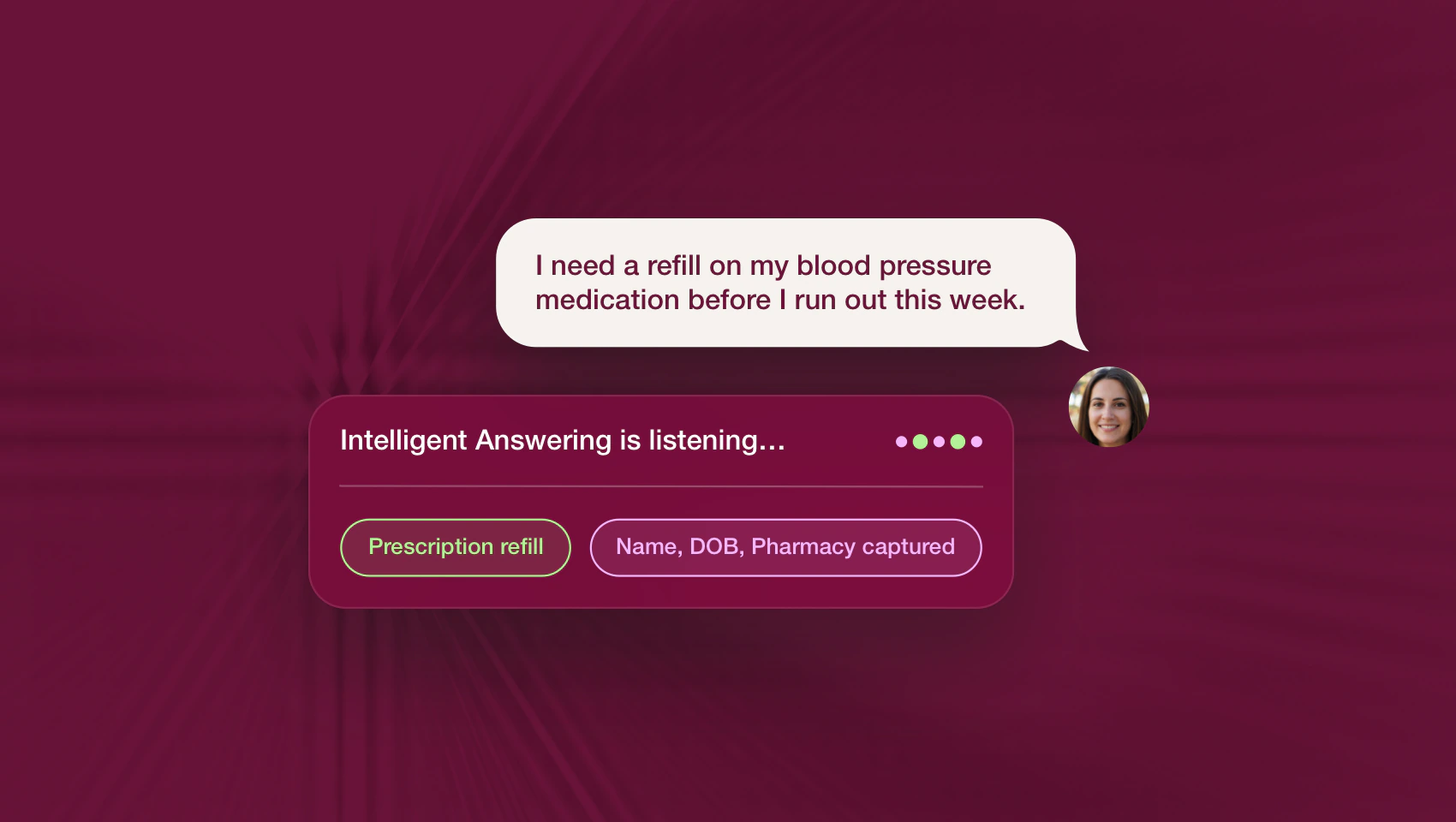
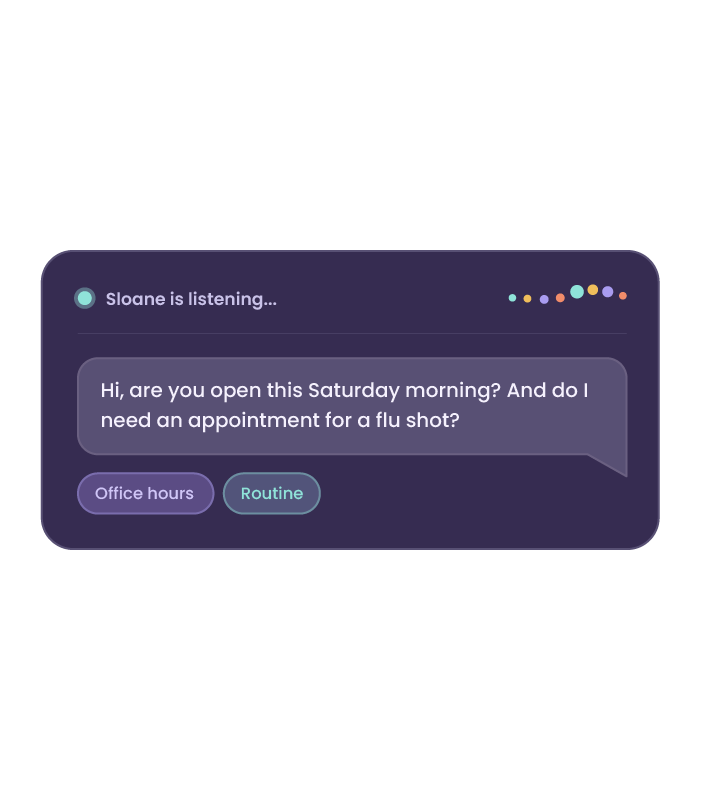
Intelligent Answering listens to what the caller describes and works out how urgent it actually is. There’s no menu required
It's also built around your practice specifically. During onboarding, Sloane goes through a mandatory learning period to see what daily call activity looks like: who calls, what they need, how each call is directed, etc. Once the training is complete, Sloane can apply all of this hyper-specific knowledge starting with the first live call.
Want a demo for what this will look like in practice? Sign up right here.
Intelligent Answering understands what the caller is saying and what to do about it:
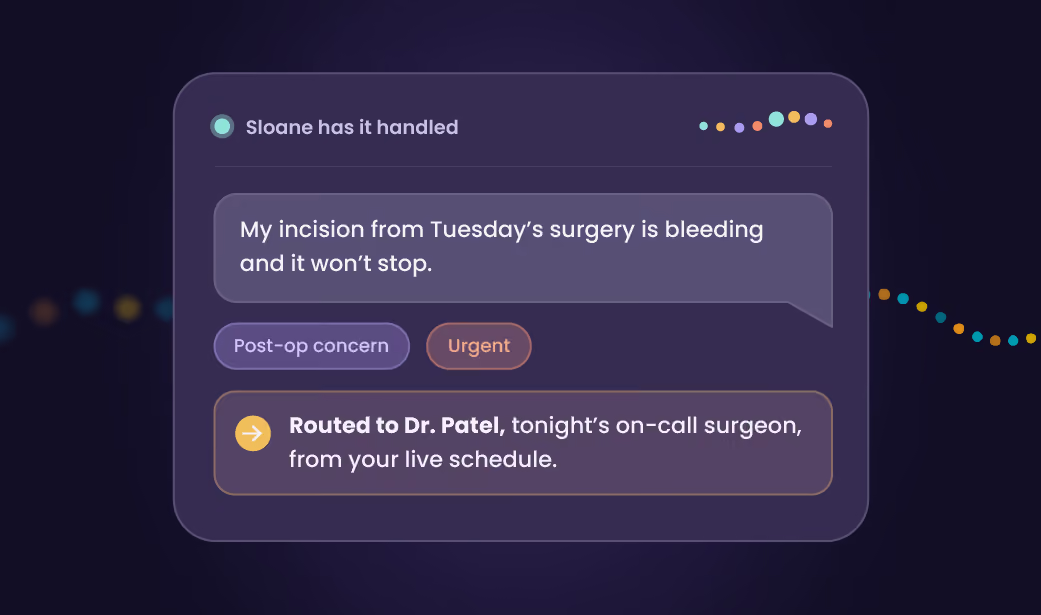
- A patient calls at midnight and says the incision from their surgery is red and swollen. Sloane recognizes a real post-op problem and gets them to the on-call provider right away.
- Another patient calls at midnight, anxious about test results they just read. Same type of caller, same hour, completely different outcome: Sloane takes a message for an admin or nurse to review in the morning. Nobody gets paged!
Trust And Safety Built In
PerfectServe CEO Guillaume Castel understands what’s at stake:
First, we've signed HIPAA business associate agreements with our AI model providers, including Amazon, Anthropic, and OpenAI. Nothing about your patients is stored in their systems or used to train their models.
The same goes for your call history. Any calls we analyze during onboarding are never used to train a larger model. We've also passed a HIPAA AI audit with one of the largest medical groups in the country. Behind the scenes, we benchmark the providers of AI models every quarter and swap in better models as they become available.
Safety Throughout the Experience
Intelligent Answering also comes with layers, even if they’re not immediately apparent during interactions.
When a call is happening, a backup AI agent is in place to double-check every response before it's spoken. The system also listens for emergencies throughout the conversation. If a caller describes anything that could be an emergency, the agent stops and directs them to call 911.
The agent won't give medical advice, make diagnoses, or read back test results. And if a caller would rather skip the AI, or a conversation stalls after a few turns, the call falls back to the familiar menu or a human agent.
Importantly, everything about Intelligent Answering is auditable. Every call is recorded as a transcript and sorted by type, with full rationale that details how it ended and why each routing decision was made. You can see all of it in a dashboard. Calls that the agent couldn't handle are flagged for review, and resulting feedback shapes how it behaves going forward. For Sloane, the learning never stops!
Personalized Patient Experience
Sloane explicitly introduces itself as an AI agent so nobody feels tricked. From there, the caller just talks instead of working through a list of options or hoping the person who answers knows what to do.
Every call is answered immediately, with no hold queue. Sloane automatically detects the language being spoken and can seamlessly transition between English and Spanish, with support for roughly 70 additional languages on the way. It works out what the caller needs from how they describe it, not from a button they press.
If the patient portal is the faster path for something, Sloane says so and points the caller there. Plus, since Sloane has access to the practice knowledge base, the patient will get the same experience whether they call at 2 AM or 3 PM.
How We Built It
For the IT folks reading this, here’s what’s under the hood:
The incoming call is received by Twilio. Deepgram turns the caller's speech into text. Then Agentix, our agent system, works out what the caller needs. An agent using one AI model runs the conversation, another lighter-weight model evaluates call urgency, and yet another model checks schedules in the background.
"While one agent is talking to you, another one is already doing everything else in the background,” explains PerfectServe Director of AI Product Sid Grover. “So you're never just sitting there in silence and hearing 'one moment please' or elevator music."
What You Can Expect From Sloane
Early feedback from our pilots is highly encouraging. A clinical leader at one pilot site described Sloane as a skilled live agent who knows your schedules intimately but never makes a routing mistake. A physician at the site started out skeptical of AI as a whole, but has become Sloane’s biggest champion.
Pilot practices have seen average call time cut in half because the caller can explain their situation in a couple of sentences instead of going back and forth with a menu system.
The improvements go beyond just the metrics, though. Sid has a favorite example of how patients experience the agent.
“The very first weekend we launched Intelligent Answering, a patient answered one of Sloane’s questions with a ‘Yes, ma’am!’ That’s not somebody fighting with a machine. That’s someone who felt heard.”
Meanwhile, healthcare providers benefit from greater accuracy in call routing. Calls that aren't really urgent are caught during the conversation, so the 2 AM page about a prescription refill never happens. Messages arrive complete, with the details the provider actually needs, so nobody has to call the patient back just to find out what the call was about.
It's also a far more scalable way to handle growth. There's no need to keep hiring staff as call volume climbs. There’s no starting over every time somebody quits, because your routing rules and practice knowledge live in the system rather than in one employee's head.
There’s true ROI attached, too. A traditional outsourced answering service may bill for every call a person touches, including the routine ones that never needed a person, and overage fees stack up in busy months. Intelligent Answering runs at roughly a third of that cost, and the routine calls it resolves on its own stop generating charges entirely.
There's also a full record of every call: what the caller needed, where the call went, why it was routed there, and how it ended. Practices we've worked with have been surprised by what that record shows. Seeing a full year of after-hours calls laid out has changed how some of them think about their routing entirely, because they could finally see where their on-call providers' time was actually going.
What’s Next For Healthcare Communications?
Intelligent Answering will integrate with five major electronic health record (EHR) platforms our customers use by year-end, starting with athenahealth and eClinicalWorks. That covers patient identification, prescriptions, appointments, and intake, so the agent can finish tasks during the call instead of just taking messages about them.
AI brings many benefits to medical answering service workflows, and it has clear potential to support front-office healthcare teams with a wide range of tasks, from scheduling to test coordination to referrals to patient intake.
PerfectServe has spent three decades building the schedules and call routing rules that healthcare communication runs on. With Intelligent Answering, we saw an opportunity to make that process even more efficient with AI so our clients can offer better care to their patients and better support to their clinical staff.
Want to see how Intelligent Answering would handle your calls? Request a scenario review. We'll run your practice's actual call patterns through the agent and walk you through the results.
See it working for real teams





.jpg)




.png)




Bring us the workflow that [hurts most]
We'll show you how it runs on PerfectServe, with your teams, your sites and your EHR.