





Closing the Communication Gap Beyond Your Organization's Walls
Healthcare orgs don’t need more communication tools. What clinical teams really need are fewer tools that are purpose-built to support care communications.

Healthcare organizations don't operate in isolation. Every care site is connected to a larger network of partners, whether that's hospitals, physician practices, rehabilitation facilities, home health agencies, referral networks, emergency medical services, or countless other healthcare stakeholders.
Even within the same hospital or health system, different departments rely on constant communication to keep operations moving. A clinician may need facility services to prepare a room for the next patient, case management may need to coordinate with a post-acute care facility, or a provider may need to communicate with a referring physician.
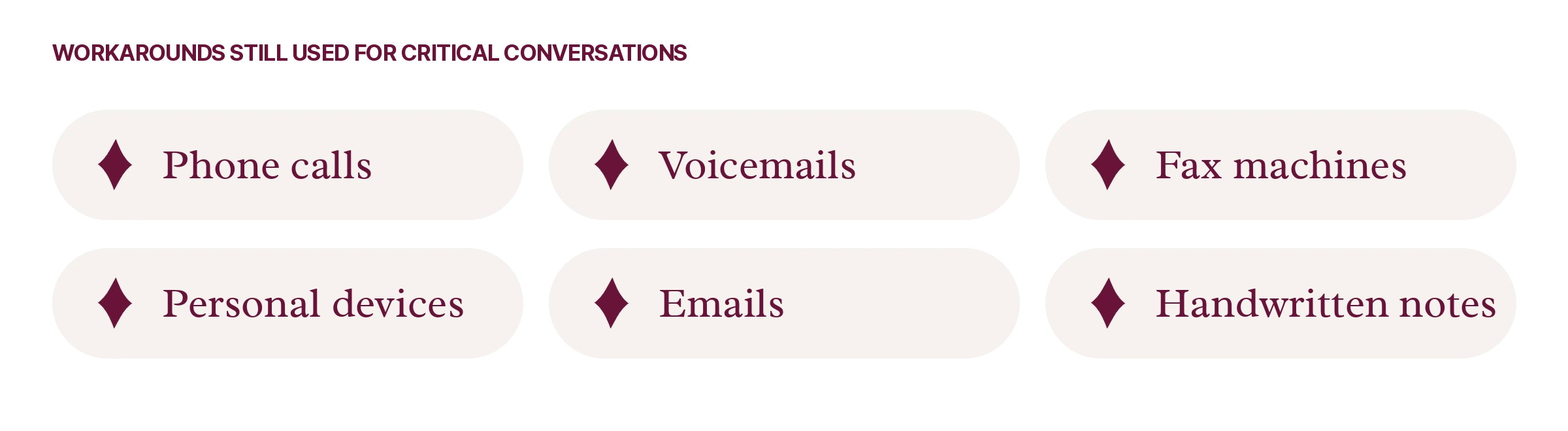
Because each connection is essential to a patient’s care journey, communication between these teams and sites should be efficient. Unfortunately, many critical conversations still take place through cumbersome or unreliable channels like phone calls, voicemails, fax machines, personal devices, emails, and even handwritten notes.
Beyond being outdated, communicating this way also creates real risk. When patient information is involved, using unsecured communication channels can lead to HIPAA compliance concerns. Communication gaps can also lead to care delays, operational inefficiencies, financial risks, and frustration for staff trying to coordinate across teams and organizations.
Healthcare organizations have an opportunity to modernize how their care teams collaborate. Today's communication tools can help reduce complexity, improve visibility and accountability, and create a more secure way to communicate across the care continuum.
What causes fragmented communication with external care partners
Communicating with external partners presents challenges because every partner uses different communication workflows and platforms.
Cost and accessibility can contribute to fragmentation as well. While larger health systems may invest in enterprise communication technology, smaller physician practices, post-acute facilities, home health agencies, and community providers often have more limited budgets and IT resources. When communication tools require additional licenses, software downloads, or complex onboarding, organizations may continue relying on familiar, but less effective and perhaps more rudimentary, communication methods.
As a result, teams often fall back on communication methods that aren't designed for healthcare, such as phone calls, voicemails, fax, and unsecured SMS texting. While these tools may be familiar, they can create fragmented workflows that make coordination more difficult.
When communication occurs across disconnected channels, delays become more common, and staff spend valuable time tracking down the right contact, leaving follow-up messages, waiting for responses, or trying to piece the story together from separate sources. Important information can be missed, while limited visibility into message delivery and response status creates uncertainty for everyone involved.
The challenge goes beyond simply sending a message. Healthcare organizations need to ensure the right information reaches the right person, regardless of which organization they're part of. They also need a solution that doesn't create additional technology burdens or compliance concerns for either side of the conversation.
Modern healthcare communication platforms can address these challenges by creating a secure connection between organizations and their external partners. Instead of relying on multiple disconnected tools, teams can communicate on a single platform that improves visibility, reduces guesswork, and helps information reach the right person more efficiently.
The financial risks of poor communication
Communication challenges create problems beyond mere frustration. They can also contribute to quality issues, operational inefficiencies, and avoidable costs.
Some of the biggest operational pain points caused by poor communication include delays in care transitions, missed follow-up actions, administrative rework, higher readmission rates, and lower value-based care performance. The Joint Commission found that communication failures during patient handoffs have been associated with up to 80% of serious medical errors.1
Communication challenges are also not limited to a single care setting. An analysis of communication-related malpractice claims found that failures occurred most frequently in ambulatory settings (48%), followed by inpatient settings (44%) and emergency departments (8%).2 This highlights how communication breakdowns can occur throughout the continuum of care, particularly when information has to move between organizations, departments, and care teams.
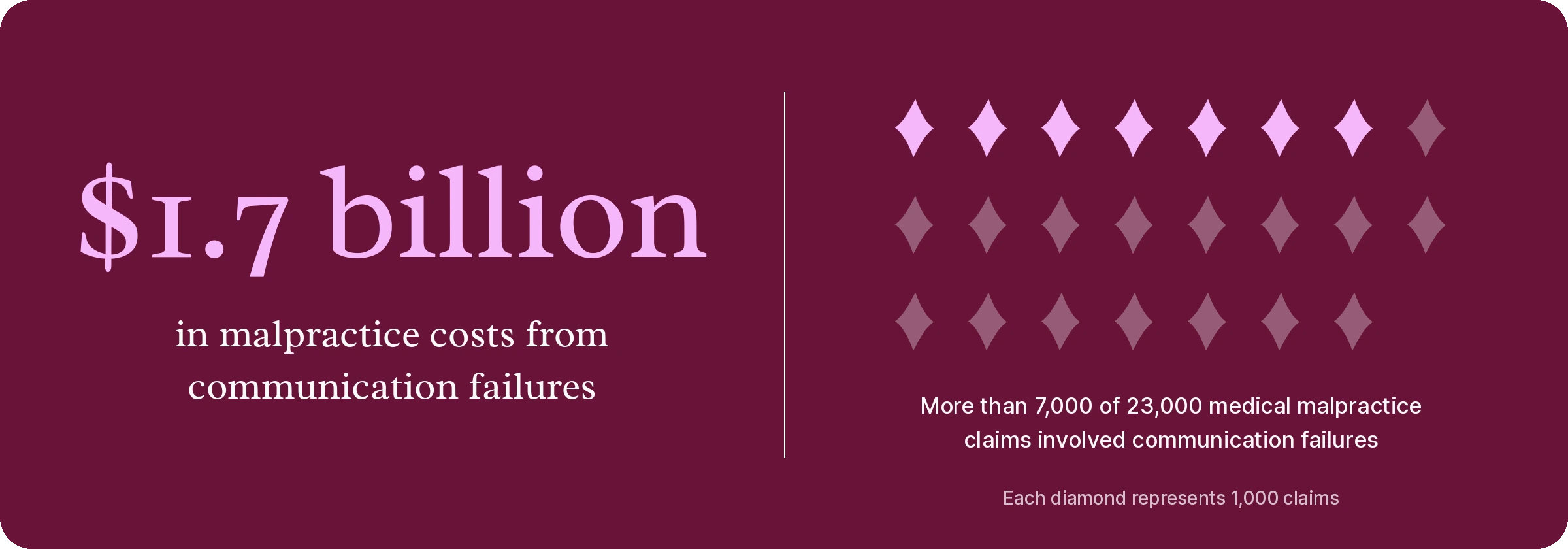
The financial impact can be substantial. Another analysis of 23,000 medical malpractice claims found that communication failures contributed to more than 7,000 cases, resulting in approximately $1.7 billion in malpractice costs.2
Every avoidable communication breakdown creates risk. The more complex the care network becomes, the more important reliable communication becomes. By creating a more reliable and accessible connection between organizations and their external partners, this risk can be mitigated.
How to mitigate workflow disruptions with better communication tech
Healthcare orgs don’t need more communication tools. External communication solutions often require separate licenses (meaning more money), software downloads, or extensive onboarding for partner organizations. Smaller physician practices, post-acute providers, and community healthcare organizations may not have the resources necessary to adopt yet another platform.
What clinical teams really need are fewer tools that are purpose-built to support care communications. Instead of forcing staff and external partners to switch between multiple systems, the right technology should simplify communication to make it easy to manage and available in one shared channel.
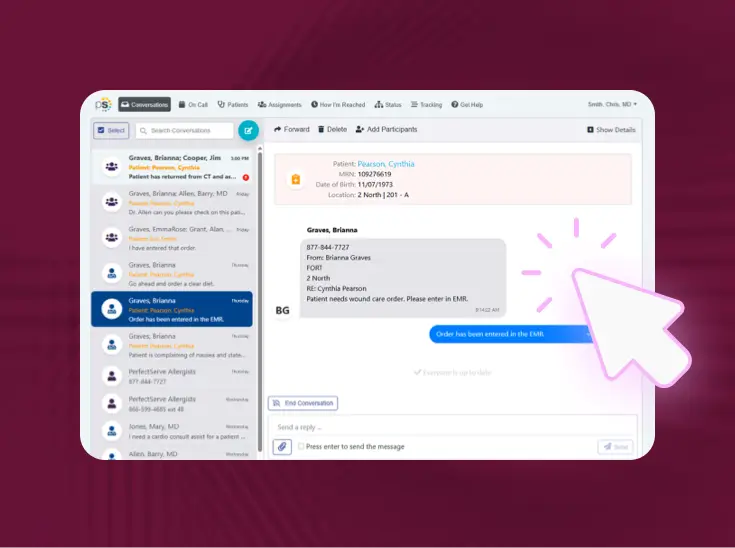
PerfectServe Connect Messaging addresses these challenges by extending secure communication beyond the walls of your organization through a simple browser-based experience. By reducing technology barriers and maintaining communication in familiar workflows, organizations can improve collaboration with external partners while minimizing administrative burden.
The best communication tools don't create more work. They fit naturally into the workflows teams already use, making it easier to coordinate care across organizations, departments, and care settings. When information moves more efficiently between care teams and external partners, organizations are better positioned to support continuity of care and create a more coordinated patient experience throughout the care journey.
Learn how Connect Messaging helps healthcare organizations securely connect with external partners, reduce communication friction, and improve care coordination. You can also schedule a demo today.
See it working for real teams
















Bring us the workflow that [hurts most]
We'll show you how it runs on PerfectServe, with your teams, your sites and your EHR.