





How a Cardiology Answering Service Can Help Limit Liability Risk
Many cardiology practices run on after-hours processes that were built in pieces. But that's exactly why a chest pain call ends up in a voicemail inbox to be handled the next day.

A patient calls their cardiology office after hours with chest pain. The recording says, "If this is an emergency, hang up and dial 911."
The patient does not think their symptoms are an emergency. They stay on the line, press the numbers to get them through the phone tree, and land in a voicemail inbox.
While checking emails the next morning, you realize this caller was describing symptoms that could potentially be life threatening but hung up mid-voicemail. You have no way of knowing who this patient was, how to get in touch with them, or what the outcome was last night.
This isn’t the first time this scenario has happened, and it's likely not the last. What you do know is that this scenario can’t continue to be the norm. Not for you, not for practice and most importantly not for the patient.
Why Minutes Matter with Chest Pain
Every cardiology practice has seen it: a patient calls after hours with what sounds like indigestion, fatigue, or mild shortness of breath. Instead of heading to the emergency department, they're looking for reassurance or guidance from the team they trust.
The concern isn't the patient with obvious symptoms who calls 911. It's the patient who doesn't realize what they're experiencing could be cardiac related. If that call lands in voicemail and sits overnight, there is no opportunity to redirect the patient to emergency care when timing matters most.
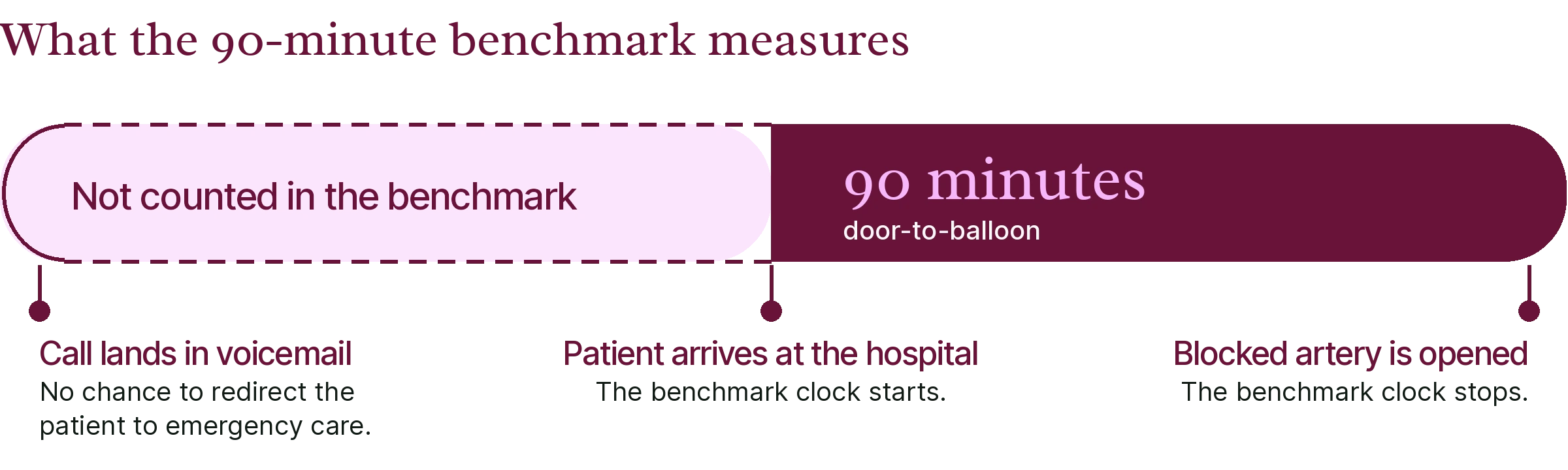
The AHA/ACC's 90-minute door-to-balloon benchmark is measured from the time a patient arrives at the hospital to the time the blocked artery is opened. It does not account for delays that occur before the patient seeks care, making early recognition and rapid referral critical to patient outcomes.
The Patchwork History of Cardiology Call Routing
Many cardiology practices run on after-hours processes that were built in pieces: an answering service added here, a personal cell phone workaround added there, and many years of patchwork fixes. Nobody sat down and designed it from end to end.
That's normal. This set up is not anyone’s fault. It’s just the result of years of implementing a solution or piecing together processes to fix problems as they arise.
It's also exactly why a chest pain call ends up in a voicemail inbox to be handled the next day. The concern isn’t the delayed message itself, but rather the possibility that a patient with life-threatening symptoms receives no clinical guidance in a critical moment.
For the practice, that creates an uncomfortable reality: a potentially high-risk patient interaction occurred, but no one had the opportunity to assess it, document it, or influence the outcome.
Four Questions to Ask Your Team About After-Hours Calls
Your call workflows need regular assessment to ensure they’re getting patient calls to the right place. Here are four questions to ask your team about your after-hours call process:
- How does your current process ensure a patient with serious symptoms (like chest pain) gets connected with an on-call provider for assessment?
- What happens if that call does get routed to the on-call physician, but they don’t respond?
- How does that call escalate if needed? (Bonus: Is there a process in place to ensure the patient isn’t left guessing their next steps?)
- If you needed to provide an audit trail of all after hours calls, could you confidently say who called, what was said, how it was routed, and when?
Answers to these questions are not meant to point fingers or place on anyone. They're designed to understand the current state of how your after-hours protocols impact patient outcome.
Who Absorbs Liability When a Call Goes Missing?
The legal exposure here isn’t hypothetical. A review of closed cardiology malpractice claims by The Doctors Company identified missed or delayed diagnosis of myocardial infarction as a top allegation.
When a claim follows a missed call, someone has to explain what happened. That responsibility may land on the individual clinician as well as the practice, even if they never knew the call came in.
In short, “I never got the message” explains the care gap, but it doesn’t close the claim.
Many providers respond by taking after-hours calls on a personal cell phone. It feels like the most reliable option, but it also means no formal system stands between the provider and that exposure. There’s no log of what came in, no record of how it was handled, and no backup if the phone is silenced, dead, or in another room. Providers shouldn’t choose between being accessible to patients and protecting themselves.
How Modern Workflows Close the Liability Gap
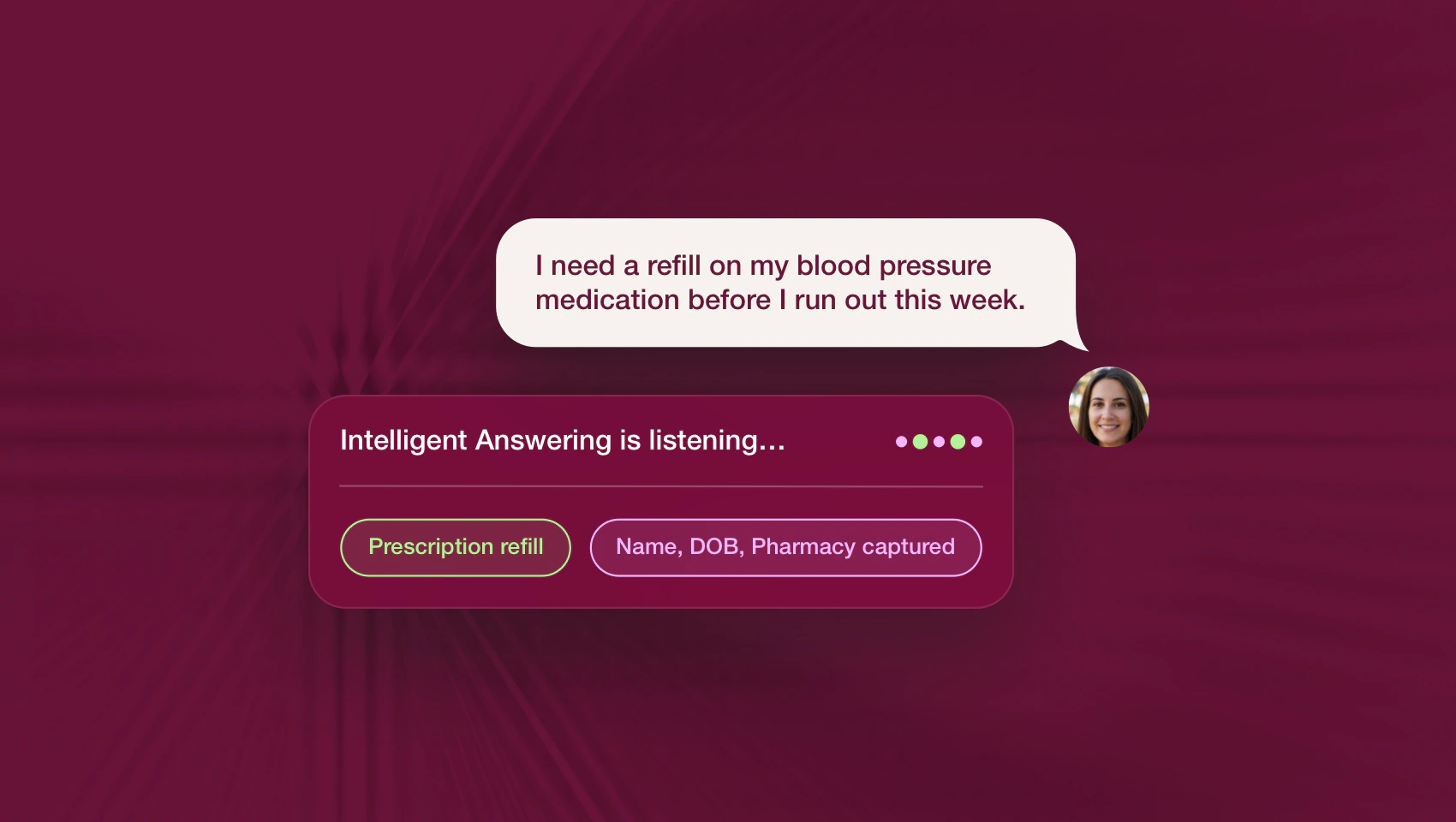
To fix these communication gaps, call workflows are evolving away from legacy manual answering services. Modern technology has the capability to understand a caller’s intent rather than relying on whatever menu button they happen to press. This approach shifts the burden away from individual providers by automating three critical safety nets:
- Immediate Escalation: True clinical emergencies (like acute chest pain) are instantly recognized and fast-tracked to the on-call physician.
- Automatic Audit Trails: Every routing decision, rationale, and call timeline is logged, creating a definitive record if a call needs to be reviewed.
- Clinical Compliance: Advanced systems operate under strict business associate agreements (BAAs), keeping PHI completely secure without using sensitive clinical calls for broad data training.
Assessing Your After-Hours Capabilities
Every after-hours call your current after-hours solution doesn't document could pose a liability risk. Without a transparent process in place, a chest pain call that gets treated as routine holds the potential to move beyond oversight and into a bigger problem for both you are your patient.
That's why we build the Chest Pain After-Hours Liability Checklist, a two-minute self-assessment covering call routing and escalation, documentation and audit trail, personal phone exposure, and cost. Work through the checklist with your team and discuss anything you can’t check off.
See how Intelligent Answering closes the liability gap.
Before any of that, you need an honest look at your current process. That's what this is for.
We built the Chest Pain After-Hours Liability Checklist, a two-minute self-assessment covering call routing and escalation, documentation and audit trail, personal phone exposure, and cost. Work through it with your team. Anything you can't check off is a gap worth discussing.
Every after-hours call your current after-hours process and solutions doesn't document is a liability. Without a real process, a chest pain call that gets treated like a routine one isn't just an oversight; it's liability exposure with your name and your practice's name attached. With Intelligent Answering urgent calls are recognized as urgent, every after-hours contact is documented automatically, and the physician on call isn't personally absorbing risk that a system should be carrying instead.
That's the difference between hoping your after-hours process holds up and knowing it will.
See it working for real teams

















Bring us the workflow that [hurts most]
We'll show you how it runs on PerfectServe, with your teams, your sites and your EHR.