

How to Improve Medication Access Using Patient Communication
Background
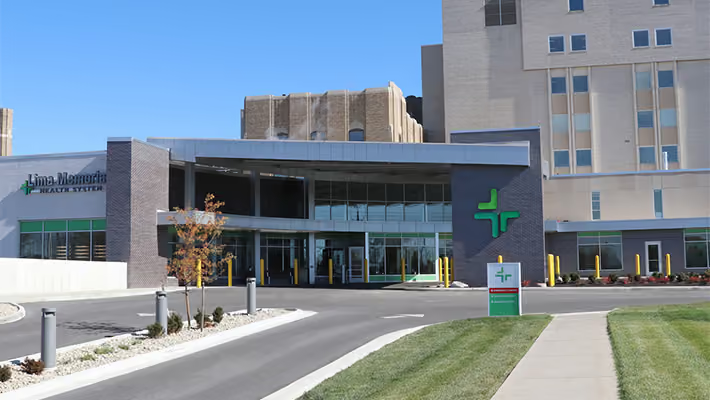
Ohio-based Lima Memorial Health System is a hospital system with more than 150 physicians and more than 1,500 employees. It’s an affiliate of the larger ProMedica Health System, which provides care for about two million patients per year in northwest Ohio, southeast Michigan, and southern Pennsylvania.
Challenge
Lima Memorial Health System was facing obstacles related to peri- and post-operative patient and family communication. During the COVID-19 pandemic, these challenges were greatly exacerbated by the preventative measures put in place to slow the spread of the virus. Stacy Graymire, Executive Director of Nursing at Lima Memorial, oversees the ER, perioperative services, and the OB department. When patients came to one of her departments for surgical care, their loved ones often had to wait in their cars for updates during procedures. There was no regular touch point in place to update family members about patient status, which understandably caused stress.
Lima Memorial needed a better solution that allowed family members to get regular updates during perioperative visits while still adhering to social distancing best practices. Ideally, the solution would support both templated messaging to lean into automation and ad hoc messaging to allow for more personalized communication as needed.
Solution
Lima Memorial implemented PerfectServe Patient Engagement to support automated updates to family members related to patient appointments and procedures. The solution—which is built into the PerfectServe Clinical Communication platform that was already deployed at Lima Memorial—allows care team members to send custom or pre-composed messages to loved ones’ personal cell phones about any number of pre- and post-op events (like when a patient is out of surgery, for example). Importantly, family members don’t need a new app or access to a patient portal to make this communication possible—just a phone that can receive text messages.
Implementation
The process of implementing the Patient Engagement solution presented a small challenge: care team members were accustomed to following very specific workflows before, during, and after procedures. Instilling new habits—even with the greater ease of use afforded by the Patient Engagement solution— isn’t always the easiest path to tread, and the process was made more challenging because the Lima Memorial team hadn’t adopted technology like this before. Due to the intensity of the pandemic, as well as other competing priorities, it took around six to eight weeks to fully adopt the new Patient Engagement workflows.
"The biggest thing for us as an organization was to make sure that we drove the 'why' behind wanting this and wanting the team to utilize it," Stacy said.
Care teams within the hospital worked closely with Lima Memorial’s IT team and PerfectServe’s implementation team to set up unique and customized communication scripts for the new Patient Engagement workflow. Stacy shared that, as a result of the implementation, each department under the perioperative services umbrella started to better understand the value they bring to each patient’s care journey. It’s common that perioperative care team members only see patients while they’re asleep, so it can be harder to appreciate the full impact of the work they do every day.
"As a result of [PerfectServe’s Patient Engagement] implementation, each department … started to better understand the value they bring to each patient’s care journey."
By communicating with loved ones during procedures, these care team members got direct evidence of how much their dedication to patients means to the people who love them.
"This was one of the key drivers for [clinicians] to see how they were better able to serve that patient’s experience long term, and even their loved ones, and give them those easy updates," Stacy said. "It felt like the [PerfectServe] team was very positive about working with us and was willing to think outside of the box and be creative as we looked through different ways to make this work. I do appreciate the team that was there to support us, especially on the PerfectServe side."
Results
Next Steps
Though Lima Memorial has seen great success with the Patient Engagement deployment, they still hope to get more out of this implementation. In the future, they hope to incorporate the Patient Engagement solution in their cardiovascular service workflows. Stacy thinks the solution could help reduce readmission rates by giving patients more information right at their fingertips. Other opportunities on the wish list include using the Patient Engagement solution in more pre-op communication and messaging, such as appointment reminders and other care notifications like when to stop taking certain medications before a surgery. Stacy has been discussing this expansion with PerfectServe’s professional services team.
"I did have a meeting a couple of weeks ago just to learn more about PerfectServe and the potential for how we can incorporate different communication platforms with other facets of care," Stacy said.
Conclusion
Like many health systems, Lima Memorial needed a way to more regularly keep patients’ family members updated during procedures, but they had yet to find a solution that seamlessly supported both ad hoc and automated messaging workflows. Though it may be common practice to simply update family members and patients after surgery, this can induce anxiety and sometimes makes it more difficult for the family unit to have a full understanding of the patient’s post-discharge care plan.
After deploying Patient Engagement, care teams are now able to see what a tremendous difference it makes when they can easily communicate with patients’ loved ones during their care journey. By removing the obstacles to regular communication with family members, Lima Memorial has ensured that patients can quickly and easily get both the medication and post-op care plan they need to have a successful recovery. It’s a win for patients and families, the entire care team, and Lima Memorial’s mission to provide high-quality care for every patient who comes through their doors.
"Our goal was to really make [implementation] seamless without placing the burden of work on any direct bedside caregivers, whether that be a nurse, a tech, a physician," said Stacy. "We’ve been able to start to show [the providers] the little things we can do with technology to really reduce that end user burden of work. And it’s really helped us to drive different platforms forward."
Discover the latest from PerfectServe



.jpg)

.png)

Bring us the workflow that [hurts most]
We'll show you how it runs on PerfectServe, with your teams, your sites and your EHR.