





Why Your Calls Keep Landing in the Wrong Place: Top Medical Call Routing Breakdowns
These are all symptoms of outdated call handling services that impact patients, providers, and staff.
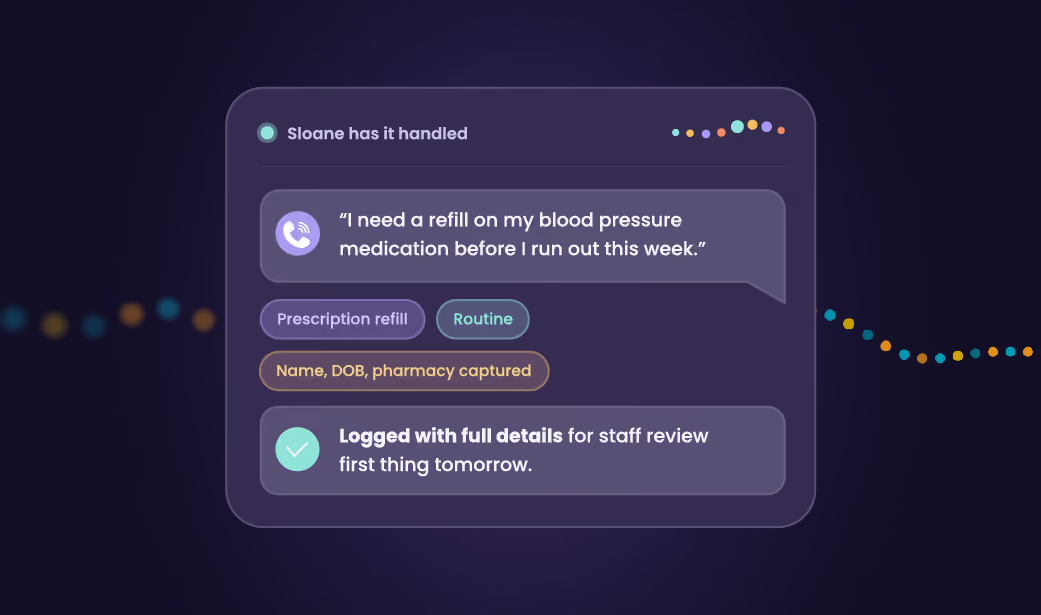

Every practice has experienced the weight of inefficient call routing: a patient feels unheard, a provider is frustrated by non-urgent calls, or an admin has no trace of a voicemail that came through yesterday. Rather than being just one failure, it’s more often a growing backlog of lost or misrouted calls that cause real workflow issues.
None of these problems reflect how dedicated your team is to delivering the best patient care. It’s just what happens when a call system directs traffic based on guesswork instead of understanding what the caller actually needs.
Let’s look at the top reasons your calls are landing in the wrong place, why it matters, and how to fix it.
Top reasons your calls land in the wrong place
In most cases, calls land in the wrong place due to one of these problems:
- Generic phone trees let callers self-select urgency: Phone tree menus aren’t built to catch the difference between urgent and routine calls, meaning patients are left to self-diagnose the urgency of their own situation.
- No self-service path for routine requests: Office hours, medication refills, insurance questions, and other non-urgent needs don’t have a clear routing path, so patients often default to speaking to a provider on call.
- Routing is based on outdated schedule and contact data: When on-call schedules, provider directories, and escalation paths fall out of date, calls are routed with the wrong information by default.
- No record of where calls go or how they get resolved: If no documentation exists to track your calls or how they get resolved, you have no record of where improvements are needed to improve future calls.
The consequences of misplaced answering service calls
The cause of call routing issues is just one half of the equation. The impact is felt in many areas:
- Calls go to the wrong person or inbox and don’t get resolved
- Providers get interrupted by non-urgent calls that didn't need their attention
- Staff lose hours managing calls that didn't need a person (i.e., questions about office hours or rescheduling a visit)
- Call quality (length, live agent interactions, etc.) varies from call to call, so patients have no standard experience
- There's no record to prove what's working or what needs to change
- Frustrated patients hang up before getting help or seek care elsewhere
Missed emergency calls: why call breakdowns pose liability risks
For the majority of non-urgent calls, going to the wrong place is more of an inconvenience and time burner than a true emergency. If a patient calls about office hours and leaves a message, they get a delay in their answer, and then someone has to call them back.
But misrouted calls always cost time. And in an emergency, the cost increases. A lot.
When a routing breakdown happens during an urgent call, the result is a delay in care. That’s a missed emergency, which is a real liability event. From test results to cardiac emergencies, the urgency of a call can't just be guessed, because that means a call goes to the wrong voicemail or takes too much time to get to a provider.
Prolonged wait times are known to negatively impact care outcomes, with effects ranging from higher readmission rates to higher mortality rates to clinical deterioration for patients who have life-threatening conditions.1
What patients expect when they call after hours
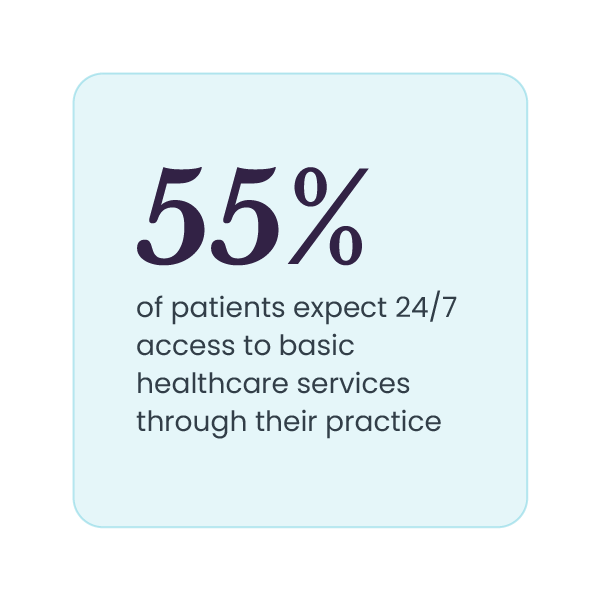
Whether it's 2 PM or 2 AM, patients expect their calls to be answered. 55% of patients expect 24/7 access to basic healthcare services through their practice.2 Most patients are used to listening to a phone tree and deciding their own urgency: they push 1 to leave a message about a prescription or push 2 to speak to the provider on call.
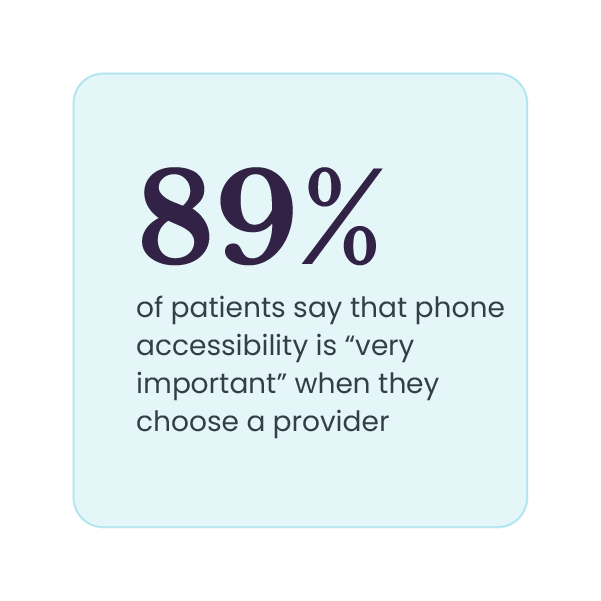
But when a patient is left circling the voicemail system, they’re much more likely to get frustrated. If a patient doesn’t speak English and reaches someone who can’t communicate with them, they’ll probably give up their call entirely. But despite these challenges, 89% of patients say that phone accessibility is “very important” when they choose a provider.2
And when patients have to wait through long hold times, their expectations are even higher. One study found that at least 60% of patients will abandon calls if they have to wait longer than one minute.3
In short, patients don’t want to wait too long or abandon their calls. They want to have the same experience day and night: to call with their question and get an answer in a reasonable amount of time. Urgent or not, it’s frustrating when that doesn’t happen.
When non-urgent calls interrupt providers
On-call providers have one role: to answer clinically urgent calls and direct patients accordingly. But when a call system can't discern an urgent call from a routine one, the provider is likely to serve as the backstop destination.
When a non-urgent call is directed to the on-call provider, it hampers the provider’s ability to provide efficient answers for urgent inquiries. Often, callers just want to talk to a live person who can answer them immediately, so whether they have a question about office hours or need to change their appointment, they want to explain themselves to get a fast resolution.
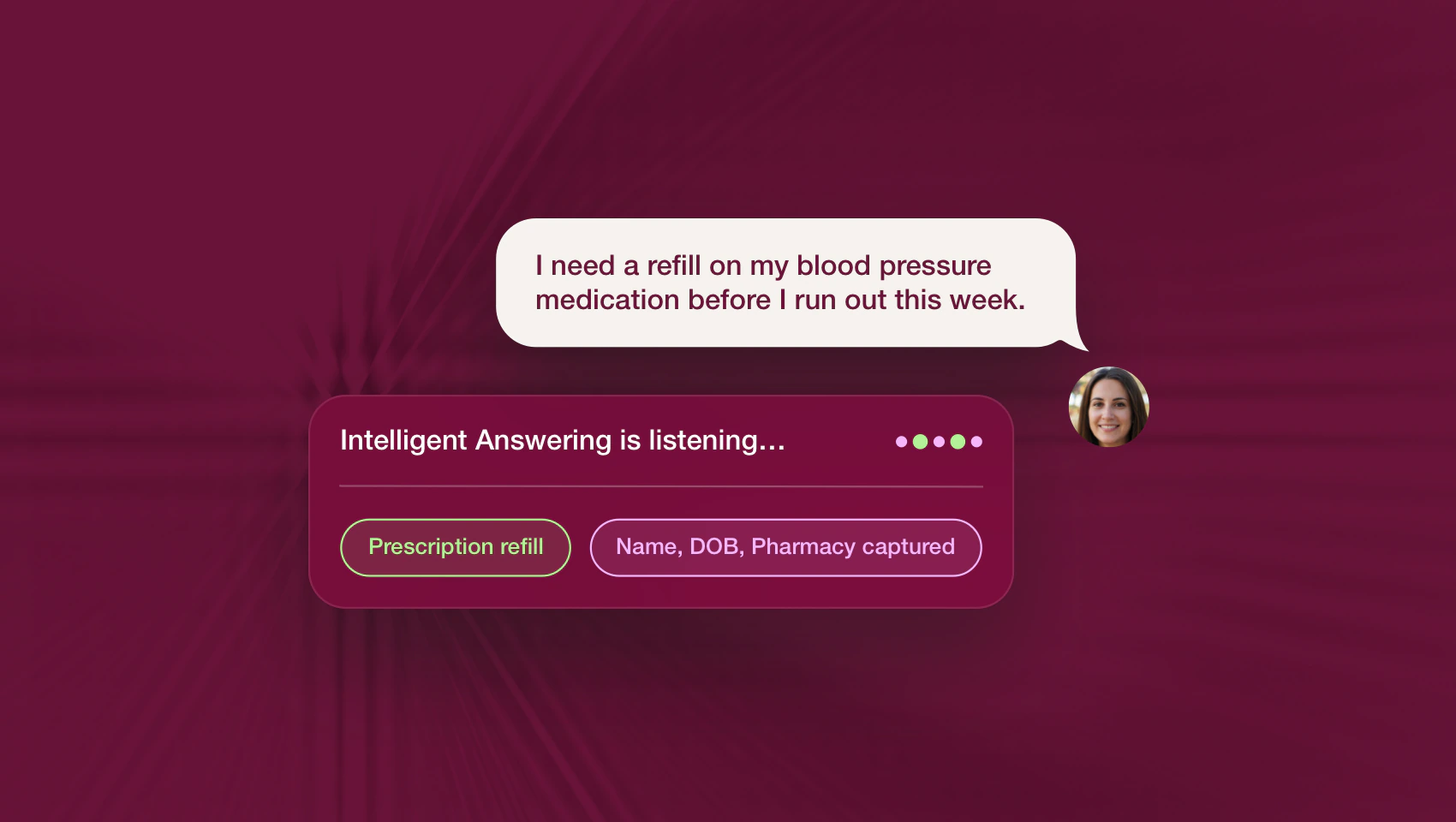
The real driver here is deciphering or understanding call intent. Callers with medical or prescription questions often want to explain their question, not just push a button. But to the provider answering yet another non-urgent call at 4 AM, it's a real frustration.
Many providers share that after-hours on-call work leads to high stress levels, burnout, constant interruptions, sleep deprivation, and fatigue.4 Preventing those non-urgent calls from reaching them can make a huge difference in their experience.
The hidden cost of routine calls on staff time
For staff and admin managing a practice’s inbox, taking routine patient calls has a real impact on their time. Think about it: if 6 patients call to ask about office hours, and 3 of them leave voicemails, staff have to take time answering questions on the phone and calling the other patients back.

A few calls may not seem like much, but they add up over time. Medical practices receive an average of 53 calls per physician per day, including requests related to appointments, prescription refills, clinical matters, billing, and referral coordination.2 67% of patients prefer to call over other contact methods, and 38% of calls occur during the first and last hour of the day.2
Specialties vary widely, but on average, that means a 4-physician practice handles 200+ calls every day.2 Receptionists have to handle those calls while checking patients in and completing other administrative tasks.
And while the most important thing is delivery high-quality care, there’s a financial cost to missing calls. One study found that the average missed call can cost a practice $125-$200 based on lost appointment revenue, patient acquisition cost for lost new patients, and other downstream loss of patient revenue.2 That means if a practice misses 25 calls, they lose $3,125-$5000 that day, which could mean up to $1.3 million annually.
No record of calls to decipher
Your calls might be going to the wrong place simply because you can’t see what’s working and what's not. Whether you have a live answering service or a voicemail phone tree, you probably have little to no data to see how many calls you’re receiving, where those calls are routed, and how they were resolved.
Without data, you’re left in the dark with no call documentation. What if you’re understaffed, but you have no way to prove it’s time to hire another receptionist? Maybe some of your calls are lost completely, but you have no way to track when they came through or where they were directed. Your system for call handling ends up looking like a black box.
What good call handling looks like for medical practices
- Calls are routed by understanding, not guesswork. A caller explains why they're calling, in their preferred language, and the system automatically sends the call where it needs to go.
- Urgency gets assessed on every call, not assumed. True clinical urgency is separated from caller anxiety, so providers are only interrupted when they're actually needed.
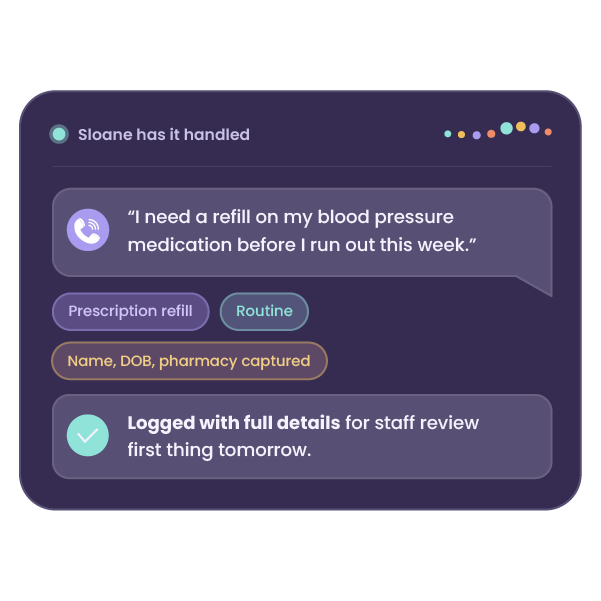
- Routine calls get handled without pulling in a person. Questions about medication refills, insurance, and office hours get resolved without having to pull in staff or providers.
- When a call does need a person, it reaches one with context already in hand. Nothing gets lost in the handoff, and providers aren’t left guessing about who’s contacting them and why.
- Every call follows the same standard, day or night. Patients experience the same call quality at 2 AM as they do at 2 PM.
- Every call leaves a record of routing rationale. What the caller needed, how it was routed, and what happened next is all documented so a practice can see what's working and fix what isn't.
- Patients return for care and recommend your practice. Satisfied patients return because they feel seen and trust your practice to deliver high-quality care, and they can confidently recommend your practice to others.
If you experience any (or all) of these common call routing problems, it’s not your fault. These are symptoms of outdated call services that impact your providers, your staff, your patients, and your practice.
If you’re curious what better call handling looks like, we'd be glad to take a look at your current call workflows with you.
Sources
- The Impact of Long Wait Times on Patient Health Outcomes: The Growing NHS Crisis, Premier Science: https://premierscience.com/pjph-25-726/
- Medical Practice Phone Statistics: 15 Numbers Every Healthcare Provider Should Know, AgentZap.ai: https://agentzap.ai/blog/medical-practice-phone-statistics
- Latest Healthcare Call Center Statistics: Must-Know for 2025, Dialog Health: https://www.dialoghealth.com/post/healthcare-call-center-statistics
- (Outpatient PA) Thoughts on patients demanding a provider phone call? Reddit: https://www.reddit.com/r/physicianassistant/comments/1hwzkmm/outpatient_pa_thoughts_on_patients_demanding_a/?solution=f83f55bddecd516bf83f55bddecd516b&js_challenge=1&token=7afd7253fec22262ff1c52b1703fe9ec2d3a8ff7261eb7817d4dddd49375af0a&jsc_orig_r=
See it working for real teams






.jpg)



.png)





Bring us the workflow that [hurts most]
We'll show you how it runs on PerfectServe, with your teams, your sites and your EHR.