





How To Reduce Stroke Time to Treatment with Better Communication
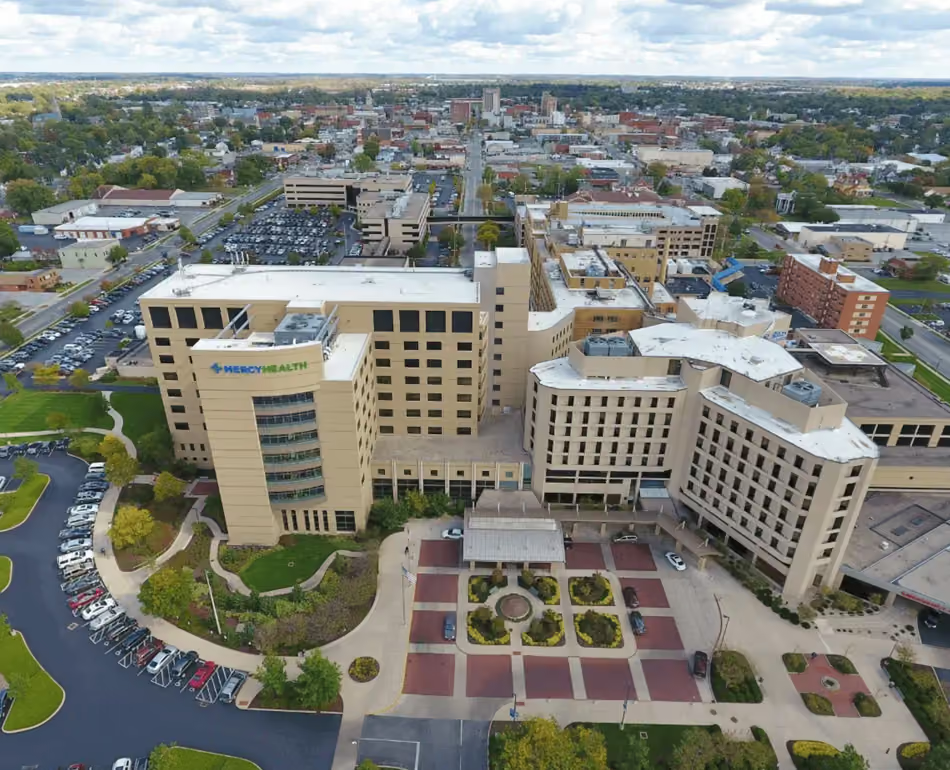
Time to treatment is critical when dealing with stroke patients. That’s why St. Rita’s Medical Center, the largest hospital in a 70-mile radius surrounding its campus in Lima, Ohio, made it a priority to address variations in its stroke team response times.
Background
Time to treatment is critical when dealing with stroke patients. That’s why St. Rita’s Medical Center, the largest hospital in a 70-mile radius surrounding its campus in Lima, Ohio, made it a priority to address variations in its stroke team response times.
The Joint Commission and the American Heart Association/American Stroke Association® recommend that a stroke patient’s treatment plan should follow these guidelines as closely as possible:
- CT scans should be interpreted within 45 minutes of the patient’s arrival at the hospital.
- tPA should be administered within a 60-minute window for maximum effectiveness.
Like many hospitals of its size, St. Rita’s used the overhead intercom to initiate code alerts. That process considerably slowed down the stroke team’s response times and delayed these critical care milestones.
In theory, overhead paging is a quick way to contact all stroke team members at once, and it should have reduced the time it took for team members to arrive. But in practice, the clinicians who needed to respond didn’t always hear the alerts—especially if an alert went out when they were consulting with another patient. That meant nurses would have to contact each team member manually, leading to even longer delays in patient care.
St. Rita’s knew they needed to streamline this process and equip their stroke team with a more effective alert system. Luckily, they were able to leverage their existing clinical communication platform.
A New Look at PerfectServe’s Capabilities
Several years before this stroke initiative began, St. Rita’s implemented PerfectServe Clinical Collaboration to reduce communication cycle times between its clinicians. After seeing significant success in streamlining communication workflows and reducing time to treatment for noncritical patient care, hospital leadership decided to expand their PerfectServe investment with the care team alerts module.
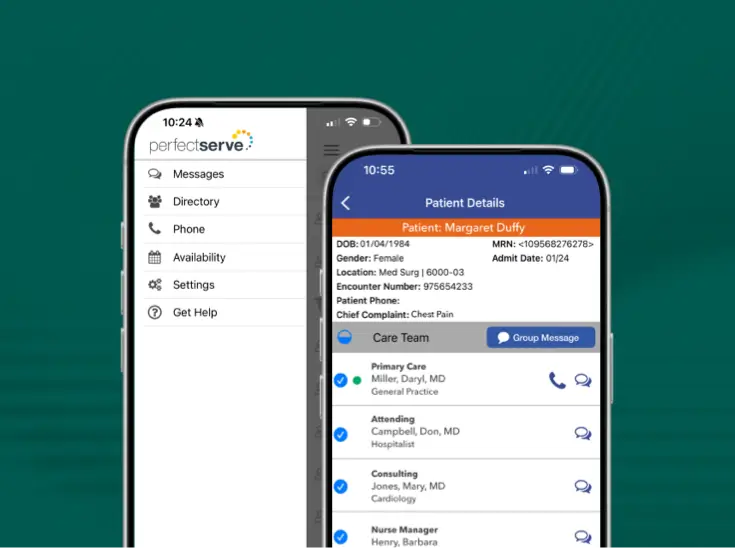
Now, instead of receiving code stroke event notifications over the intercom, each member of the St. Rita’s stroke team—which consists of rapid response nurses, physicians, nursing supervisors, nurse practitioners, radiologists, and managers, along with admissions and patient placement professionals—is immediately notified with the simple touch of a button in the PerfectServe mobile or desktop app.
Because PerfectServe was already used throughout the hospital, implementing care team alerts for the stroke team was simply a matter of setting up the communication rules for each team member. And now that they receive immediate notification of emergent clinical events, the St. Rita’s stroke team has improved and stabilized rapid care team response times.
But they didn’t stop there.
With positive feedback from the stroke team, St. Rita’s leadership enhanced the care team alert functionality even further by adding a component that gives clinicians the ability to send additional alerts to the team, such as notifying them when the stroke patient is receiving tPA and needs to be transferred to the ICU. They’ve also expanded the team to include pharmacy staff to expedite the mixing of time-sensitive medications.
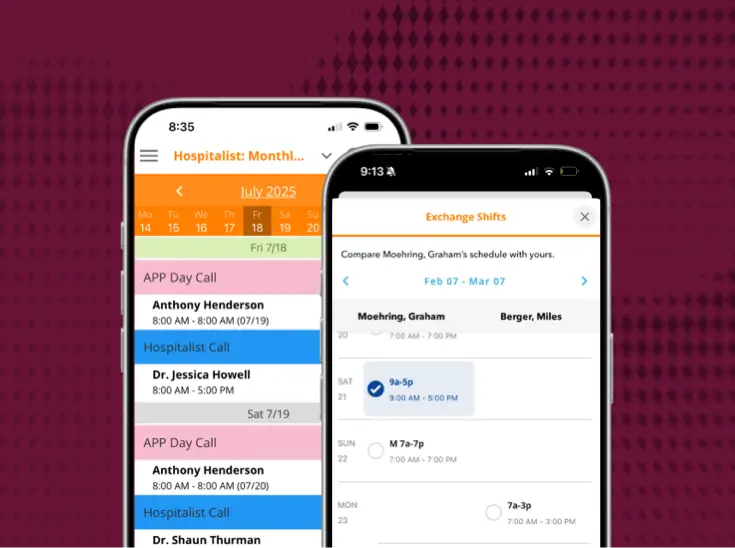
The stroke team credits PerfectServe’s interactive, real-time mobile call schedule, contact method and status management features for empowering them to exchange clinical information quickly and easily.
Surpassing Time-to-Treatment Goals
In addition to following The Joint Commission’s CT scan and tPA administration guidelines, St. Rita’s also wanted to implement response time rules for its stroke team members to follow.
They decided that, at a minimum:
- Physicians should arrive at a stroke patient’s bedside within 10 minutes of the patient’s ED arrival.
- A CT scan for that patient should be ordered within 15 minutes.
- Results of the CT scan, in addition to other tests and blood work, should be completed and available for physician review within 45 minutes.
Since the implementation of PerfectServe’s care team alerts, stroke patients at St. Rita’s are evaluated by a physician and set to receive the necessary scans and tests in about 10 minutes. These low time-to-treatment ratios have surpassed industry standards and remain critical to the stroke team’s success in patient care and safety.
Discover the latest from PerfectServe





.jpg)


.png)






Bring us the workflow that [hurts most]
We'll show you how it runs on PerfectServe, with your teams, your sites and your EHR.