





How to Simplify Psychiatry Residency Schedules

"Our clinical mission can’t be our focus if we’re focused on all these operational logistical pieces. We need tools that will free up mind space and time to pursue and grow our clinical mission."

—Nadia Alamo, Project Manager
Background
The Department of Psychiatry at UNC Chapel Hill is the second largest department within the School of Medicine. As a critical mental healthcare provider for North Carolina’s 11 million residents, the department manages a network of over 200 providers, including attendings, residents, and fellows, across inpatient, outpatient, and specialized treatment programs.
Key Results
∞ to 2x
Reduced schedule publishing from continuous to two times annually
20+
Supported schedules for 20+ new physicians annually
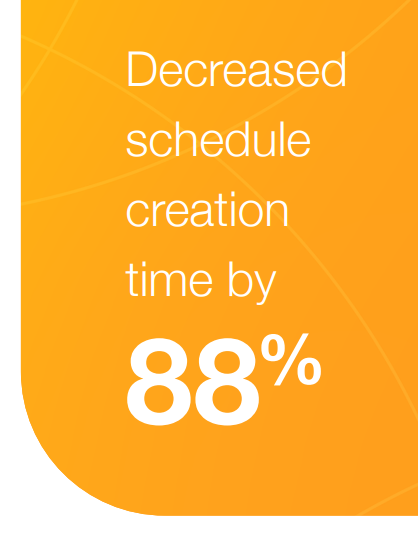
88%
Decrease in time spent creating schedules
1
Source of scheduling truth for all
41
Custom schedule views implemented
Challenges
The scope of operations continues to expand rapidly, as Project Manager, Nadia Alamo explained:
"I’ve been with the department for four years, and we’ve hired 20 new MDs every year since I’ve started, which is unheard of. We used to hire about four per year. We’re growing at an astronomical rate."
Solution & Implementation
The department selected Lightning Bolt for its ability to solve intricate scheduling puzzles through combinatorial optimization. Unlike manual scheduling or simpler automated systems that might get stuck with partial solutions, Lightning Bolt’s optimization engine successfully incorporates all preferences and requirements to create the best possible schedule without gaps.
The department took a strategic approach to implementation, focusing on three key areas:
Distributed Expertise Model
- Training schedule administrators as subject matter experts with standardized operations across all schedulers
- Giving administrators decision-making power about schedules for their location to avoid delays or confusion
- Building an institutional knowledge base
Defined Shift Priorities
- Top Priority: 24/7 attending on-call coverage
- Second Priority: Complex multi-provider schedules (assignments requiring coordination of multiple providers’ availabilities and specialties across different units)
- Third Priority: Simple, straightforward assignments
Custom Visibility Solutions
- 41 tailored schedule views so only critical, role-dependent aspects of the schedule are visible to each user
- Role-based access controls
- Real-time update capabilities
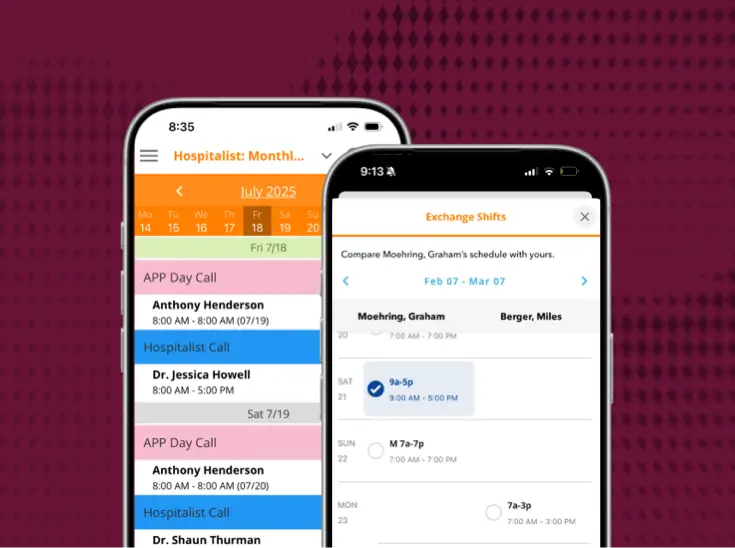
With guidance from their Lightning Bolt technical consultant, the department implemented a structured change management approach. Hands-on training and consistent support helped schedule administrators trust the platform’s ability to manage complex scheduling while remaining flexible to individual needs.
The implementation team focused heavily on stakeholder education and anxiety management. As Nadia notes:
"A lot of what change management is, in my opinion, is anxiety management. People [don’t always trust] that [an automated scheduling tool] will help them the way their supervisor will help them get the schedule that they want."
Results
Operational Transformation
The implementation replaced fragmented processes with streamlined, automated solutions. The most significant operational improvements centered around standardization and centralization:
- Consolidated publishing dates (May 1 and November 1)
- Single source of truth for all schedules
- Automated and balanced provider allocation
- Integrated vacation request management
Efficiency Metrics
Administrative efficiency has seen measurable improvements across all key scheduling processes. In addition to reducing schedule creation time by 88%, the department has documented other significant time savings and process improvements:
Before & After
Schedule Swaps
Publishing Cycles
Source of Truth
Coordination
15
mins
Continuous & inconsistent
Multiple documents
Manual negotiations
30
mins
2x
annually
Single system
Automated resolutions
Strategic Impact
By dramatically reducing the administrative burden associated with scheduling, the department can focus on expansion and improvement of clinical services. This newfound operational efficiency has helped them better support several major initiatives:
- Launching a 54-bed children’s hospital
- Implementing a virtual intensive outpatient program
- Expanding their internal wellness program
- Supporting rapid departmental growth
Lessons Learned
The department’s implementation experience yielded several valuable insights for other organizations considering similar scheduling transformations:
Conclusion
Lightning Bolt has transformed scheduling operations at UNC Chapel Hill’s Department of Psychiatry from a fragmented, time-intensive process to a streamlined, automated system. As the department continues its rapid growth, the platform provides the scalability and efficiency needed to support its expanding clinical mission. Nadia sums up the impact:
"Our clinical mission can’t be our focus if we’re focused on all these operational logistical pieces. We need tools that will free up mind space and time to pursue and grow our clinical mission."
Looking ahead, the department plans to leverage more advanced reporting capabilities, expand to include additional provider types, and find new ways to optimize schedule automation even further.
Discover the latest from PerfectServe






.jpg)




.png)






Bring us the workflow that [hurts most]
We'll show you how it runs on PerfectServe, with your teams, your sites and your EHR.