






Physician Scheduling Best Practices for Medical Groups
Physician scheduling gets harder with every provider, location, and rule you add. Spreadsheets, email threads, and group texts rarely keep up. When scheduling processes break down, the effects reach far beyond the schedule itself.

A provider calls out at 6 AM. Someone has to find coverage, update the schedule, tell everyone affected, and make sure everybody is looking at the same version.
For a small practice, it's just a few messages. But for a growing medical group, this process can take an entire morning. Or more.
Physician scheduling gets harder with every provider, location, and rule you add. Spreadsheets, email threads, and group texts won't cut it. At the same time, providers expect schedules to be fair, flexible, and easy to access, while administrators are tasked with maintaining coverage and controlling administrative burden. It's a lot of details and not much room for error.
When scheduling processes break down, the effects reach far beyond the schedule itself. In a survey of 343 clinicians, burnout was reported by 75% of respondents who lacked control over their workload and schedules, compared with 39% of those who felt they had good control.1
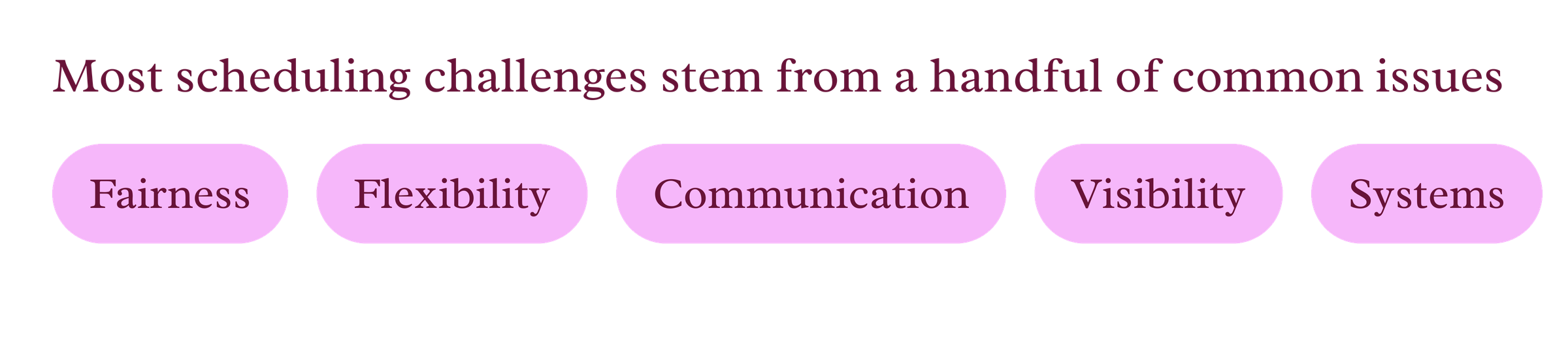
Most scheduling challenges stem from a handful of common (and fixable) issues: fairness, flexibility, communication, visibility, and the systems that support them. Here are six physician scheduling best practices to help medical groups build a scheduling process that providers trust and administrators can more easily manage.
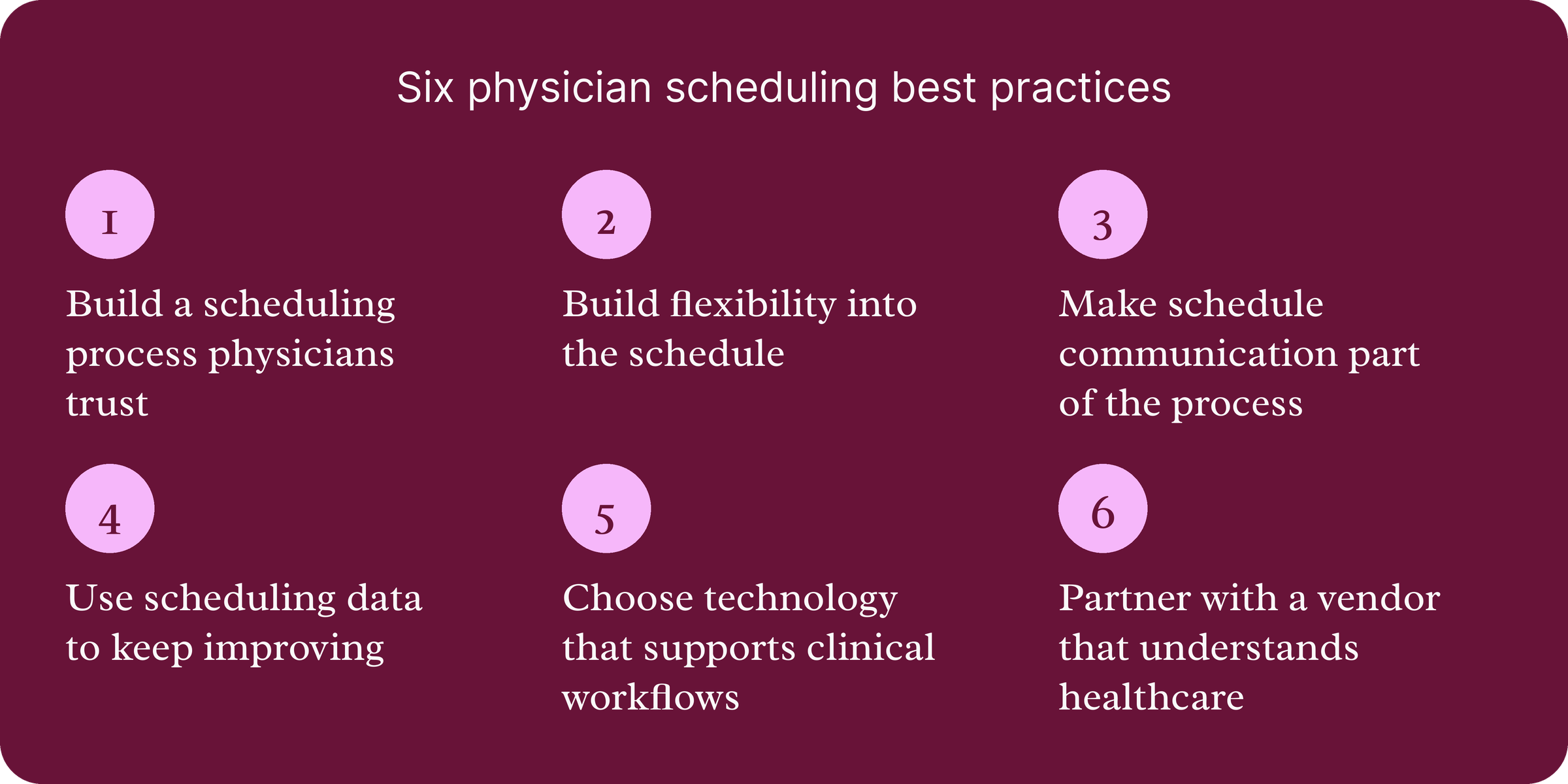
1. Build a scheduling process physicians trust
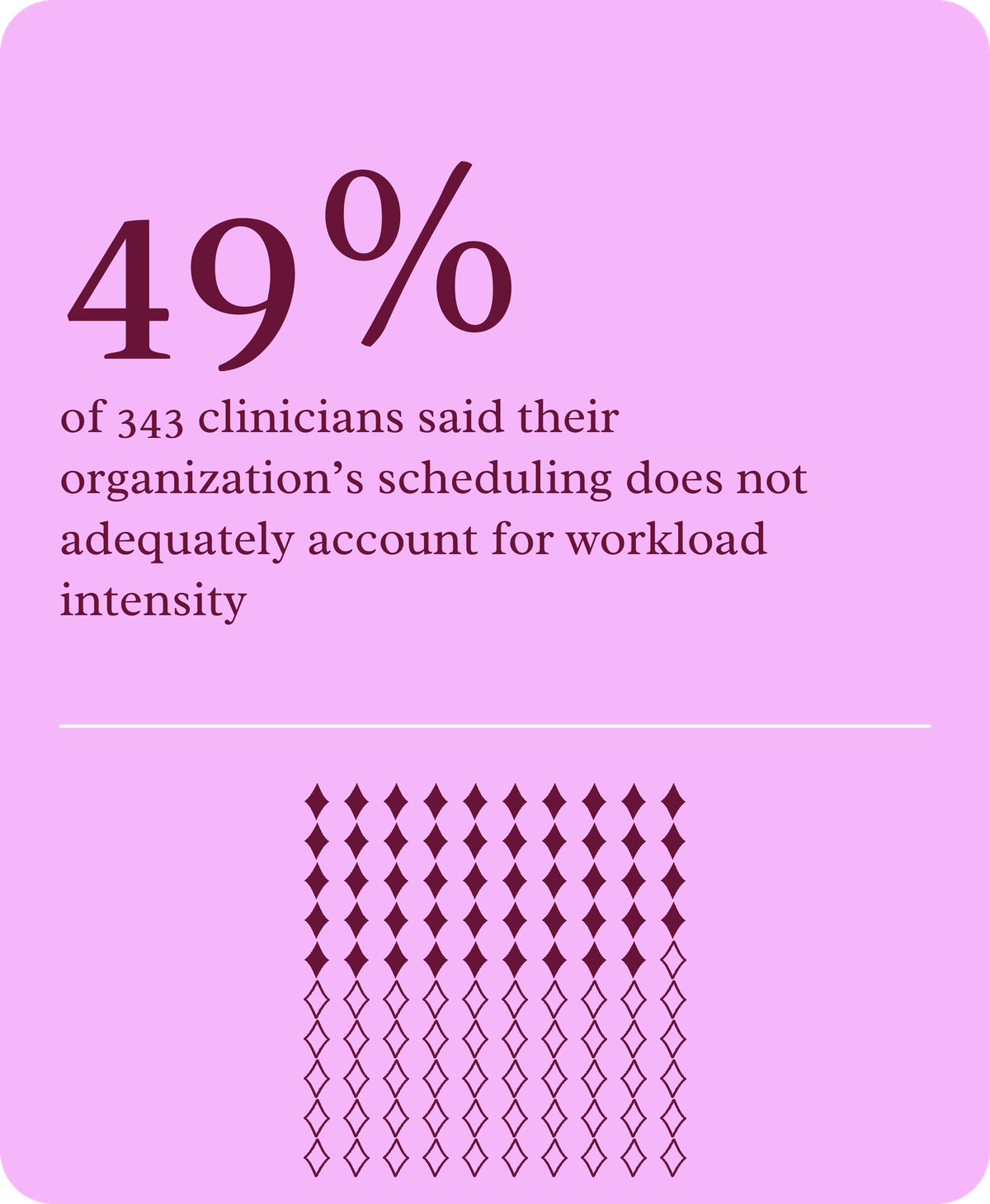
Fairness is the foundation. In the survey mentioned above, 49% of respondents said their organization's scheduling does not adequately account for workload intensity.2 Providers want proof that hard shifts are shared fairly across the physician call schedule.
- Rank shifts by difficulty. Overnight call, weekends, and holidays are not equal burdens, so you should take special care to spread these around evenly.
- Rank your scheduling rules. Some rules cannot bend, like always having an on-call provider and a backup. Others can, if it keeps call fair and doesn't create risk.
- Measure over quarters, not weeks. A schedule can look balanced in a month while one provider quietly carries more call responsibility over a longer stretch of time.
2. Build flexibility into the schedule
Even a careful schedule will not survive unchanged. Time off, emergencies, and long clinic days are normal, so plan for them from the start.
- Capture provider preferences in a structured way so they can inform the schedule and help reduce unnecessary PTO requests and scheduling conflicts.
- Set a clear PTO request process with deadlines, approval criteria, and expectations for busy periods.
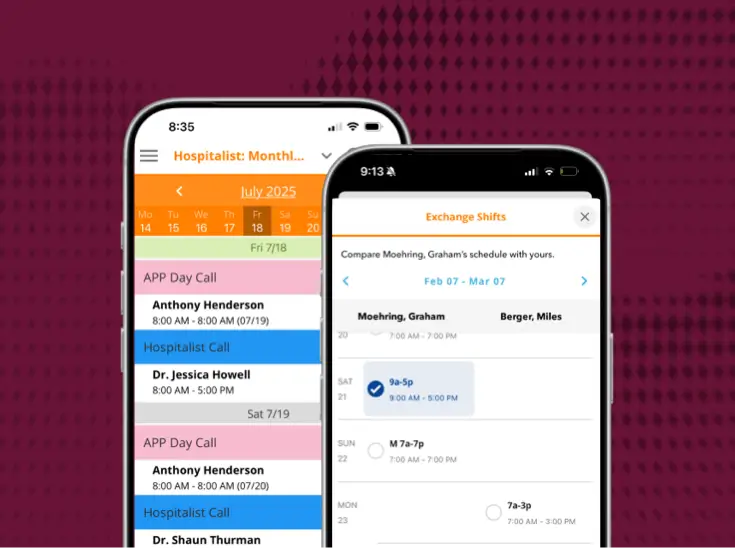
- Define shift swap and coverage procedures so providers can manage shift swaps, address coverage gaps, and resolve conflicts without creating additional administrative work.
3. Make schedule communication part of the process
Building the schedule is half the job. The other half is making sure everyone knows where the current version lives and hears about changes.
- Keep one visible schedule, ideally with a mobile view, so outdated copies stop circulating. If applicable, external partners should be able to see your schedule, too.
- Automate notifications when shift swaps and coverage changes are approved.
- Assign clear ownership so providers know how updates are communicated and when acknowledgment is expected.
4. Use scheduling data to keep improving
Your schedule holds more information than you may realize. Using that information effectively matters, especially when you consider that the AAMC projects a physician shortage of up to 86,000 by 2036.3 Making the most of every provider starts with understanding the patterns hidden in your scheduling data.
- Open shifts can reveal coverage gaps and areas where patient access may be at risk.
- Workload and physician call schedule reports show who carries the heaviest burden and whether coverage is distributed fairly. These reports can help you get ahead of burnout patterns before they take root.
- Shift swap and PTO request trends can reveal assignments, workflows, or coverage models that need to be rethought.
5. Choose technology that supports clinical workflows
The right physician scheduling software makes scheduling easier, not more complicated. Look for:
- Flexible rules for provider preferences, organizational requirements, specialties, and locations
- Automated communication and mobile access
- Built-in reporting and analytics
- Integrations with EHR, payroll, and communication systems (among others)
- Scalability as providers, locations, and scheduling complexity grow
6. Partner with a vendor that understands healthcare
The right partner understands the realities of physician scheduling and supports your team long after go-live.
Look for healthcare expertise, hands-on onboarding, role-based training, ongoing optimization, and responsive support that helps you adapt as your scheduling needs evolve.
Where to start: the FAIR framework
You don't need to tackle every scheduling challenge at once. Start by identifying the area that needs the most attention. The FAIR framework can help you evaluate the strengths and gaps in your current scheduling process:
Ready to Go Deeper?
These six best practices can help your organization improve scheduling today, but sustainable success requires a repeatable framework.
Download our physician scheduling best practices guide for detailed examples, implementation tips, and the complete FAIR framework for evaluating and improving your scheduling process.
See it working for real teams



















Bring us the workflow that [hurts most]
We'll show you how it runs on PerfectServe, with your teams, your sites and your EHR.