






QGenda vs Lightning Bolt: Which Handles Complex Healthcare Scheduling Better?
Most healthcare scheduling software can build a schedule. What really matters is what happens when the rules get complicated.

Most healthcare scheduling software can build a schedule. What really matters is what happens when the rules get complicated.
Schedulers must balance call, organizational requirements, credentialing restrictions, and many other variables. Different healthcare organizations, from small practices to large multi-site health systems, manage these variables in different ways. Increasingly, that looks like using scheduling software in the vein of QGenda or Lightning Bolt Clinical Team Scheduling.
But with software, the challenge goes beyond generating the schedule. That's because the real challenge is ensuring the schedule doesn’t require hours of manual cleanup after it’s made.
Let's take a look at QGenda and Lightning Bolt to analyze how each solution builds schedules and which is better optimized for healthcare.
QGenda Overview
QGenda is a healthcare workforce management platform designed to help organizations manage physician and staff scheduling, provider credentialing, on-call schedules, workforce analytics, and related operational workflows.
The platform is used by hospitals, health systems, and medical groups to coordinate workforce coverage, track staffing needs, and manage provider availability across departments and locations.
Core capabilities:
- Physician scheduling
- Workforce management and staffing optimization
- Workforce analytics and reporting
- Provider credentialing and enrollment management
Lightning Bolt Overview
PerfectServe's Lightning Bolt Clinical Team Scheduling is a healthcare scheduling solution made for provider and staff scheduling. It’s used by hospitals, health systems, and medical groups to automate provider scheduling while balancing organizational requirements, provider preferences, equity considerations, and coverage needs.
The platform also connects with the broader PerfectServe ecosystem to support communication and care team coordination.
Core capabilities include:
- Provider scheduling
- AI-powered scheduling automation
- Schedule reporting
- Integration with other clinical systems
How scheduling algorithms impact schedulers
The effectiveness of scheduling software is usually measured by the quality of the schedule it generates. Most modern platforms can automate schedule creation, but they differ in the amount of work still left to be done once the first draft of the schedule is done.
This leftover manual “fixing” is what can make or break a scheduler’s time.
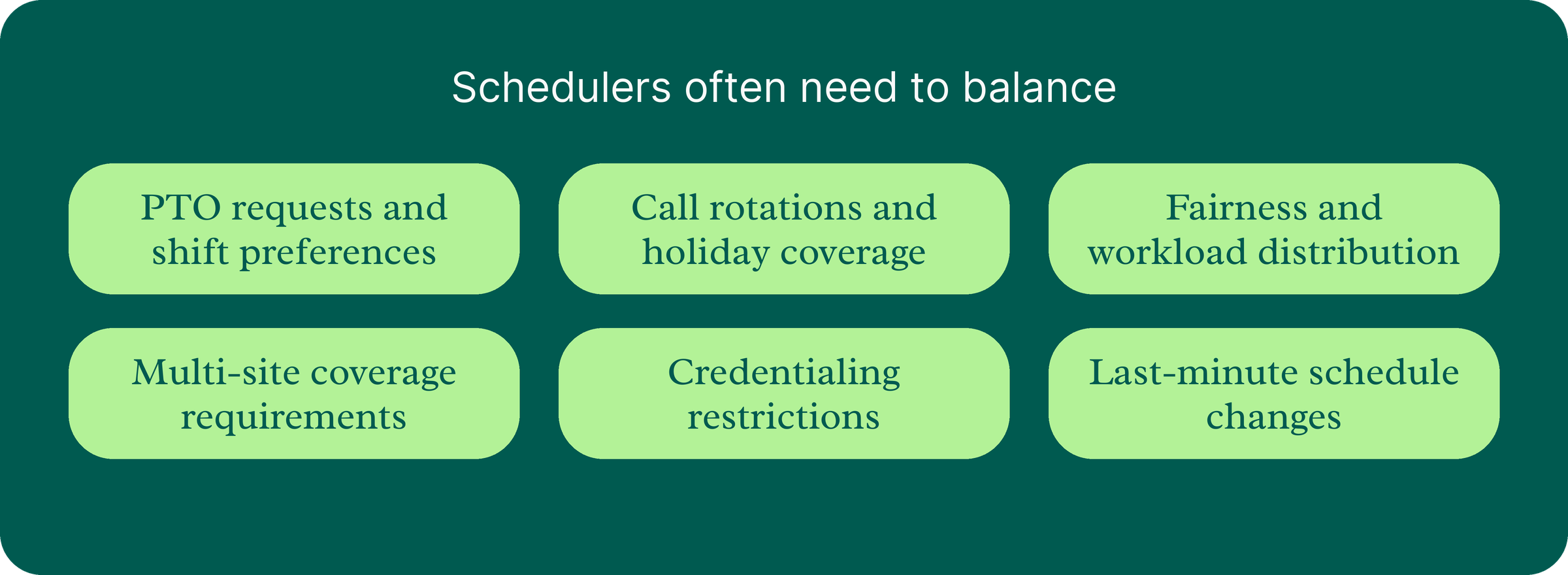
As organizations grow and scheduling rules become more complex, schedulers often need to balance:
- PTO requests and shift preferences
- Call rotations and holiday coverage
- Fairness and workload distribution
- Multi-site coverage requirements
- Credentialing restrictions
- Last-minute schedule changes
When these requirements compete with one another, the scheduling engine must determine how to prioritize and balance them. The more effectively a scheduling platform accounts for those constraints during schedule generation, the less time schedulers have to spend making manual adjustments afterward.
QGenda vs Lightning Bolt: Scheduling engine differences
Not all scheduling platforms solve scheduling challenges the same way. The methodology behind the scheduling engine can influence schedule completeness, fairness, and schedule adjustment time.
QGenda uses a heuristic model, which applies scheduling rules and priorities in a fairly straightforward manner to generate a workable schedule. Lightning Bolt uses an AI-backed combinatorial optimization algorithm that considers many possible scheduling scenarios at once to balance coverage, preferences, and fairness requirements.
The key difference between these scheduling approaches comes down to how they handle complexity and real-time shift management. As organizations add more scheduling rules, coverage requirements, locations, and provider preferences, it becomes more likely that multiple rules or variables will come into conflict with one another. When faced with two conflicting rules that have equal importance (maybe both are labeled "high" priorities), a heuristic model is likely to leave a gap since it can't pick one over the other. Lightning Bolt, on the other hand, allows for a much wider range of rule priorities, and that nuance means it's more capable of generating a complete, optimized schedule that accounts for all available rules.
Lightning Bolt also makes it possible to manage and update schedules in real time, granting the scheduler the ability to trust that the schedule is not only optimized, but also accurate at all times.
Why finding the right scheduling solution matters
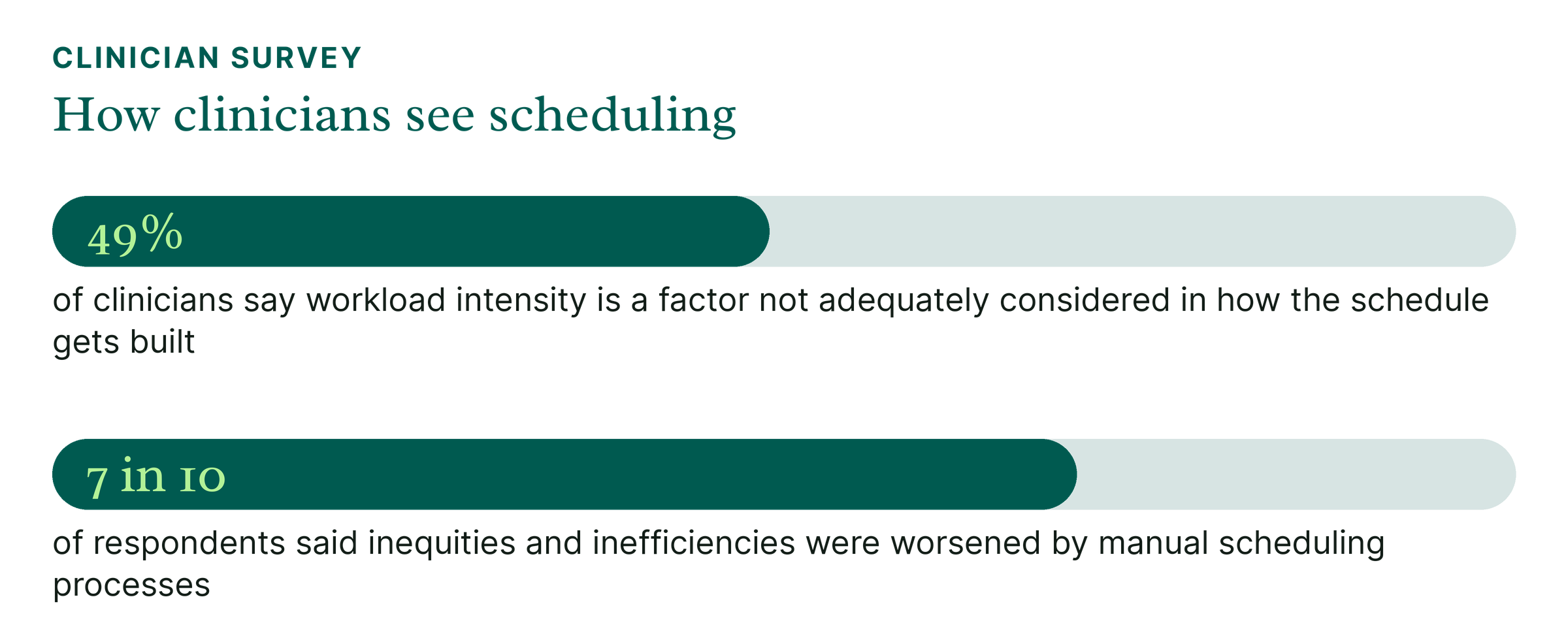
Different scheduling engines and methodologies aren’t just technical distinctions. The schedules they generate affect the day-to-day experiences of schedulers, providers, leaders, and even patients whose care relies on accurate schedules. PerfectServe's own research has found that 49% of clinicians say workload intensity is a factor not adequately considered in how the schedule gets built, so there's clearly an appetite for schedules that better support and "recognize" the kind of work clinicians are doing every day. No two shifts are alike, after all.
Schedule Completeness
As scheduling complexity increases, schedulers often need to balance dozens or even hundreds of requirements simultaneously. Coverage rules, provider preferences, credentialing restrictions, and call responsibilities all have to compete with one another.
Solutions that can more flexibly evaluate different constraints during schedule generation may reduce the amount of manual review and adjustment required before schedules are finalized. For example, if there are only three priorities available for every rule (low, medium, high), you're much more likely to run into situations where the system gets deadlocked because it's trying to pick between two rules with the exact same priority level. A system that allows for a wider range of numerical priority assignments (say, from 1 to 1,000 for each rule) has more built-in flexibility and is less likely to stumble when choosing between two rules of similar—but not exactly the same—priority level.
More flexibility during schedule creation means you're more likely to get a completed schedule with no gaps.
Equal vs. Equitable
Schedule equity has become an increasingly important component of provider scheduling. In a 2025 survey of nearly 350 clinicians, 7 in 10 respondents said scheduling inequities and inefficiencies were made worse by manual scheduling processes.
This highlights the role scheduling practices can play in provider satisfaction and burnout. Schedulers and providers both want schedules that meet coverage requirements and distribute desirable and undesirable shifts (like weekends, holidays, and overnight call) equitably.
While both QGenda and Lightning Bolt support scheduling rules and coverage requirements, Lightning Bolt's combinatorial optimization approach is better designed to evaluate fairness considerations alongside other scheduling constraints during schedule generation.
Measuring Schedule Fairness
Fairness can be difficult to assess without visibility into scheduling patterns over time. Scheduling reports can help answer questions such as:
- Are call responsibilities distributed equitably across the group?
- Are the same providers consistently assigned weekends or holidays?
- How often are provider preferences accommodated?
- Are workloads balanced across locations, shifts, and service lines?
Lightning Bolt includes customizable reporting capabilities that allow organizations to analyze scheduling trends over time and measure fairness across providers, shift types, service lines, and coverage assignments. This visibility can help schedulers validate that scheduling policies are being applied consistently and make data-driven adjustments when needed.
QGenda vs. Lightning Bolt: Different scheduling engine outcomes
Healthcare organizations are ultimately concerned with outcomes. The differences between heuristic and combinatorial optimization scheduling models can impact how schedulers manage complexity, resolve conflicts, and maintain schedules as organizational requirements evolve.
Which Scheduling Platform Is Right for You?
Both QGenda and Lightning Bolt help healthcare organizations automate provider scheduling, but they take different approaches to solving scheduling challenges.
QGenda may be a good fit for organizations that:
- Need a workforce management platform that includes credentialing, workforce analytics, and related operational tools
- Want to manage provider scheduling as part of a broader workforce management strategy
- Are evaluating workforce operations beyond scheduling alone
Lightning Bolt may be a good fit for organizations that:
- Need scheduling technology that can account for complex coverage requirements, provider preferences, and organizational policies simultaneously
- Want to reduce the amount of manual schedule review and adjustment after schedule generation
- Prioritize schedule equity, provider satisfaction, and balanced workload distribution
- Want a scheduling solution that integrates with an entire platform of clinical communication tools (along with 270+ other clinical and IT systems)
See how Lightning Bolt uses combinatorial optimization to build equitable, optimized provider schedules while reducing manual scheduling effort. Request a demo to learn more.
Latest news from PerfectServe


















Bring us the workflow that [hurts most]
We'll show you how it runs on PerfectServe, with your teams, your sites and your EHR.