





8 Best QGenda Competitors for Physician Scheduling and Clinical Communication
This guide highlights 8 QGenda competitors and compares features, reviews, and pricing so you can choose the physician scheduling solution that best fits your organization’s needs.

Quick Summary
Many hospitals struggle with the complexities of physician scheduling and the resulting coordination gaps that waste thousands of clinical hours each year. The vendor makeup in the physician scheduling space has changed quite a bit in the past few years, both with acquisitions of existing vendors and new vendors entering the field. The current landscape may be a bit confusing, so it’s a good time to take a look at current players and compare their features.
QGenda is well established in the physician scheduling market segment, with a broader focus on workforce management. Other functionality includes credentialing, clinical capacity and workforce analytics, and room utilization.
This guide highlights 8 QGenda competitors and compares features, reviews, and pricing so you can choose the physician scheduling solution that best fits your organization’s needs.
Our Shortlist: The Top 3 QGenda Alternatives in 2026
Why Listen To Us?
PerfectServe has been improving healthcare scheduling and communication for almost 30 years. Our solutions are deployed in 500+ hospitals and facilitate daily operations for 1 million users. We support a wide range of health systems, hospitals, medical groups, specialty networks, and clinics that need help managing complex physician and staff scheduling and clinical communication workflows.
Our clients regularly see significant decreases in time devoted to schedule creation. Before Lightning Bolt, UK HealthCare’s hospitalist group spent nearly 1,300 hours building and managing provider schedules. After the switch, that number dropped to just 260 hours per year. A 60-physician radiology group used Lightning Bolt to gradually expand its interventional radiology service line to 5 full days per week, which opened up more revenue opportunities and expanded patient access without sacrificing the providers’ work-life balance.
Lightning Bolt has also been named Best in KLAS in the physician scheduling category a total of five times, including the past three years: 2017, 2018, 2024, 2025, and 2026.

What is QGenda?
QGenda is a cloud-based workforce management solution used by healthcare organizations of various sizes and specialties. It’s known mostly for physician and nurse scheduling, but also does a good job managing credentialing and time tracking. QGenda does support basic in-app secure messaging, but its messaging functionality doesn’t approach the sophistication of established clinical communication platforms.

Some users have reported that QGenda’s auto-generated schedules leave coverage gaps that require manual oversight and correction. Other long-time users have noted that, as the company has grown, its customer service model has shifted to a pooled approach that no longer emphasizes dedicated resources for each account. This requires customers to enter a general support queue when they need help.
Key Features
- Provider Scheduling: Auto-generated schedules powered by heuristics for physicians, residents, and clinical staff.
- On-Call Management: Enterprise visibility for the providers on call, along with mobile access and shift trading.
- Reporting and Workforce Analytics: Reports, filters, and analytics that help organizations understand provider supply and demand.
- Credentialing: In-solution credential management and accelerated provider onboarding to deliver and bill for patient care sooner.
- Room Utilization: Centralized visibility into accurate provider and exam room utilization.
Pricing
QGenda does not publish pricing publicly. It operates on a scalable, per-provider pricing model, and may also offer facility pricing. Organizations currently on Shift Admin (QGenda’s acquired product, which is being sunsetted) have reported that they’re being migrated to the QGenda platform, so pricing for them may change.
Pros
- Auto-generation capabilities for physician scheduling
- Rules can account for individual preferences
- Scales well for large health systems
- Established reputation in healthcare workforce management
Cons
- Customers have noted that QGenda’s heuristic algorithm may generate incomplete schedules that require a fair amount of manual manipulation.
- QGenda has moved to a centralized support model, replacing dedicated resources with a pooled help desk. This may impact response times and support consistency if reps aren’t familiar with the account from which they’re fielding an inquiry.
- Customers don’t have direct access to the back end of the platform where scheduling rules are configured. Rule updates and troubleshooting require going through QGenda support.
- Some customers have reported limitations with key integrations, particularly EHR schedule synchronization and payroll connectivity.
The Comparison Table: Best 8 QGenda Competitors
1. PerfectServe (Lightning Bolt Scheduling)
PerfectServe’s Lightning Bolt Scheduling is the leading QGenda competitor because it’s one of the most advanced and effective physician scheduling platforms on the market. It’s a 5-time Best in KLAS winner (2017, 2018, 2024, 2025, 2026) that generates complete, optimized schedules that can be tailored to the needs of any healthcare organization, whether it’s a department, clinic, specialty network, or large health system. Lightning Bolt doesn’t just schedule providers. It builds the best schedule every time.

Additionally, Lightning Bolt customers have access to a dedicated, 24/7 customer support team. PerfectServe understands the importance of physician scheduling and the impact it can have on a healthcare organization’s day-to-day operations, so its customer success function is built to be available for customers whenever the need arises.
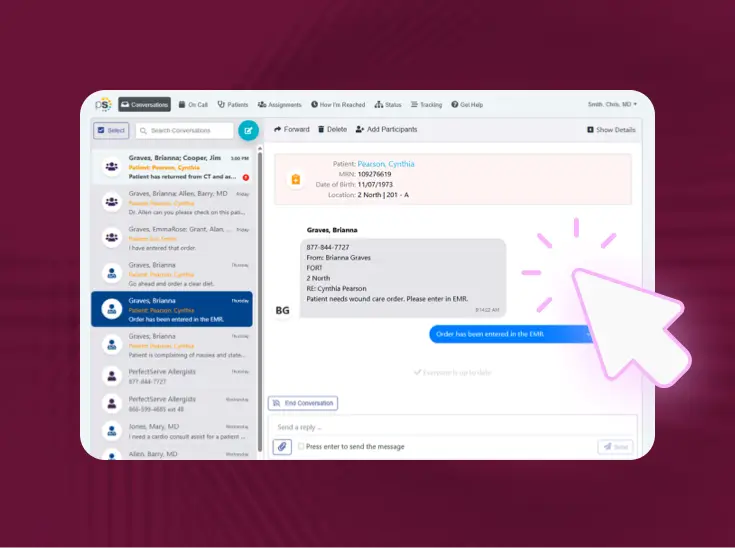
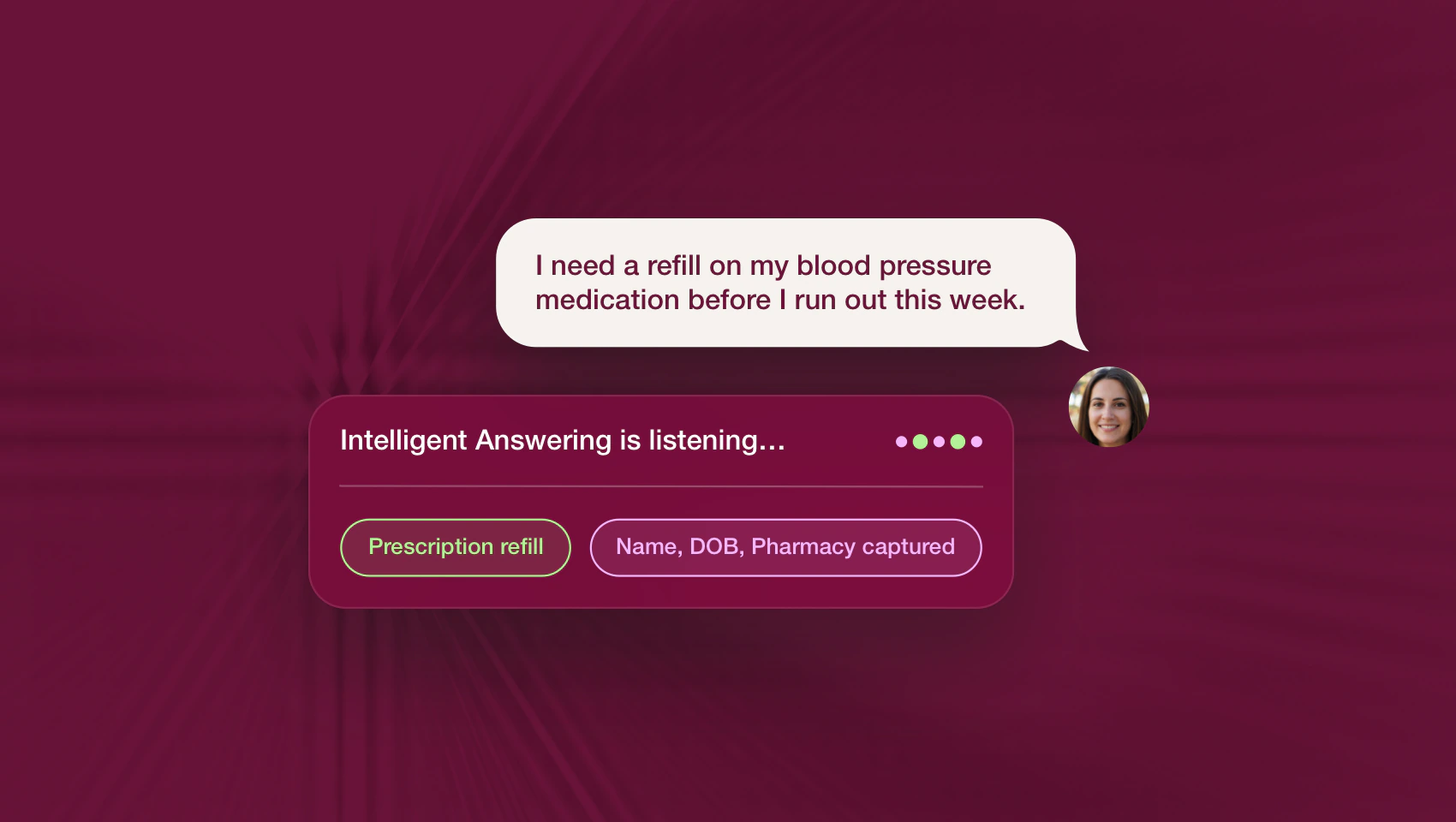
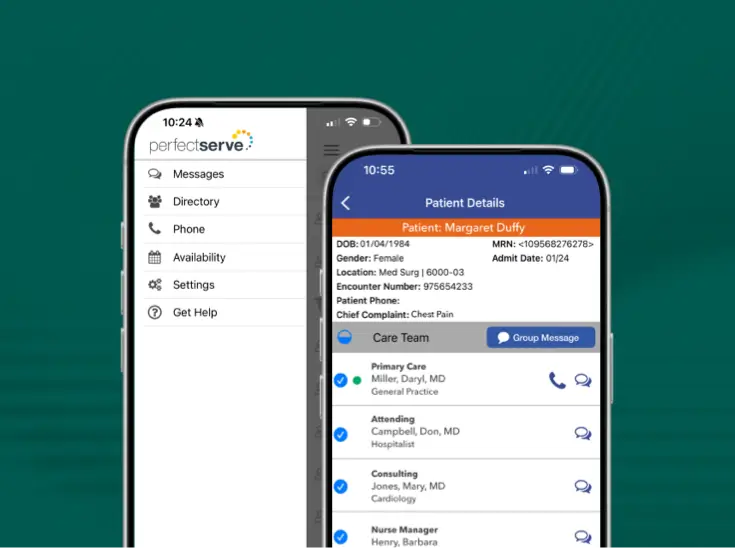
PerfectServe also offers highly customizable clinical communication software built for clinics, medical groups, hospitals, and health systems. By pairing Lightning Bolt with PerfectServe’s intelligent clinical communication solution, healthcare organizations can manage provider scheduling and care team communication in one system to drive faster speed to care.
Key Features
- Unlimited Rules: Lightning Bolt uses combinatorial optimization to create the best possible schedule with custom rules and priority levels that align with your group's requirements and individual provider preferences.
- Data and Analytics: Track PTO, assignments, availability, and changes using automated reports with privacy controls.
- Integrations: Connect to other key systems (EHR, payroll, clinical communication) to prevent errors from manual entries, power clinical workflows, increase schedule visibility, and ensure accurate pay.
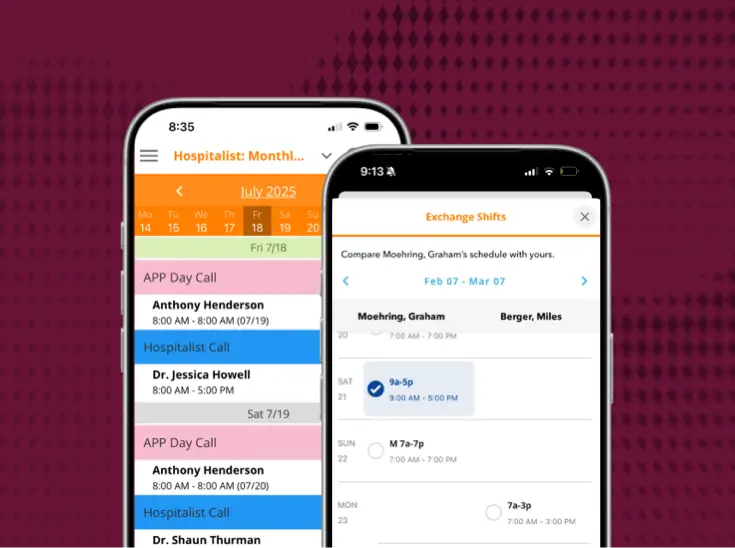
- Flexible Shift Swaps: Get coverage from a specific colleague or offer shifts to multiple team members at once.
- Mobile App: View and manage schedules anywhere — submit PTO requests, swap shifts, or offer coverage.
- Control Access: Customized privileges across roles allow for different setups, including admin oversight for all shift swaps and schedule changes, or a decentralized approach that allows providers to adjust on their own.
- Public Link Sharing: Share schedules with anyone using public links; no logins required.
Pros
- Can handle any degree of schedule “difficulty,” from simple to very complex
- Works for organizations of any size, from groups with 10 physicians to national health systems
- Auto-generates optimized schedules while reducing manual scheduling workload significantly
- Takes into account individual provider preferences and organizational requirements
- Deep integration support, including EHRs, payroll, and clinical communication systems
- Paired with PerfectServe Clinical Collaboration, offers unified communication and scheduling in one platform
Cons
- Requires time investment on the front end to take advantage of feature depth and customizable rules
- Limited full-month visibility in some interface views
2. Doximity (Amion Physician Scheduling)
Amion (now owned by Doximity) is a widely used physician scheduling platform designed to manage on-call schedules, rotations, and shift coordination across healthcare organizations.

Key Features
- Centralized physician and on-call scheduling
- Automated schedule building with templates and rules
- Shift swaps, time-off requests, and schedule tracking
Pros
- Easy to use and quick to navigate for daily scheduling tasks
- Strong mobile access for checking schedules and contacting providers
Cons
- Mobile experience can feel limited or less intuitive
- Interface and capabilities may feel basic compared to modern enterprise solutions
3. TigerConnect Physician Scheduling
TigerConnect Physician Scheduling (formerly Call Scheduler, which TigerConnect acquired in 2020) is a cloud-based physician scheduling platform designed to manage on-call schedules, shift assignments, and provider availability across healthcare organizations.

Key Features
- Automated physician and on-call scheduling
- Role-based scheduling with customizable rules
- Management of time-off requests and shift swaps
Pros
- Highly rated for usability, ease of deployment, and cross-platform access
- Mobile access allows providers to check schedules anytime
Cons
- May have difficulty with complex schedules for specialties like radiology or cardiology
- Users have reported uneven customer support experiences
- Other users have reported that TigerConnect's scheduling and messaging functions are housed in separate apps
4. symplr Physician Scheduling
symplr Physician Scheduling (formerly SpinFusion, which symplr acquired in 2021) is an enterprise-grade physician scheduling platform designed to simplify complex scheduling processes across hospitals and health systems.

Key Features:
- Customizable scheduling rules and templates
- Integration with payroll, EHR, and workforce systems
- Time tracking and workforce analytics
Pros
- Highly customizable and automated scheduling workflows for complex environments
- Helps streamline provider management, credentialing, and compliance processes
Cons
- Interface and usability may feel complex compared to simpler tools
- May be more capability than necessary for small practices with basic scheduling needs
- Users have reported difficulty getting timely responses from symplr's customer support team
5. UKG EZCall
UKG EZCall is a powerful, enterprise-grade physician scheduling platform. It helps organizations create fair, flexible, and compliant physician schedules using rule-based automation.

Key Features
- On-call scheduling and shift distribution
- Mobile access for viewing and swapping schedules
- Real-time dashboards and workforce analytics
Pros
- Capable of handling fairly complex scheduling rules
- Can improve fairness and workload distribution across providers
Cons
- Setup and configuration may require time and technical expertise
- Some users have reported slow responses from customer support
- It can be expensive due to enterprise-level pricing models
6. Petal Health
Petal Health is a Canada-based healthcare workforce platform. It delivers a comprehensive, modular system for automated physician scheduling, on-call management, and clinical communications.

Key Features
- AI-driven automated scheduling
- On-call solutions with instant live provider access
- Secure clinical communications integrated directly with live scheduling data
Pros
- Petal Health reports a 98% reduction for schedule creation time
- Allows customers to deploy one product without committing to the full suite
Cons
- Much smaller US customer base compared to PerfectServe or QGenda
- Pricing is not publicly available
7. Intrigma
Intrigma is a physician and nurse scheduling platform built for medical groups, hospitals, and urgent care networks of all sizes.

Key Features
- Self-scheduling mobile app
- Automated physician scheduling with customizable rules
- Open shift management automatically matches available clinical workers to unfilled shifts based on skills and availability
Pros
- The free entry tier makes it genuinely accessible for small and mid-size practices
- 100% customer satisfaction rating on support tickets per published data
Cons
- Scheduling-only tool—no support for clinical communication, on-call routing, or after-hours call management
- Fewer enterprise integrations compared to larger platforms
8. MDsyncNET
MDsyncNET is a dedicated physician scheduling platform built to manage on-call schedules, provider availability, and shift coordination across healthcare organizations.

Key Features
- Physician and on-call scheduling management
- Customizable call rotations and scheduling rules
- Real-time schedule updates and provider availability tracking
Pros
- Effective for managing on-call rotations and coverage
- Reduces manual coordination and scheduling errors
Cons
- Interface and features may feel basic for large hospitals
- Fewer integrations than larger enterprise scheduling systems
Why Healthcare Teams Are Switching to PerfectServe’s Lightning Bolt Scheduling
Physician scheduling is where operational excellence starts … and where it can unravel. Every coverage gap creates a downstream cascade: delayed responses, rerouted messages, care team confusion. The best scheduling platforms don't just fill slots. They feed real-time availability into the systems and people who need it.
That's where Lightning Bolt outperforms every other solution on this list. Its combinatorial optimization engine builds the best possible schedule, not just a workable one, given your rules, preferences, and constraints. And because Lightning Bolt is part of the PerfectServe platform, schedule data flows directly into intelligent on-call routing, so the right provider is always reachable at the right time.
The results are measurable: organizations using Lightning Bolt reduce schedule creation time by up to 82% and reach on-call physicians 88% faster. That’s why Lightning Bolt has been named Best in KLAS in physician scheduling five times (2017, 2018, 2024, 2025, 2026).
If you're evaluating QGenda alternatives, get a Lightning Bolt demo to take a closer look.
Latest news from PerfectServe






.jpg)





.png)





Bring us the workflow that [hurts most]
We'll show you how it runs on PerfectServe, with your teams, your sites and your EHR.