


The Real Cost of Vibe-Coding Physician Scheduling Software in 2026: What Healthcare Leaders Need to Know
AI is transforming healthcare operations, but not all AI approaches are created equal. It can't replace purpose-built scheduling software designed specifically for healthcare organizations.

AI is transforming healthcare operations, but not all AI approaches are created equal. As excitement around generative AI and "vibe coding" continues to grow, some healthcare organizations are beginning to explore whether physician scheduling software can be rapidly built using large language models and agentic AI tools.
The promise sounds compelling: lower upfront costs, faster development, and complete customization, but the reality is often far more complex.
Physician scheduling impacts patient access, provider satisfaction, regulatory compliance, and clinical operations. That means healthcare organizations need more than software that just appears to work. They need a solution that consistently delivers safe, optimized, compliant schedules at enterprise scale.
This is where the distinction between vibe coding, agentic AI, and purpose-built healthcare scheduling platforms becomes critical. And it's why organizations continue to rely on proven solutions like Lightning Bolt Clinical Team Scheduling rather than treating physician scheduling as an AI experiment.
What Is "Vibe Coding"?
"Vibe coding" generally refers to building software through generative AI systems, allowing the AI to generate most or all of the application's code.
This process can accelerate prototyping, but healthcare leaders should recognize that generating software and operating mission-critical healthcare infrastructure are fundamentally different challenges.
A scheduling application may successfully generate a calendar interface, time-off requests, and shift assignment logic. But physician scheduling is far more complex than creating a user interface.
Enterprise physician scheduling requires:
- Coverage optimization
- Specialty-specific scheduling rules
- Call schedules
- Fairness and workload balancing
- Multi-site coordination
- Regulatory requirements
- Integration with clinical workflows
- Security and auditing requirements
- Ongoing governance and support
The complexity is in building the decision engine that powers the schedule, not just designing the screen and UI.
The Hidden Cost #1: Implementation Complexity
One of the biggest misconceptions surrounding AI-generated applications is that development equals deployment. In reality, physician scheduling implementations often require hundreds of scheduling variables and business rules.
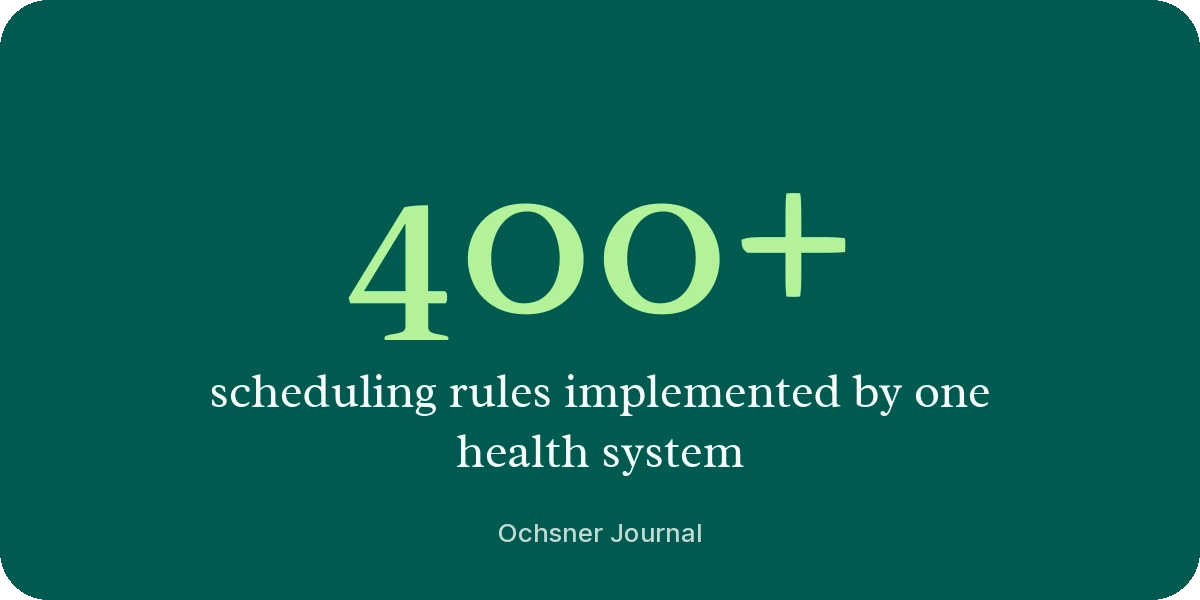
One health system implemented more than 400 scheduling rules within Lightning Bolt's scheduling engine to optimize staffing and clinician workload.1 The platform uses combinatorial optimization to evaluate scheduling scenarios and generate optimized schedules.
Similarly, Lightning Bolt has documented customer environments with more than 213 scheduling rules and over 1,000 monthly requests and preferences incorporated into schedule generation.2
Healthcare organizations often discover that implementing scheduling logic is significantly more difficult than generating code. A vibe-coded scheduling application may generate schedules, but can it consistently account for the following?
- Specialty requirements
- Credentialing constraints
- Vacation policies
- Call distribution fairness
- Work-hour restrictions
- Site coverage requirements
- Provider preferences
- Real-time schedule changes
The Hidden Cost #2: "Who Do You Call When It Breaks?"
Support is one of the least discussed risks of AI-generated software, because care don't stop at 5 PM.
If schedules fail to generate, call routing breaks, or coverage gaps appear, organizations need immediate expertise. And with a purpose-built vendor, there is accountability through:
- Dedicated implementation teams
- Product specialists
- Technical support
- Customer success resources
- Escalation paths
By contrast, organizations building critical workflows on top of foundation models often inherit platform dependencies they do not control.
AI model providers often introduce new versions and retire old models, which can modify capabilitites and generated code. Anthropic's documentation explicitly notes that applications may require updates as models are deprecated and replaced over time.3
For healthcare leaders, this creates an important operational question: If a model update changes application behavior, who owns troubleshooting, validation, compliance review, and remediation?
While AI is admittedly fast, operating software that care teams depend on to delivery high-quality patient care requires stability, accountability, and support. That's not something an AI bot can just replace.
The Hidden Cost #3: Garbage In, Garbage Out
AI systems are only as effective as the data, constraints, and objectives they're given, and ,healthcare scheduling is especially vulnerable to this reality. Missing provider data, poorly defined rules, inaccurate availability, or incomplete coverage requirements can all produce schedules that aren't fair, are missing information, or create gaps in coverage that trickles down and impacts patients.
A 2026 WIRED investigation reported complaints from nurses regarding AI-supported scheduling deployments associated with Palantir-powered workforce management tools. Some nurses reported scheduling issues involving preference matching, staffing assignments, and workload concerns.
Healthcare IT News also reported questions raised by nursing organizations regarding automated staffing technologies and the level of clinical oversight required for workforce scheduling decisions.
To be clear, these reports are not evidence that all AI scheduling systems are flawed, but they do illustrate an important principle: AI does not automatically produce better schedules simply because AI is involved.
Agentic AI, Generative AI, and Optimization AI Are Not the Same Thing
Many conversations about AI lump together fundamentally different technologies, when they all work differently.
Generative AI
Generative AI models, like Claude, ChatGPT, and Gemini, create text, code, and content based on prompts. These systems excel at creating outputs but are not inherently designed to solve complex workforce optimization problems.
Agentic AI
Agentic systems use AI-driven workflows to complete multi-step tasks autonomously. These systems are promising but still require governance, validation, and oversight, particularly in regulated industries.
Optimization AI
Optimization AI is completely different. Lightning Bolt has used optimization-based AI techniques for physician scheduling for many years, leveraging complex mathematical algorithms like combinatorial optimization to evaluate millions of potential scheduling combinations and identify optimal staffing configurations.
These are similar to what airline systems use to manage the complexity of flight schedules, and the distinction matters. Healthcare scheduling is not primarily a content-generation problem, but an optimization problem.
In short, if you're going to use AI for healthcare scheduling, it needs to be purpose-built for healthcare systems.
The Hidden Cost #4: PHI, HIPAA, SOC 2, and Compliance Risk
Healthcare organizations must evaluate more than functionality, because healthcare orgs have to consider compliance. Questions leaders should ask include:
- Where is Protected Health Information (PHI) stored?
- What data is shared with AI providers?
- How are audit logs maintained?
- How are access controls enforced?
- How are model outputs validated?
- How is data retained and deleted?
Orgs remain responsible for HIPAA compliance regardless of how applications are built. That means if you use AI that isn't HIPAA-compliant and something happens, it falls on your organizations.
Lightning Bolt is marketed as a healthcare scheduling platform designed for healthcare environments and identifies HIPAA and SOC 2 compliance among its certifications and controls.
Organizations developing custom scheduling applications may need to independently address the following:
- HIPAA compliance
- SOC 2 controls
- Vendor risk management
- Business associate agreements (BAAs)
- Security monitoring
- Penetration testing
- Disaster recovery planning
- Ongoing compliance audits
These are rarely included in the apparent "savings" associated with rapid AI-generated development.
The Hidden Cost #5: Dynamic Routing and Operational Intelligence
Creating a schedule is only one component of care team coordination.
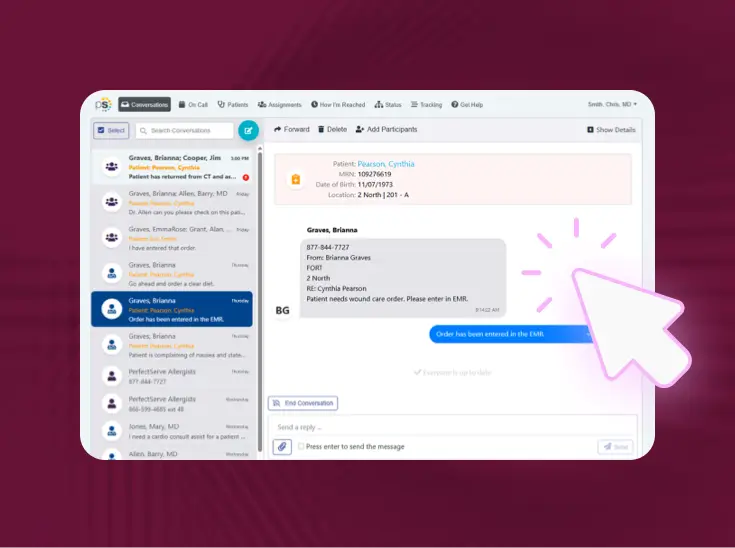
The real value comes from connecting schedules to clinical communication workflows. Lightning Bolt's scheduling platform integrates with broader clinical operations and communication workflows, helping organizations maintain accurate, real-time schedule information and support downstream operational processes.
Many custom-built scheduling tools stop at schedule creation, but healthcare organizations still need solutions for:
- On-call management
- Clinical communication
- Escalation workflows
- Coverage visibility
- Enterprise-wide coordination
A scheduling solution that's disconnected from operational workflows can create additional manual work instead of reducing it.
The True Total Cost of Ownership
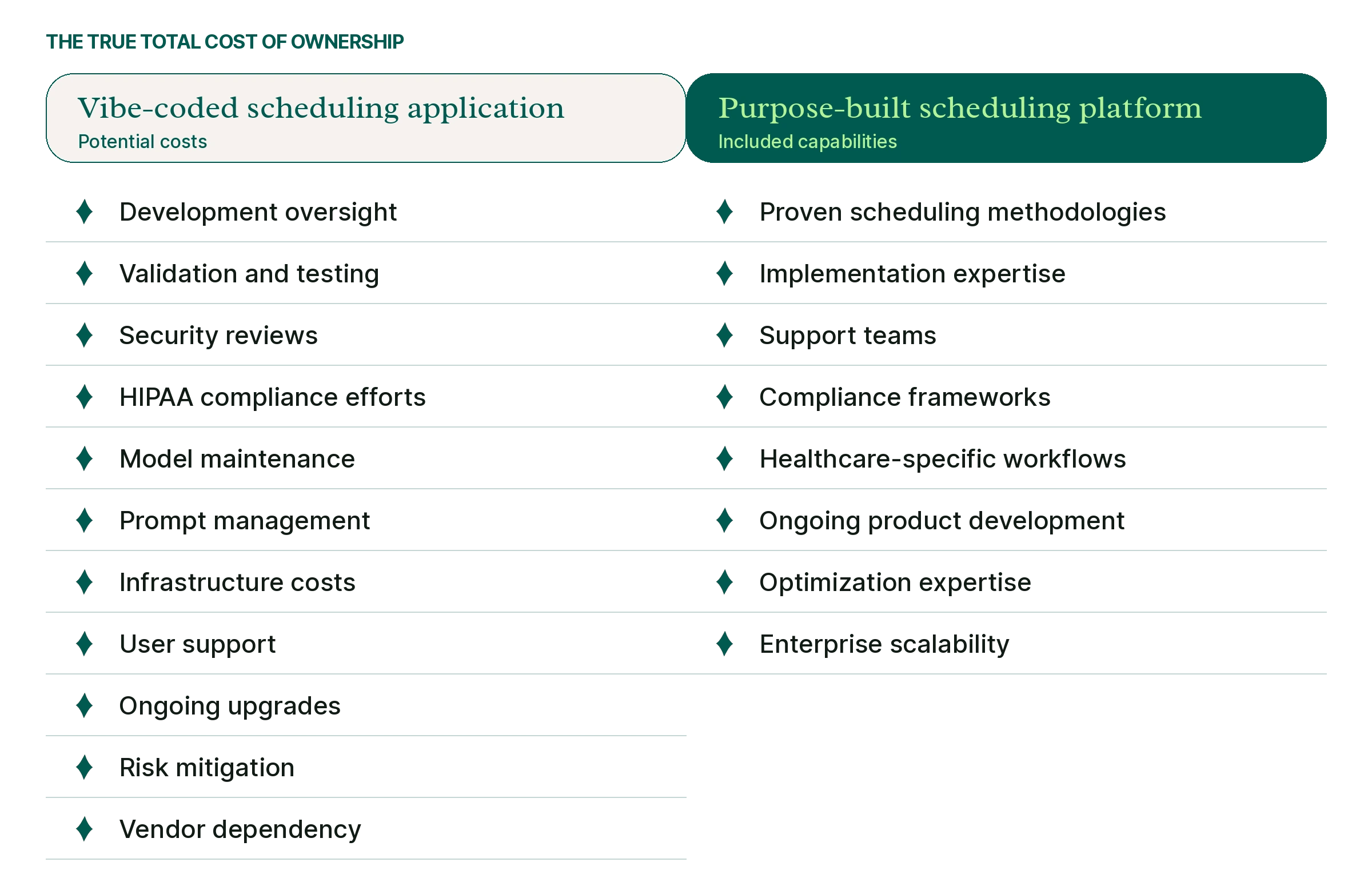
At first glance, vibe coding can appear less expensive than purchasing an enterprise scheduling platform, but healthcare leaders should consider the full picture. Here's a break down:
Vibe-Coded Scheduling Application
Potential Costs
- Development oversight
- Validation and testing
- Security reviews
- HIPAA compliance efforts
- Model maintenance
- Prompt management
- Infrastructure costs
- User support
- Ongoing upgrades
- Risk mitigation
- Vendor dependency
Purpose-Built Scheduling Platform
Included Capabilities
- Proven scheduling methodologies
- Implementation expertise
- Support teams
- Compliance frameworks
- Healthcare-specific workflows
- Ongoing product development
- Optimization expertise
- Enterprise scalability
The comparison isn't simply "buy versus build." It's evaluating whether a healthcare organization wants to operate a scheduling platform or operate healthcare services.
Final Thoughts
AI will continue to play a growing role in healthcare operations, but physician scheduling is not a coding problem. It's a healthcare operations problem.
The organizations achieving the best outcomes are not merely adopting the latest AI trend. They're choosing solutions designed specifically for the realities of healthcare delivery:
- Complex scheduling rules
- Provider satisfaction
- Fair workload distribution
- Compliance requirements
- Enterprise support
- Operational reliability
Generative AI can write software, and agentic AI can automate tasks, but optimized physician scheduling requires something different: proven healthcare scheduling intelligence built on years of real-world operational expertise.
For healthcare organizations evaluating their options, the question isn't whether AI should play a role. The question is whether they want to trust physician scheduling to a prompt, or to a platform purpose-built for the complexity of healthcare operations.
See it working for real teams















Bring us the workflow that [hurts most]
We'll show you how it runs on PerfectServe, with your teams, your sites and your EHR.