





How to Create Equitable Residency Program Schedules

Background
Kaiser Permanente’s Santa Rosa Family Medicine Residency was founded in 2018 as a training program for residents across multiple specialties. The program puts residents through a range of learning experiences in various specialties for patient care across all life stages.
Part of participating in the program includes working in continuity clinics, where residents are scheduled to work outside of the program in a neighboring organization for a week at a time. This furthers the learning and training experience for residents, but it also makes putting their schedules together a lot more complicated.
Challenge
Program scheduler and Medical Director Dr. Jeffrey Meckler used to build four-week rotation schedules for 19 residents and 16 medical assistants in Excel. This manual process took far too long and often yielded inconsistent results and unbalanced shifts. It also created discrepancies if any shifts were updated after the final schedule was complete.
Beyond scheduling residents for their traditional rotations and call shifts, the continuity clinic (CC) shifts themselves were quite difficult to schedule. A common issue was having only one resident available to work a CC shift, meaning the resident working that shift for that week was often overworked. This made it difficult to provide consistent continuity of care to patients. What’s more, a preceptor had to be scheduled with the resident for each CC shift.
Since its inception, Dr. Meckler and the medical director at Santa Rosa had been building shifts as four week rotations. They wanted to change this to a two-week rotation, believing it would more appropriately meet ACGME elective guidelines, as well as provide a better learning experience for residents.
Dr. Meckler was intimidated by the idea of manually changing the rotation schedule, but he was also overwhelmed with the idea of switching to a new scheduling process.
Though the manual workflow was cumbersome, it allowed Dr. Meckler to build out resident schedules, call schedules, rotations, and CC shift schedules in detail. Dr. Meckler doubted that an automated scheduling tool could handle Santa Rosa’s complex organizational requirements. Nevertheless, he wanted to find a better—and more efficient—solution.
Solution
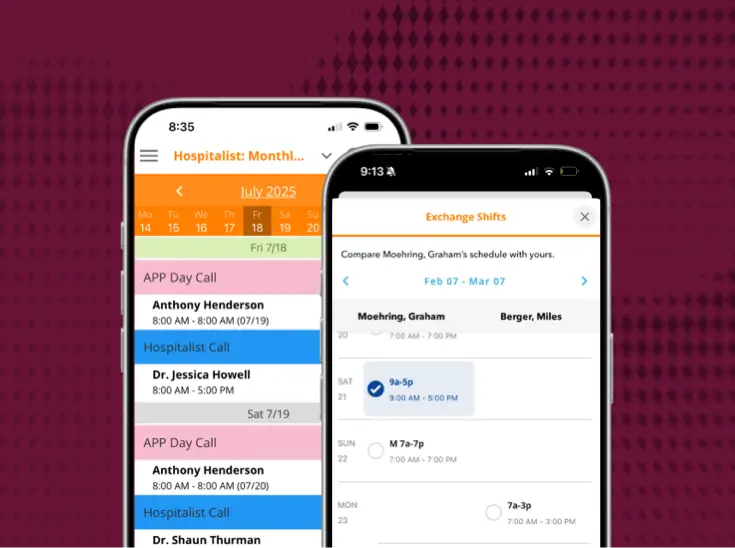
After researching available scheduling technology, Dr. Meckler decided PerfectServe’s Lightning Bolt Scheduling solution was the best fit for optimizing schedules at Santa Rosa Family Medicine. He and fellow scheduler Kimberly Nix were eager to use Lightning Bolt’s automation to help them create fairer schedules more efficiently, hoping this would also improve patient experiences in their continuity clinics.
Results
Future Plans and Growth
Much of the benefit of implementing Lightning Bolt comes from its ability to scale with teams and organizations of any size and type. After using Lightning Bolt for just a few years, Santa Rosa received permission to increase the number of new residents they employ from six to eight. Lightning Bolt will play a vital role in building these residents into the block and daily rotations, and as additional needs arise, the team can work with their technical consultant to customize their Lightning Bolt instance even further.
Running a successful residency program involves a lot more moving parts than just residents. Other faculty and staff also need to be accounted for, so Dr. Meckler plans to use Lightning Bolt to schedule other roles, such as matching a preceptor to a resident working a CC shift. This means that, over time, Lightning Bolt will become the single source of truth not just for the residency program, but for the entire organization.
Conclusion
When it comes to scheduling technology, automation and robust optimization capabilities can be extremely valuable tools for managing the complexities of accreditation and the organizational requirements unique to a residency program. Being able to quickly flex schedules to accommodate the needs of the moment can have an outsize impact on provider satisfaction, much in the same way residents who feel like every shift is helping them reach their education goals are more likely to be happy with their experience.
With Lightning Bolt, Kaiser Permanente’s Santa Rosa Family Medicine Residency can adjust its schedule rotation as often as necessary. The newfound capabilities of schedule optimization have made the group's CC shift allocation issues a thing of the past—Lightning Bolt now ensures an adequate number of residents are always available in continuity clinics. From happier schedulers and providers to improved shift equity and patient care continuity, Lightning Bolt has changed scheduling workflows at Santa Rosa for the better.
Discover the latest from PerfectServe














Bring us the workflow that [hurts most]
We'll show you how it runs on PerfectServe, with your teams, your sites and your EHR.